Try the questions in the test above first, then open each one here to see the correct answer and why every other option is wrong.
01A contest contains 30 problems. Each correct answer is worth 4 points, and 1 point is deducted for each incorrect answer. No points are given for unanswered problems. Salma scored 86 points and left exactly one problem unanswered. How many problems did she answer incorrectly?
Past exam question Unit: Algebra and Arithmetic
A2
With 2 wrong answers there are 27 correct, giving 108-2=106, not 86.
B3
With 3 wrong there are 26 correct, giving 104-3=101, well above 86.
C4
With 4 wrong there are 25 correct, giving 100-4=96, still above 86.
D5
With 5 wrong there are 24 correct, giving 96-5=91, still above 86.
E6 ✓ Correct answer
She answered 29 problems: c+w=29 and 4c-w=86. Adding gives 5c=115, so c=23 and w=6.
Reference: KAUST Mathematics Competition 2026, Phase One, Juniors track (grades 8–9), Question 9 and published solution
Ask a friend
02The numerator and the denominator of a fraction are positive integers whose sum is 2025. The value of this fraction is less than \frac{1}{3}. What is the greatest such fraction?
Past exam question Unit: Algebra and Arithmetic
A\frac{506}{1519} ✓ Correct answer
With numerator a the denominator is 2025-a, and 3a<2025-a gives a<506.25. The largest a is 506, so the fraction is \frac{506}{1519}.
B\frac{507}{1518}
3\times507=1521>1518, so \frac{507}{1518} is greater than \frac13 and breaks the condition.
C\frac{511}{1514}
3\times511=1533>1514, so this fraction is greater than \frac13.
D\frac{512}{1513}
3\times512=1536>1513, so this fraction is greater than \frac13.
E\frac{513}{1512}
3\times513=1539>1512, so this fraction is greater than \frac13 and fails the condition.
Reference: KAUST Mathematics Competition 2026, Phase One, Juniors track (grades 8–9), Question 15 and published solution
Ask a friend
03Evaluate the sum:
1 + 2 - 3 - 4 + 5 + 6 - 7 - 8 + \cdots + 1445 + 1446 - 1447
Past exam question Unit: Algebra and Arithmetic
A-1448
-1448 counts 362 blocks of -4, as if the sum ended at 1448; it ends at 1447, so the last three terms give +1444.
B-1447
-1447 is only the last term; the earlier blocks of four give -1444 and the last three terms give +1444.
C-2
-2 is just one pair such as (1-3) or (2-4); the blocks up to 1444 give -1444 and the last three terms add +1444.
D0 ✓ Correct answer
Each block of four terms gives (4k+1)+(4k+2)-(4k+3)-(4k+4)=-4. Up to 1444 there are 361 blocks, giving -1444; the rest is 1445+1446-1447=1444. The total is 0.
E1447
1447 is the last number taken as positive, which ignores the signs and the earlier blocks.
Reference: KAUST Mathematics Competition 2026, Phase One, Juniors track (grades 8–9), Question 20 and published solution
Ask a friend
04Let a, b, c be non-zero real numbers which satisfy:
a + \frac{1}{b} = 2,\quad b + \frac{1}{c} = 3,\quad c + \frac{1}{a} = 4
What is the value of the following expression?
abc + \frac{1}{abc}
Past exam question Unit: Algebra and Arithmetic
A9
9 is just 2+3+4; it is not abc+\frac1{abc}.
B15 ✓ Correct answer
Multiply the three equations: 24=(a+\frac1b)(b+\frac1c)(c+\frac1a)=abc+\frac1{abc}+\Big[(a+\frac1b)+(b+\frac1c)+(c+\frac1a)\Big]=abc+\frac1{abc}+9. So the value is 24-9=15.
C18
18 comes from subtracting 6 from 24 instead of the full 9 from the sum of the right-hand sides.
D21
21 comes from subtracting only 3 from 24 instead of 9.
E24
24 is just the product 2\times3\times4, forgetting the extra terms that add up to 9.
Reference: KAUST Mathematics Competition 2026, Phase One, Juniors track (grades 8–9), Question 24 and published solution
Ask a friend
05Ali is creating a 5-digit password (with no zeros) such that each digit, except the last one, is equal to the sum of all digits to its right. What is the sum of the digits in the password?
Past exam question Unit: Number Theory
A5
A sum of 5 is too small: from the right the digits are d,d,2d,4d,8d, so the sum is 16d, at least 16.
B9
9 does not fit: from the right the digits are d,d,2d,4d,8d, which sum to 16d, a multiple of 16.
C15
15 does not fit: the sum is always 16d, which cannot equal 15.
D16 ✓ Correct answer
From the right the digits are d, d, 2d, 4d, 8d. Since 8d\le9, d=1: the password is 84211, with digit sum 16.
E45
45 is the sum of the digits 1 to 9 and has nothing to do with the condition; the password 84211 has digit sum 16.
Reference: KAUST Mathematics Competition 2026, Phase One, Juniors track (grades 8–9), Question 19 and published solution
Ask a friend
06There are two sisters, Fatimah and Samira. The age of Fatimah is one of the numbers 10, 11, \dots, 20, and the age of Samira is one of the numbers 27, 28, 29. The product of their ages is the square of an integer. What is the sum of their ages?
Past exam question Unit: Number Theory
A36
The smallest possible sum is 10+27=37, so a sum of 36 is impossible.
B37
A sum of 37 means 10+27, whose product 270 is not a perfect square.
C38
A sum of 38 means 11+27 (product 297) or 10+28 (product 280); neither is a perfect square.
D39 ✓ Correct answer
27=3^3 needs Fatimah's age to be 3 times a square: 12 is the only one in range, and 12\times27=324=18^2, so the sum is 39. 28 would need 7 times a square, and 29 is prime, so neither works.
E40
A sum of 40 means 13+27 (351), 12+28 (336) or 11+29 (319), and none is a perfect square.
Reference: KAUST Mathematics Competition 2026, Phase One, Juniors track (grades 8–9), Question 23 and published solution
Ask a friend
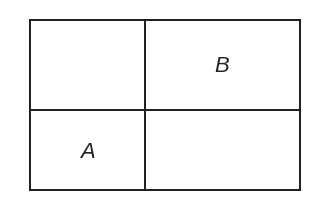
07A rectangle is divided into 4 smaller rectangles, as shown. The perimeters of rectangles A and B are 10 cm and 20 cm, respectively. Find the perimeter of the large rectangle.
Past exam question Unit: Geometry
A20 cm
20 cm is just the perimeter of B alone; the large rectangle has a larger perimeter than B.
B30 cm ✓ Correct answer
A's width plus B's width is the full width, and their heights add to the full height, so half the big perimeter is 5+10=15: 30 cm.
C40 cm
40 cm comes from 4\times10, treating all four small rectangles as copies of A, but they are not equal.
D50 cm
50 cm comes from 10+20+20, counting B's perimeter twice as if the empty pieces matched B.
E60 cm
60 is double the right value; it comes from computing 2\times(10+20) as if 10 and 20 were half-perimeters, when they are full perimeters.
Reference: KAUST Mathematics Competition 2026, Phase One, Juniors track (grades 8–9), Question 11 and published solution
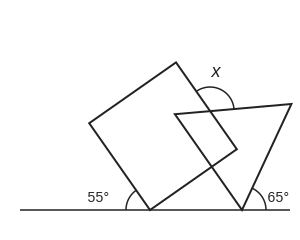
08A square and an equilateral triangle were drawn as shown below. What is the measure of the angle x?
Past exam question Unit: Geometry
A100°
100° uses 90^\circ-65^\circ=25^\circ as the tilt of the triangle's top side, as if it were right-angled; the tilt is 65^\circ-60^\circ=5^\circ.
B105°
105° comes from adding 45^\circ+60^\circ, the angle of a square's diagonal and the triangle's angle, which are not the sides meeting at x.
C110°
110° comes from 180^\circ-65^\circ-5^\circ, using the triangle's 65° in place of the square side's 55° tilt.
D115°
115° comes from 180^\circ-65^\circ alone, ignoring the 55° at the square.
E120° ✓ Correct answer
The triangle's right side leans 65° from the line and its top side turns 60° from it, leaning 65^\circ-60^\circ=5^\circ. The square's side leans 55°, so x=180^\circ-55^\circ-5^\circ=120^\circ.
Reference: KAUST Mathematics Competition 2026, Phase One, Juniors track (grades 8–9), Question 18 and published solution
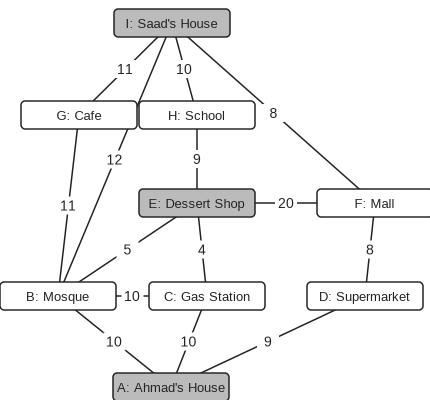
09Saad invited Ahmad for Iftar. Ahmad wants to stop at a dessert shop first. Using the map showing travel times between locations (in minutes), determine when Ahmad arrives at Saad's house if he leaves 30 minutes before Iftar and takes the fastest route via the dessert shop.
Past exam question Unit: Combinatorics and Logic
A8 minutes before Iftar
8 minutes early means a 22-minute trip: that is A-B-I (10+12), going straight to Saad's house and skipping the dessert shop.
B3 minutes before Iftar
27 minutes comes from A-B-E (10+5) followed by B-I (12), forgetting the 5 minutes back from the shop to the mosque.
C1 minute after Iftar ✓ Correct answer
The shortest A to E is A-C-E: 10+4=14. The shortest E to I is E-B-I: 5+12=17. Total 31, so he arrives 1 minute after Iftar.
D2 minutes after Iftar
32 comes from going A-B-E (15) and then E-B-I (17); passing the gas station instead saves a minute (14).
E3 minutes after Iftar
33 comes from using E-H-I (19) instead of E-B-I (17), which is not the fastest route.
Reference: KAUST Mathematics Competition 2026, Phase One, Juniors track (grades 8–9), Question 12 and published solution
10How many ways are there to mark two cells of a 7\times7 grid square that have a common side or a common vertex? (The two cells must touch horizontally, vertically or diagonally.)
Past exam question Unit: Combinatorics and Logic
A150
150 counts vertical pairs as 6\times6=36 instead of 7\times6=42: 42+36+72=150.
B152
152 drops the 4 diagonal pairs that touch a corner cell, counting 68 diagonal pairs instead of 72.
C154
154 adds up neighbours cell by cell but gives each corner cell 2 neighbours instead of 3: (200+100+8)\div2.
D156 ✓ Correct answer
Horizontal pairs: 7\times6=42; vertical: 42. Each 2\times2 block has two diagonal pairs and there are 6\times6=36 such blocks, so 72 diagonal pairs. Total 42+42+72=156.
E158
158 gives each corner cell 4 neighbours instead of 3 when adding neighbours cell by cell: (200+100+16)\div2.
Reference: KAUST Mathematics Competition 2026, Phase One, Juniors track (grades 8–9), Question 22 and published solution
Ask a friend