SCFHS Electrocardiograph (ECG) Technician Exam
SCFHS Electrocardiograph (ECG) Technician Exam — Number of questions: 150 questions. Exam time: 3 hours. Pass mark: 55%. Calculator: The SCFHS content guideline does not say whether a calculator is allowed. Exam fee: Paid to SCFHS online when you apply through Mumaris Plus; the amount is shown in your application. Source: Saudi Commission for Health Specialties (SCFHS) (Last verified: 2026-11-17). Question bank: full mock exams of 150 questions in 180 minutes, like the real test with a result for every unit, plus 562 explained questions across 10 units, every option explained, a review of your mistakes, and two ways to practise: see the answer right away, or sit a full timed mock. Free questions: a 10-question diagnostic test covering the main units, no sign-up; at the end we compare your score with the pass mark and show your weakest units. With lifetime access: the Complete Review Guide, a 66-page PDF ordered by unit weight; chapter 1 is free to read on the guide page.
Last verified on the Saudi Commission for Health Specialties (SCFHS) website: 17 November 2026
If you sat the exam today, what would you score?
10 free questions · no sign-up · your score as soon as you finish
Question 1 of 10
A patient taking sotalol has a sinus rate of about 120 beats per minute, and the machine's Bazett QTc reads 452 ms. Which statement is most appropriate?
All 10 free questions with answers and an explanation for every option
Where the questions come from
- Cardiac Anatomy8 questions
- Cardiac Electro-physiology15 questions
- Pharmacotherapy7 questions
- Ischemic Heart Disease15 questions
- Valvular Heart Disease8 questions
- Tachy-arrhythmias15 questions
- Brady-arrhythmias15 questions
- Technical aspect of 12 LEAD ECG22 questions
- Pacemakers and Defibrillators15 questions
- Basic Life Support30 questions
Exam facts
- Exam language
- English
- Number of questions
- 150 questions Source
- Exam time
- 3 hours Source
- Pass mark
- 55% Source
- Calculator
- The SCFHS content guideline does not say whether a calculator is allowed Source
- Exam fee
- Paid to SCFHS online when you apply through Mumaris Plus; the amount is shown in your application Source
- Registration
- Apply through the Professional Classification service in Mumaris Plus; SCFHS has not published a separate window calendar for the ECG technician exam Source
- Retakes
- If you do not pass you get further attempts under SCFHS regulations and pay the evaluation fee Source
Last verified: 2026-11-17
Where other sources differ
- The pass mark for technicians is 55% in the content guideline, applying to tests from 29 June 2022 onward. Section weights may differ by up to 5% in each category.
- Ten sections: basic life support 20%; technical aspects of the 12-lead ECG 15%; cardiac electrophysiology, tachy-arrhythmias, brady-arrhythmias, ischemic heart disease, and pacemakers and defibrillators 10% each; cardiac anatomy, pharmacotherapy and valvular heart disease 5% each.
Exam body
Saudi Commission for Health Specialties (SCFHS): Official website: Saudi Commission for Health Specialties (SCFHS)
How to register
- Choose the Professional Classification service in the Mumaris Plus system and submit your application with your certificate and documents.
- Once your application is accepted you are referred to an electronic written exam delivered through Prometric or Pearson VUE.
- Pay the evaluation fee shown in your application.
- Book your slot at a test centre through the booking service SCFHS opens in your application.
- On exam day bring your ID or passport and your booking confirmation.
Study guides (3)
Frequently asked questions
How many questions are there and how long is the exam?
150 multiple-choice questions in 3 hours, according to the SCFHS Electrocardiograph content guideline.
Can I try ECG Technician questions for free?
Yes. Free questions: a 10-question diagnostic test covering the main units, no sign-up; at the end we compare your score with the pass mark and show your weakest units. The free practice test page lists the same questions with answers and an explanation for every option. The rest of the questions and the full mock exams come with a pass from SAR 26.
What makes this ECG Technician question bank different?
Question bank: full mock exams of 150 questions in 180 minutes, like the real test with a result for every unit, plus 562 explained questions across 10 units, every option explained, a review of your mistakes, and two ways to practise: see the answer right away, or sit a full timed mock. Practice questions and explanations are ready to use on your phone. Try the free questions and read the explanations before you buy.
Is there a PDF review guide for ECG Technician?
Yes. "ECG Technician Complete Review Guide 2026–2027" is a 66-page Arabic PDF: 10 units ordered from the heaviest in the exam to the lightest, each chapter with key points, common mistakes and review cards, plus a 7-day plan. Chapter 1 is free to read on the guide page; the full guide comes with lifetime access to this exam and is not part of 7-day access. The guide has no questions: scoring, practice and mock exams are on the site.
What is the pass mark?
55% for technicians according to the guideline. On our site your result shows your percentage in each section so you can see where you lose points.
What language is the exam in?
SCFHS does not state the exam language, but the guideline and its reference books are in English, so our questions and the explanation of every option are in English.
Which sections does the exam cover?
Ten sections: basic life support (20%), technical aspects of the 12-lead ECG (15%), five sections at 10% each, and three at 5%.
Does the exam include rhythm strips?
The guideline covers tachy- and brady-arrhythmias and the technical side of the ECG, and our practice includes drawn rhythm strips so you learn to recognize the common rhythms.
Is this site part of SCFHS?
No. This is an independent exam preparation site with no link to SCFHS, Prometric or any government body. Always rely on what SCFHS announces.
Is this an official site, and how do I pay?
It is an independent site, not part of Qiyas, this exam's regulator or any government body, with practice questions and answer explanations. You pay once, with no automatic renewal, through Waffo Pancake (the merchant of record) by Visa, Mastercard, Apple Pay or Google Pay, and your statement shows "WAFFO". If you were charged twice or the pass did not open, email support@saudiexams.com.
ECG Technician Complete Review Guide 2026–2027
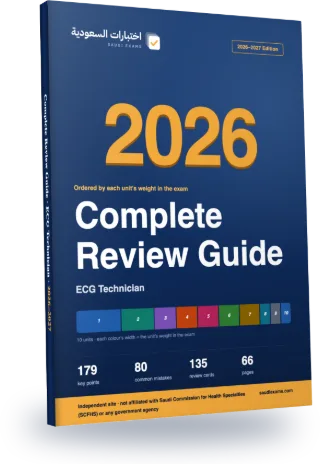
66-page · 179 key points · 80 common mistakes · 135 review cards
The first three chapters alone cover about 45% of the exam. Short on time? Start there.
About the question bank
Know your score before the SCFHS ECG Technician exam. We picked 562 questions across cardiac anatomy, electrophysiology, arrhythmias, 12-lead ECG technique, pacemakers and defibrillators, and basic life support, so you see where you lose points before test day.
- 150 questions in 180 min, like the real test
- 562 questions covering the main scoring topics, with explanations
- 55% pass mark, with targeted practice on your weak spots
See the gap to your target score Practise the units costing you the most marks A full mock exam like the real one
Every option explained so you understand why
What you get
- 562questions in the bankPractise with the answer shown right away, or sit a full timed mock
- 10unitsSplit by the exam syllabus
- 135flashcardsTo lock in terms and definitions
- 179quick review pointsEach unit in a few key lines
Study material sample: Cardiac Anatomy
Summary
This unit covers the heart anatomy an ECG technician needs. About 8 of the 150 questions come from it (5% of the exam). It has four parts: chambers, valves and septum; coronary arteries and perfusion; pericardium, heart wall and great vessels; and the position of the heart and its relation to the chest and ECG leads. Questions ask for the path of blood through the chambers and valves, the artery behind each wall of the heart, the layers of the wall, and the chest electrode positions. Electrode positions matter most for a technician, because a misplaced electrode changes the tracing. Link each artery to the area it supplies and to the leads that show changes there.
What the exam focuses on · Common traps · Try the flashcards
What the exam focuses on
- The blood path: right atrium, tricuspid valve, right ventricle, pulmonary valve, pulmonary trunk, lungs, pulmonary veins, left atrium, mitral valve, left ventricle, aortic valve, aorta.
- The difference between the atrioventricular valves (tricuspid and bicuspid or mitral) and the semilunar valves (pulmonary and aortic).
- The right and left coronary arteries and their branches (anterior descending, circumflex, marginal, posterior descending) and what each supplies.
Show 5 more
- The artery behind infarction of the anterior, inferior and lateral walls.
- The layers of the heart wall (epicardium, myocardium, endocardium) and the layers of the pericardium.
- The position of the heart in the mediastinum and the location of the base and apex.
- The exact positions of chest electrodes V1 to V6, and the number of electrodes in a 12-lead ECG.
- Matching lead groups (inferior, lateral, anterior) to the walls of the left ventricle.
Common traps
- The pulmonary trunk and its branches are the only arteries that carry low-oxygen blood. The pulmonary veins are the only veins that carry highly oxygenated blood.
- The mitral valve has two cusps and the tricuspid has three. Do not swap the numbers or the sides.
- There are three papillary muscles in the right ventricle and two in the left. The moderator band is in the right ventricle only.
Show 5 more
- The semilunar valves have no chordae tendineae or papillary muscles. The atrioventricular valves have them.
- The inferior wall is supplied by the right coronary artery in about 80% of cases and by the left circumflex in about 18%. Do not say it is always the right.
- The epicardium is the same layer as the visceral pericardium. The pericardium and the heart wall share it.
- V1 goes in the 4th intercostal space at the right sternal border and V2 at the left. Swapping them is a common mistake.
- V4, V5 and V6 sit on the same horizontal level. They differ only in side position: mid-clavicular, then anterior axillary, then mid-axillary line.
Try the flashcards
Tap a card to see the answer
How many cusps does the mitral valve have? The tricuspid?
Mitral: two. Tricuspid: three.
Which pulmonary vessels carry oxygenated blood?
The pulmonary veins, the only veins carrying highly oxygenated blood.
Where do the coronary arteries arise?
From the aorta, just above the aortic valve.
What are the two branches of the left coronary artery?
The left anterior descending (LAD) and the circumflex.
Which artery most often causes an anterior infarct?
The left anterior descending artery (LAD).
Which artery causes inferior infarction in about 80% of cases?
A dominant right coronary artery (the left circumflex in about 18%).
Name the heart wall layers from outside in.
Epicardium, myocardium, endocardium.
Where is the moderator band found?
In the right ventricle only.
Why you can trust these questions
- Published questions: 562. Read the explanations and references, and report any error from the question.
- Exam facts last checked against the organiser’s website: 2026-11-17. We check them again every three months and two weeks before each test.
- Found a mistake? Tap "Report an error" under any question in the practice area, or email us at support@saudiexams.com
- Independent website. Not affiliated with ETEC (Qiyas), the Financial Academy, ACAMS, the ACFE, Saudi Aramco or any government body.
Update log
- 2026-11-17 Added the exam from the Electrocardiograph content guideline (150 questions, 3 hours, 55% pass mark) and the SCFHS classification exams page.
Full prep for this exam
All of this in one purchase.
- Full mock exam, same as the real one150 questions in 180 minutes. You get a total score and a score for every unit.
- Practice unit by unit562 questions, every option explained with its source. Starts with your weakest units.
- Complete Review Guide 2026–2027 (PDF)Ordered by each unit's weight in the exam. With lifetime access only.
Choose your access
Continue with your Google account and you go straight to the payment page.