SCFHS Emergency Medical Technician (Basic) Exam
SCFHS Emergency Medical Technician (Basic) Exam — Number of questions: 150 questions. Exam time: 3 hours. Pass mark: 55%. Calculator: The SCFHS content guideline does not say whether a calculator is allowed. Exam fee: Paid to SCFHS online when you apply through Mumaris Plus; the amount is shown in your application. Source: Saudi Commission for Health Specialties (SCFHS) (Last verified: 2026-11-15). Question bank: full mock exams of 150 questions in 180 minutes, like the real test with a result for every unit, plus 687 explained questions across 7 units, every option explained, a review of your mistakes, and two ways to practise: see the answer right away, or sit a full timed mock. Free questions: a 10-question diagnostic test covering the main units, no sign-up; at the end we compare your score with the pass mark and show your weakest units. With lifetime access: the Complete Review Guide, a 44-page PDF ordered by unit weight; chapter 1 is free to read on the guide page.
Last verified on the Saudi Commission for Health Specialties (SCFHS) website: 15 November 2026
If you sat the exam today, what would you score?
10 free questions · no sign-up · your score as soon as you finish
Question 1 of 10
No aerosol-generating procedure is planned. For which patient should the EMT wear an N95 respirator instead of a standard surgical mask?
All 10 free questions with answers and an explanation for every option
Where the questions come from
- Airway, Breathing and Cardiac (ABC)18 questions
- Infants and Children15 questions
- Medical/Behavioral Emergencies and Obstetrics/Gynecology21 questions
- Operations9 questions
- Patient assessment23 questions
- Preparatory27 questions
- Trauma37 questions
Exam facts
- Exam language
- English
- Number of questions
- 150 questions Source
- Exam time
- 3 hours Source
- Pass mark
- 55% Source
- Calculator
- The SCFHS content guideline does not say whether a calculator is allowed Source
- Exam fee
- Paid to SCFHS online when you apply through Mumaris Plus; the amount is shown in your application Source
- Registration
- Apply through the Professional Classification service in Mumaris Plus; SCFHS has not published a separate window calendar for the EMT (Basic) exam Source
- Retakes
- If you do not pass you get further attempts under SCFHS regulations and pay the evaluation fee Source
Last verified: 2026-11-15
Where other sources differ
- The pass mark is 55% in the content guideline. Section weights may differ by up to 5% in each category, and percentages and content may change at any time.
- Seven sections: Trauma 25%, Preparatory 18%, Patient assessment 15%, Medical/Behavioral Emergencies and Obstetrics/Gynecology 14%, ABC 12%, Infants and Children 10% and Operations 6%.
- This is the Emergency Medical Technician (Basic) exam. It is separate from the Paramedics Specialist exam and from the Paramedic Science Technician exam.
Exam body
Saudi Commission for Health Specialties (SCFHS): Official website: Saudi Commission for Health Specialties (SCFHS)
How to register
- Choose the Professional Classification service in the Mumaris Plus system and submit your application with your certificate and documents.
- Once your application is accepted you are referred to an electronic written exam delivered through Prometric or Pearson VUE.
- Pay the evaluation fee shown in your application.
- Book your slot at a test centre through the booking service SCFHS opens in your application.
- On exam day bring your ID or passport and your booking confirmation.
Study guides (3)
Frequently asked questions
How many questions are there and how long is the exam?
150 multiple-choice questions in 3 hours, according to the SCFHS Emergency Medical Technician Basic content guideline.
Can I try EMT Basic questions for free?
Yes. Free questions: a 10-question diagnostic test covering the main units, no sign-up; at the end we compare your score with the pass mark and show your weakest units. The free practice test page lists the same questions with answers and an explanation for every option. The rest of the questions and the full mock exams come with a pass from SAR 26.
What makes this EMT Basic question bank different?
Question bank: full mock exams of 150 questions in 180 minutes, like the real test with a result for every unit, plus 687 explained questions across 7 units, every option explained, a review of your mistakes, and two ways to practise: see the answer right away, or sit a full timed mock. Practice questions and explanations are ready to use on your phone. Try the free questions and read the explanations before you buy.
Is there a PDF review guide for EMT Basic?
Yes. "EMT Basic Complete Review Guide 2026–2027" is a 44-page Arabic PDF: 7 units ordered from the heaviest in the exam to the lightest, each chapter with key points, common mistakes and review cards, plus a 7-day plan. Chapter 1 is free to read on the guide page; the full guide comes with lifetime access to this exam and is not part of 7-day access. The guide has no questions: scoring, practice and mock exams are on the site.
What is the pass mark?
55% according to the guideline. On our site your result shows your percentage in each section so you can see where you lose points.
What language is the exam in?
The guideline and its reference books are in English, so our questions are in English, every option is explained in English.
Which sections does the exam cover?
Seven sections: Trauma (25%), Preparatory (18%), Patient assessment (15%), Medical/Behavioral Emergencies and Obstetrics/Gynecology (14%), ABC (12%), Infants and Children (10%) and Operations (6%).
How is it different from the Paramedics Specialist exam?
This is the EMT (Basic) exam: 150 questions, seven sections and a 55% pass mark. The Paramedics Specialist exam is a higher level with a 60% pass mark and its own content guideline.
Is this site part of SCFHS?
No. This is an independent exam preparation site with no link to SCFHS, Prometric or any government body. Always rely on what SCFHS announces.
Is this an official site, and how do I pay?
It is an independent site, not part of Qiyas, this exam's regulator or any government body, with practice questions and answer explanations. You pay once, with no automatic renewal, through Waffo Pancake (the merchant of record) by Visa, Mastercard, Apple Pay or Google Pay, and your statement shows "WAFFO". If you were charged twice or the pass did not open, email support@saudiexams.com.
EMT Basic Complete Review Guide 2026–2027
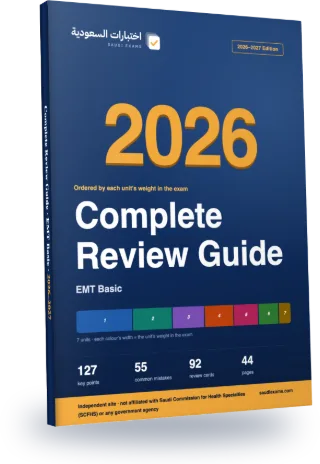
44-page · 127 key points · 55 common mistakes · 92 review cards
The first three chapters alone cover about 58% of the exam. Short on time? Start there.
About the question bank
Know your score before the SCFHS Emergency Medical Technician (Basic) exam. We picked 687 questions across airway and cardiac care, trauma, pediatrics, obstetrics and patient assessment, so you see where you lose points before test day.
- 150 questions in 180 min, like the real test
- 687 questions covering the main scoring topics, with explanations
- 55% pass mark, with targeted practice on your weak spots
See the gap to your target score Practise the units costing you the most marks A full mock exam like the real one
Every option explained so you understand why
What you get
- 687questions in the bankPractise with the answer shown right away, or sit a full timed mock
- 7unitsSplit by the exam syllabus
- 92flashcardsTo lock in terms and definitions
- 127quick review pointsEach unit in a few key lines
Study material sample: Airway, Breathing and Cardiac (ABC)
Summary
This unit covers about 18 of the 150 questions on the EMT Basic exam and deals with airway, breathing and cardiac care. It has six sections: airway anatomy, manual maneuvers, OPA/NPA and suction; oxygen therapy, bag-mask ventilation and pulse oximetry; respiratory emergencies; adult BLS with high-quality CPR and AED use; chest pain, acute coronary syndrome, aspirin and nitroglycerin; and special arrest situations with post-ROSC care. Questions mostly ask you to pick the correct first action and to recall the core numbers of high-quality resuscitation, such as rate, depth, ratio and ventilation timing.
What the exam focuses on · Common traps · Try the flashcards
What the exam focuses on
- Choosing the right maneuver or adjunct for the patient (head-tilt chin-lift, jaw thrust, OPA, NPA)
- Oxygen delivery devices and flow rates: non-rebreather mask and nasal cannula
- Bag-mask ventilation: rate, volume and the sign of visible chest rise
Show 5 more
- Recognizing respiratory emergencies (asthma, COPD, pulmonary edema) and the first action
- High-quality compression numbers: rate, depth, recoil and the 30:2 ratio
- AED operating sequence and special precautions
- Chest pain: aspirin, nitroglycerin and contraindications
- Cardiac arrest in pregnancy, drowning, hypothermia and post-ROSC care
Common traps
- Use the jaw thrust, not head tilt, when spinal injury is suspected.
- An OPA is only for an unresponsive patient with no gag reflex; an NPA is better tolerated by a patient who still has one.
- Suction an adult for no more than 15 seconds at a time.
Show 5 more
- Over-ventilation does harm by reducing venous return and inflating the stomach; give only enough to see the chest rise.
- A patient with asthma who speaks with difficulty and is not improving needs rapid transport rather than waiting on scene.
- Do not give nitroglycerin to a patient who took a PDE5 inhibitor such as sildenafil or tadalafil, or who is hypotensive.
- Keep interruptions in compressions under 10 seconds and resume at once after a shock without a pulse check.
- In drowning, start resuscitation with rescue breaths because the cause is hypoxia, not a rhythm problem.
Try the flashcards
Tap a card to see the answer
Adult compression rate
100 to 120 per minute
Adult compression depth
At least 5 cm, no more than 6 cm
Adult compression-to-ventilation ratio without advanced airway
30:2
Maneuver when spinal injury is suspected
Jaw thrust
Sizing an OPA
Corner of mouth to earlobe
Sizing an NPA
Tip of nose to earlobe
Maximum suction time for an adult
15 seconds
Non-rebreather mask flow rate
10 to 15 L/min
Why you can trust these questions
- Published questions: 687. Read the explanations and references, and report any error from the question.
- Exam facts last checked against the organiser’s website: 2026-11-15. We check them again every three months and two weeks before each test.
- Found a mistake? Tap "Report an error" under any question in the practice area, or email us at support@saudiexams.com
- Independent website. Not affiliated with ETEC (Qiyas), the Financial Academy or any government body.
Update log
- 2026-11-15 Added the exam from the EMT Basic content guideline (150 questions, 3 hours, 55% pass mark).
Full prep for this exam
All of this in one purchase.
- Full mock exam, same as the real one150 questions in 180 minutes. You get a total score and a score for every unit.
- Practice unit by unit687 questions, every option explained with its source. Starts with your weakest units.
- Complete Review Guide 2026–2027 (PDF)Ordered by each unit's weight in the exam. With lifetime access only.
Choose your access
Continue with your Google account and you go straight to the payment page.