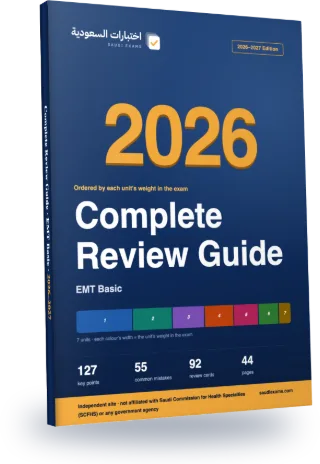
EMT Basic Complete Review Guide 2026–2027
Every exam topic in a 44-page Arabic PDF, ordered from the heaviest unit to the lightest. The first three chapters alone cover about 58% of the exam questions.
- 44Pages
- 127Key points
- 55Common mistakes
- 92Flashcards
Guide map
Each chapter is one exam unit, ordered by its weight in the real exam.
| Chapter | Unit | Weight | Exam questions | Key points |
|---|---|---|---|---|
| 1 | Trauma | 25% | 37 | 17 |
| 2 | Preparatory | 18% | 27 | 20 |
| 3 | Patient assessment | 15% | 23 | 18 |
| 4 | Medical/Behavioral Emergencies and Obstetrics/Gynecology | 14% | 21 | 18 |
| 5 | Airway, Breathing and Cardiac (ABC) | 12% | 18 | 18 |
| 6 | Infants and Children | 10% | 15 | 18 |
| 7 | Operations | 6% | 9 | 18 |
Chapter 1 in full: Trauma
25% of the exam, about 37 questions. These are its key points, as in the guide.
- (Bleeding, shock and tourniquet use) The first action for severe external bleeding is direct pressure with a sterile dressing; if bleeding continues, pack the wound with hemostatic or plain gauze and keep pressure on.
- (Bleeding, shock and tourniquet use) Place a tourniquet proximal to the wound, not over a joint, tighten until bleeding stops, record the time applied and do not loosen it in the field.
- (Bleeding, shock and tourniquet use) Early (compensated) shock shows rapid pulse, rapid breathing, pale cool clammy skin and anxiety; low blood pressure is a late sign.
The rest of chapter 1, on this page
- (Soft tissue injuries and burns) Adult burn area uses the rule of nines: head 9%, each arm 9%, front trunk 18%, back trunk 18%, each leg 18% and genitalia 1%.
- (Soft tissue injuries and burns) A superficial (first-degree) burn involves only the epidermis with redness and pain, a partial-thickness burn causes blisters and severe pain, and a full-thickness burn is leathery or charred and often painless.
- (Soft tissue injuries and burns) Burn care priorities: stop the burning process, remove clothing and jewelry that are not stuck, cover with a dry sterile dressing, and do not break blisters.
- (Chest and abdominal injuries) Flail chest shows paradoxical movement of a chest wall segment; stabilize it with a bulky dressing or manual pressure and assist ventilation if needed.
- (Chest and abdominal injuries) An open chest wound (open pneumothorax) is covered with an occlusive dressing taped on three sides, and the patient is watched for tension pneumothorax.
- (Head and spine injuries) If spine injury is suspected, hold the head manually in a neutral position, apply spinal motion restriction with a cervical collar, and use the jaw thrust to open the airway.
- (Head and spine injuries) The Glasgow Coma Scale has eye opening (4), verbal response (5) and motor response (6), for a total of 3 to 15.
- (Musculoskeletal injuries and splinting) For a long-bone fracture the splint spans the joint above and below, and pulse, motor and sensation (PMS) are checked before and after splinting.
- (Musculoskeletal injuries and splinting) A traction splint is for an isolated femur fracture and not when there is a pelvic fracture or an injury to the hip, knee or lower leg on the same side.
- (Eye, face and neck injuries, amputation, crush and electrical injuries) A severed part is wrapped in moist sterile gauze, sealed in a plastic bag and kept cool, never placed directly on ice, after bleeding at the stump is controlled.
- (Eye, face and neck injuries, amputation, crush and electrical injuries) In electrical injury, make the scene safe and cut the power first, look for entry and exit wounds, and monitor for arrhythmias and cardiac arrest.
- (Trauma assessment, triage criteria and special populations) Trauma assessment starts with scene safety, mechanism of injury, spinal stabilization and control of severe bleeding; critical patients are transported without delay on scene.
- (Trauma assessment, triage criteria and special populations) START triage assesses respirations, perfusion and mental status: breathing over 30 per minute, capillary refill over 2 seconds or failure to follow commands makes the patient red.
- (Trauma assessment, triage criteria and special populations) In children compensation lasts then collapses suddenly, and padding under the torso is used for spinal alignment because of the large head; in the elderly bones are fragile and some medications can mask a rising pulse.
Common mistakes in this chapter
- Elevation or pressure points are not a substitute for direct pressure on a bleeding wound.
- Hypotension is a late sign of shock; waiting for it means missing early compensation, whereas fast pulse and cool clammy skin warn sooner.
- Do not remove impaled objects in the field; stabilize them in place, except a cheek object obstructing the airway or when CPR is needed.
- An occlusive dressing for an open chest wound is taped on three sides and one side is left open, not sealed on four sides.
- Never push protruding organs (evisceration) back into the abdomen; cover with a moist sterile dressing and then an occlusive layer.
- A long-bone splint includes the joint above and below the fracture; for a joint injury, include the bones above and below.
- In START triage, a patient who is not breathing after the airway is opened is black, but one who starts breathing after opening is red.
The other chapters are in the full guide
One purchase · lifetime access · review guide included
7-day review plan
The chapters are spread over 6 days by weight so each day carries a similar load. Day 7 is a full exam.
Day 1 · 25% of the exam
Chapter 1: Trauma
Day 2 · 18% of the exam
Chapter 2: Preparatory
Day 3 · 15% of the exam
Chapter 3: Patient assessment
Day 4 · 14% of the exam
Chapter 4: Medical/Behavioral Emergencies and Obstetrics/Gynecology
Day 5 · 12% of the exam
Chapter 5: Airway, Breathing and Cardiac (ABC)
Day 6 · 16% of the exam
Chapter 6: Infants and Children
Chapter 7: OperationsDay 7
Full mock exam: 150 questions in 180 minutes, then review the common mistakes in the units where you lost marks.
How many correct answers do you need?
- Pass mark 55%83 correct out of 150
Before you read: see your score today
10 free questions from the main units, no sign-up. Then you know which chapter to start with.
Try 10 free questions and see your levelA look at each chapter
The first three key points of each chapter, as they appear in the guide (in Arabic in the PDF).
Chapter 1: Trauma
- (Bleeding, shock and tourniquet use) The first action for severe external bleeding is direct…
- (Bleeding, shock and tourniquet use) Place a tourniquet proximal to the wound, not over…
- (Bleeding, shock and tourniquet use) Early (compensated) shock shows rapid pulse, rapid breathing, pale…
Chapter 2: Preparatory
- (EMS systems, roles and quality improvement) The medical director provides physician oversight of EMTs…
- (EMS systems, roles and quality improvement) Quality improvement is a continuous review of performance…
- (EMS systems, roles and quality improvement) The patient care report (PCR) is a legal…
Chapter 3: Patient assessment
- (Scene size-up) Scene size-up is the first step on every call: scene safety, mechanism…
- (Scene size-up) Standard precautions include hand hygiene and always wearing gloves when body fluid…
- (Scene size-up) Significant MOI examples in adults
Chapter 4: Medical/Behavioral Emergencies and Obstetrics/Gynecology
- (Diabetes, altered mental status) Hypoglycemia means blood glucose below 70 mg/dL with signs or…
- (Diabetes, altered mental status) Oral glucose is given only to a patient who is…
- (Diabetes, altered mental status) Deep, rapid Kussmaul respirations and fruity breath suggest diabetic ketoacidosis.
Chapter 5: Airway, Breathing and Cardiac (ABC)
- (Airway
- (Airway
- (Airway
Chapter 6: Infants and Children
- (Pediatric anatomy and PAT) Infants and young children have a proportionally larger head, so…
- (Pediatric anatomy and PAT) The Pediatric Assessment Triangle has three parts: appearance (tone, interactiveness…
- (Pediatric anatomy and PAT) Nasal flaring, retractions and grunting are signs of increased work…
Chapter 7: Operations
- (Ambulance operations
- (Ambulance operations
- (Ambulance operations
The full guide comes with lifetime access
The full guide (44 pages) is included with lifetime access to this exam, together with every question and full mock exam. Chapter 1 is free for everyone.
Questions about the guide
Is the guide free?
Chapter 1 is free to read on the guide page. The full guide comes with lifetime access to this exam; 7-day access does not include it.
Is it up to date for 2026–2027?
Yes. Unit weights and exam facts follow what the exam body last published, and the last check date is printed in the guide. If the standards change we update the file and buyers download the new version.
Does the guide have questions?
No. The guide covers key points and common mistakes; scoring, weak-area practice and full mock exams are on the site.
Can I read it on my phone?
Yes. A5 pages in a single column, with chapters linked from the contents.
- Pages
- 44
- Edition
- 1448 AH · 2026–2027
- Language
- Arabic
- Last updated
Full prep for this exam
All of this in one purchase.
- Full mock exam, same as the real one150 questions in 180 minutes. You get a total score and a score for every unit.
- Practice unit by unit687 questions, every option explained with its source. Starts with your weakest units.
- Complete Review Guide 2026–2027 (PDF)Ordered by each unit's weight in the exam. With lifetime access only.
Choose your access
Continue with your Google account and you go straight to the payment page.