PMI-PBA
PMI Professional in Business Analysis (PMI-PBA) Exam
PMI Professional in Business Analysis (PMI-PBA) Exam — Number of questions: 200 questions. Exam time: 240 minutes. Pass mark: PMI does not publish a numeric pass mark; the passing score is set for each exam by psychometric analysis. Calculator: On-screen calculator. Exam fee: USD 405 for PMI members, USD 555 for non-members. Source: Project Management Institute (PMI) (Last verified: 2026-11-15). Question bank: full mock exams of 200 questions in 240 minutes, like the real test with a result for every unit, plus 542 explained questions across 5 units, every option explained, a review of your mistakes, and two ways to practise: see the answer right away, or sit a full timed mock. Free questions: a 10-question diagnostic test covering the main units, no sign-up; at the end you get your score and your weakest units. With lifetime access: the Complete Review Guide, a 39-page PDF ordered by unit weight; chapter 1 is free to read on the guide page.
Last verified on the Project Management Institute (PMI) website: 15 November 2026
If you sat the exam today, what would you score?
10 free questions · no sign-up · your score as soon as you finish
Question 1 of 10
An automation initiative at a services company costs SAR 2,000,000 upfront, with annual running costs of SAR 100,000 and annual benefits of SAR 900,000. Ignoring discounting, what is the payback period?
All 10 free questions with answers and an explanation for every option
Where the questions come from
- Needs Assessment36 questions
- Planning44 questions
- Analysis70 questions
- Traceability and Monitoring30 questions
- Evaluation20 questions
Exam facts
- Exam code
- PMI-PBA
- Exam language
- English
- Number of questions
- 200 questions Source
- Exam time
- 240 minutes Source
- Pass mark
- PMI does not publish a numeric pass mark; the passing score is set for each exam by psychometric analysis Source
- Calculator
- On-screen calculator Source
- Exam fee
- USD 405 for PMI members, USD 555 for non-members Source
- Registration
- Available all year at Pearson VUE centres or online; you pick the date after your application is accepted and the fee is paid Source
- Retakes
- Up to 3 attempts within the one-year eligibility period, then a one-year wait from the last attempt before reapplying Source
- Validity
- 3 years, renewed by earning 60 professional development units (PDUs) in each cycle Source
Last verified: 2026-11-15
Where other sources differ
- Questions are in English only; PMI offers the PMI-PBA in English and Simplified Chinese, not Arabic, so every question and explanation here is in English.
- The exam content outline published on PMI's site comes from the 2013 role delineation study (printed July 2017) and no newer version exists; its five domains and weights are the ones PMI's certification page lists today.
- Of the 200 questions, 175 are scored and 25 are unscored pretest questions spread across the domains.
Exam body
Project Management Institute (PMI): Official website: Project Management Institute (PMI)
How to register
- Check eligibility: a secondary degree or diploma with 60 months of business analysis experience in the last 8 years, a bachelor's or higher with 36 months, or a degree from a PMI Global Accreditation Center (GAC) programme with 24 months of non-overlapping experience.
- Complete 35 contact hours of training in business analysis practices.
- Apply on the PMI website and document your experience and training; your application may be selected for audit, in which case you provide a copy of your degree and supervisor-signed verification of experience.
- Once your application is accepted, pay the exam fee, verify your identity with a selfie and a government photo ID, then book at a Pearson VUE centre or take the exam online with a remote proctor.
- You have one year to pass, with up to 3 attempts in that year.
Study guides (3)
Frequently asked questions
What is the PMI-PBA exam, and can I take it in Arabic?
PMI-PBA is the Professional in Business Analysis certification from the Project Management Institute (PMI). It tests your ability to elicit, analyze and manage requirements and to evaluate the solution. The exam is offered in English or Simplified Chinese, with no Arabic version, according to the certification page on PMI's website. That is why every question and explanation here is in English.
Can I try PMI-PBA questions for free?
Yes. Free questions: a 10-question diagnostic test covering the main units, no sign-up; at the end you get your score and your weakest units. The free practice test page lists the same questions with answers and an explanation for every option. The rest of the questions and the full mock exams come with a pass from SAR 26.
What makes this PMI-PBA question bank different?
Question bank: full mock exams of 200 questions in 240 minutes, like the real test with a result for every unit, plus 542 explained questions across 5 units, every option explained, a review of your mistakes, and two ways to practise: see the answer right away, or sit a full timed mock. Practice questions and explanations are ready to use on your phone. Try the free questions and read the explanations before you buy.
Is there a PDF review guide for PMI-PBA?
Yes. "PMI-PBA Complete Review Guide 2026–2027" is a 39-page Arabic PDF: 5 units ordered from the heaviest in the exam to the lightest, each chapter with key points, common mistakes and review cards, plus a 7-day plan. Chapter 1 is free to read on the guide page; the full guide comes with lifetime access to this exam and is not part of 7-day access. The guide has no questions: scoring, practice and mock exams are on the site.
How many questions are on the PMI-PBA exam and how long is it?
200 questions in 240 minutes: 175 are scored and 25 are unscored pretest questions spread across the domains, according to the Exam Content Outline and the certification page.
What are the five domains and their weights?
Needs Assessment 18%, Planning 22%, Analysis 35%, Traceability and Monitoring 15% and Evaluation 10%. Analysis is the largest domain, so it deserves the most study time, according to the Exam Content Outline.
What is the PMI-PBA pass mark?
PMI does not publish a numeric pass mark. The passing score is set for each exam by psychometric analysis, according to PMI's Certification Handbook. That is why the full mock exams here give you a score for each domain, so you can see which domain needs work before your date.
What do I need to apply for the PMI-PBA exam?
You need experience as a business analysis practitioner within the last 8 years: 60 months with a secondary degree or diploma, 36 months with a bachelor's or higher, or 24 months with a degree from a PMI GAC-accredited programme. In every case you also need 35 contact hours of training in business analysis practices.
How many times can I retake the PMI-PBA exam?
You can sit the exam up to 3 times within one year of your application being accepted. If you do not pass in three attempts, you wait a full year from the last attempt before applying again.
Are the questions on this site taken from PMI or PMI's books?
No. We wrote every question ourselves against the tasks in the PMI-PBA Exam Content Outline and reviewed each one, and every question names the domain and task it tests. We do not copy PMI's text or its official questions.
Is this site affiliated with PMI?
No. This is an independent website with no connection to the Project Management Institute (PMI). "PMI" and "PMI-PBA" are registered marks of the Project Management Institute and are mentioned here only to identify the exam. You register and pay for the exam on PMI's website.
Is this an official site, and how do I pay?
It is an independent site, not part of Qiyas, this exam's regulator or any government body, with practice questions and answer explanations. You pay once, with no automatic renewal, through Waffo Pancake (the merchant of record) by Visa, Mastercard, Apple Pay or Google Pay, and your statement shows "WAFFO". If you were charged twice or the pass did not open, email support@saudiexams.com.
PMI-PBA Complete Review Guide 2026–2027
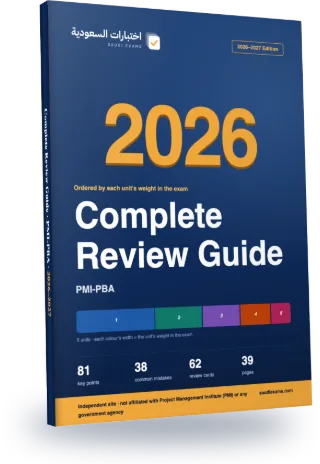
39-page · 81 key points · 38 common mistakes · 62 review cards
The first three chapters alone cover about 75% of the exam. Short on time? Start there.
About the question bank
PMI-PBA is 200 English questions in 240 minutes, so know where you stand before you book. We've handpicked 542 questions across the five domains of the exam content outline, to help you push for a top score before test day!
- 542 questions in the bank
- 200 questions in 240 min per mock
- 62 flashcards
Every option explained so you understand why
What you get
- 542questions in the bankPractise with the answer shown right away, or sit a full timed mock
- 5unitsSplit by the exam syllabus
- 62flashcardsTo lock in terms and definitions
- 81quick review pointsEach unit in a few key lines
Study material sample: Needs Assessment
Summary
Domain 1, Needs Assessment, carries 18% of the scored questions, about 36 of the 200. It has five tasks. Task 1: define the business problem or opportunity, write the solution scope statement and feed the business case. Task 2: collect and analyze information with valuation tools to determine the value proposition. Task 3: help develop project goals and objectives by clarifying business needs and solution scope. Task 4: identify stakeholders so the right parties are represented, informed and involved. Task 5: determine stakeholder values with elicitation techniques to form a baseline for prioritizing requirements. Questions test which tool fits a situation and what the business analyst does first.
What the exam focuses on · Common traps · Try the flashcards
What the exam focuses on
- (Task 1) The difference between a problem and an opportunity, and when root cause analysis (Ishikawa/fishbone, 5 Whys) comes before proposing any solution.
- (Task 1) The solution scope statement: what the solution includes and excludes, and how it relates to the business case.
- (Task 2) The valuation tools named in the outline: cost-benefit analysis, force field analysis, Kano model, net promoter score, purpose alignment model, SWOT analysis, value stream map.
Show 4 more
- (Task 3) The difference between a goal and a measurable objective, and aligning the product with organizational goals.
- (Task 4) Identifying stakeholders from goals, objectives and requirements, and using the RACI matrix and personas to analyze them.
- (Task 5) Choosing the right elicitation technique: brainstorming, focus groups, interviews, workshops, observation, document analysis, surveys.
- (Task 5) Stakeholder values serve as the baseline for prioritizing requirements, using tools such as MoSCoW, multi-voting and weighted criteria.
Common traps
- Confusing a problem with its solution: "we need a new system" is a proposed solution, not a problem. The analyst first asks what the business impact is and what causes it.
- Treating the symptom instead of the root cause: an option that fixes the visible effect without looking for its cause is usually wrong.
- Mixing up a goal and an objective: a goal is a general direction, an objective is a specific result with a measure and a deadline.
Show 4 more
- Mixing up valuation tools and elicitation tools: SWOT and cost-benefit analysis assess value, while interviews and workshops collect information from people.
- Treating stakeholders as only the sponsor and the customer: stakeholders include anyone who affects or is affected by the solution, such as users, operations and regulators.
- Mixing up identifying stakeholders and determining their values: the first is Task 4 (who they are), the second is Task 5 (what the product means to each of them).
- Believing the business analyst sets priorities alone: the analyst gathers stakeholder values and facilitates agreement, and the decision belongs to the business decision makers.
Try the flashcards
Tap a card to see the answer
What does the business analyst do before proposing a solution to a problem?
Defines the problem and analyzes its root cause (such as 5 Whys or an Ishikawa diagram), so the cause is treated and not the symptom.
What is the solution scope statement?
A description of what the solution includes and excludes. It is an output of Task 1 and is given as input to the business case.
What does gap analysis compare?
The current state with the desired state, to see what the solution must cover.
Which valuation tools does the exam outline list for Task 2?
Cost-benefit analysis, force field analysis, Kano model, net promoter score, purpose alignment model, SWOT analysis, value stream map.
What does force field analysis compare?
The forces driving a change against the forces resisting it, to judge how likely the change is to succeed.
What does cost-benefit analysis measure?
The expected costs of an initiative against its expected benefits, to support the value proposition.
What is the difference between a goal and an objective?
A goal is a general direction. An objective is a specific, measurable, time-bound result that supports it.
Who are stakeholders?
Any individual or group that is affected by the solution or can affect it, not only the sponsor and the customer.
Why you can trust these questions
- Published questions: 542. Read the explanations and references, and report any error from the question.
- Exam facts last checked against the organiser’s website: 2026-11-15. We check them again every three months and two weeks before each test.
- Found a mistake? Tap "Report an error" under any question in the practice area, or email us at support@saudiexams.com
- Independent website. Not affiliated with ETEC (Qiyas), the Financial Academy or any government body.
Update log
- 2026-11-15 Published the PMI-PBA exam facts from PMI's Exam Content Outline and certification page.
Full prep for this exam
All of this in one purchase.
- Full mock exam, same as the real one200 questions in 240 minutes. You get a total score and a score for every unit.
- Practice unit by unit542 questions, every option explained with its source. Starts with your weakest units.
- Complete Review Guide 2026–2027 (PDF)Ordered by each unit's weight in the exam. With lifetime access only.
Choose your access
Continue with your Google account and you go straight to the payment page.
You pay on the Waffo Pancake checkout page (in English). The amount is in US dollars and your bank converts it to riyals. One payment with no automatic renewal, by Visa, Mastercard (a mada card with either logo works too), Apple Pay or Google Pay. Your statement shows "WAFFO". Purchases are not refundable.