CME-5A – Corporate Finance Technical Foundations
CME-5A – Corporate Finance Technical Foundations — Number of questions: 50 questions. Exam time: 60 minutes. Pass mark: 70%. Exam fee: SAR 1,950. Calculator: onscreen. Source: Financial Academy (Last verified: 2026-11-15). Question bank: full mock exams of 50 questions in 60 minutes, like the real test with a result for every unit, plus 560 explained questions across 5 units, every option explained, a review of your mistakes, and two ways to practise: see the answer right away, or sit a full timed mock. Free questions: a 10-question diagnostic test covering the main units, no sign-up; at the end we compare your score with the pass mark and show your weakest units. With lifetime access: the Complete Review Guide, a 41-page PDF ordered by unit weight; chapter 1 is free to read on the guide page.
Last verified on the Financial Academy website: 15 November 2026
If you sat the exam today, what would you score?
10 free questions · no sign-up · your score as soon as you finish
Question 1 of 10
Beta Co has 30 million shares in issue trading at £4.00, and debt with a book value of £48 million. A bidder offers a 25% premium to the share price. What is the transaction value?
All 10 free questions with answers and an explanation for every option
Where the questions come from
- Quantitative Analysis for Corporate Finance15 questions
- Capital Structure11 questions
- Business Valuations8 questions
- Corporate Transactions11 questions
- Corporate Finance Documentation5 questions
Exam facts
How to register
- Sign in to your account on the Financial Academy website (fa.gov.sa), or create one; if your employer registers you, it is done from the employer's account.
- Open the CME-5A exam page and choose the exam language (Arabic or English).
- Pick an available date and test centre and review the booking details.
- Pay the fee in full through the Academy's systems; it is not refunded once payment is confirmed unless the Academy cancels the exam.
- On exam day, arrive at least 30 minutes early with valid ID that matches your registration name.
Study guides (3)
Frequently asked questions
What is the CME-5A pass mark?
35 marks out of 50 questions, which is 70%, according to the Financial Academy exam page and the CISI workbook specification.
Can I try CME-5A questions for free?
Yes. Free questions: a 10-question diagnostic test covering the main units, no sign-up; at the end we compare your score with the pass mark and show your weakest units. The free practice test page lists the same questions with answers and an explanation for every option. The rest of the questions and the full mock exams come with a pass from SAR 26.
What makes this CME-5A question bank different?
Question bank: full mock exams of 50 questions in 60 minutes, like the real test with a result for every unit, plus 560 explained questions across 5 units, every option explained, a review of your mistakes, and two ways to practise: see the answer right away, or sit a full timed mock. Practice questions and explanations are ready to use on your phone. Try the free questions and read the explanations before you buy.
Is there a PDF review guide for CME-5A?
Yes. "CME-5A Complete Review Guide 2026–2027" is a 41-page Arabic PDF: 5 units ordered from the heaviest in the exam to the lightest, each chapter with key points, common mistakes and review cards, plus a 7-day plan. Chapter 1 is free to read on the guide page; the full guide comes with lifetime access to this exam and is not part of 7-day access. The guide has no questions: scoring, practice and mock exams are on the site.
How much does the CME-5A exam cost?
SAR 1,950 per attempt, according to the Financial Academy exam page. The page says the fee can be reclaimed after passing through the Hadaf platform. Hadaf appears to require passing both CME-5A and CME-5B and completing the professional certificate, so check its conditions before counting on it.
How long is CME-5A and in which language is it offered?
60 minutes, in Arabic or English; you choose the language when you register on the Financial Academy website.
Can I use a calculator in CME-5A?
Hand-held calculators are not allowed in CISI exam venues; you use the on-screen calculator, according to the official workbook.
How do I register for CME-5A?
Through your account on the Financial Academy website (fa.gov.sa), or through your employer's account if your organisation registers you. You choose the exam, the date and the centre, then pay the fee in full to confirm the booking.
What does CME-5A cover, and how many questions per section?
50 questions, split as follows: Quantitative Analysis for Corporate Finance (15), Capital Structure (11), Business Valuations (8), Corporate Transactions (11), Corporate Finance Documentation (5). Each section may vary by up to 2 questions. Source: the exam specification in the CISI workbook.
Is CME-5A enough for the corporate finance certificate?
No. The professional certificate has two parts and you must pass both: CME-5A and CME-5B (Saudi Capital Market Rules and Regulations – Corporate Finance), according to the Financial Academy page.
Is this an official site, and how do I pay?
It is an independent site, not part of Qiyas, this exam's regulator or any government body, with practice questions and answer explanations. You pay once, with no automatic renewal, through Waffo Pancake (the merchant of record) by Visa, Mastercard, Apple Pay or Google Pay, and your statement shows "WAFFO". If you were charged twice or the pass did not open, email support@saudiexams.com.
CME-5A Complete Review Guide 2026–2027
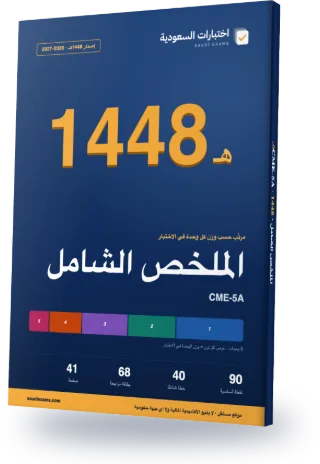
41-page · 90 key points · 40 common mistakes · 68 review cards
The first three chapters alone cover about 74% of the exam. Short on time? Start there.
About the question bank
Practise quantitative analysis, capital structure, business valuation, corporate transactions and finance documentation with explanations for every option.
- 50 questions in 60 min, like the real test
- 560 questions covering the main scoring topics, with explanations
- 70% pass mark, with targeted practice on your weak spots
See the gap to your target score Practise the units costing you the most marks A full mock exam like the real one
Every option explained so you understand why
What you get
- 560questions in the bankPractise with the answer shown right away, or sit a full timed mock
- 5unitsSplit by the exam syllabus
- 68flashcardsTo lock in terms and definitions
- 90quick review pointsEach unit in a few key lines
Study material sample: Quantitative Analysis for Corporate Finance
Summary
This unit covers quantitative analysis for corporate finance and carries about 15 of the 50 questions (30%) in CME-5A. It covers accounting standards (IFRS and US GAAP), group accounts and non-controlling interests, the statements of financial position, comprehensive income and cash flows, free cash flow, EBITDA, NOPAT and CFADS, narrative and sustainability reporting, profitability, liquidity, gearing and investor ratios, and the variability of returns through variance, standard deviation and covariance. Most questions are calculations, so learn each formula and try it with small numbers.
What the exam focuses on · Common traps · Try the flashcards
What the exam focuses on
- Quoted companies prepare audited accounts under IFRS (most markets) or US GAAP (companies quoted in the US) and produce consolidated accounts.
- Consolidation includes 100% of a subsidiary's assets, liabilities, income and expenses, then deducts the non-controlling interest; an associate (20% to 49.9%) is included in proportion to the holding.
- Net assets always equal total equity; non-current assets are shown at net book value.
Show 5 more
- Other comprehensive income items (revaluations, actuarial gains, hedging gains and losses) are mostly unrealised and are left out of the ratios.
- Depreciation is a non-cash expense: it is added back to operating profit in operating cash flow, and EBITDA adds back depreciation, amortisation and impairment.
- Enterprise cash flow is before interest, debt repayment and dividends; equity cash flow is after debt service and before dividends.
- CFADS = EBITDA less taxes, maintenance capex and changes in working capital; debt service cover = CFADS / total debt service.
- Most-tested ratios: margins, ROCE, liquidity, debt to equity, interest cover, EPS, P/E, dividend yield, dividend cover and EV/EBITDA.
Common traps
- Do not confuse total debt with net debt: net debt = debt less cash, and EV = market capitalisation + net debt.
- The quick ratio excludes inventory; the current ratio includes all current assets.
- ROCE uses operating profit (EBIT) over capital employed (non-current assets + net current assets); ROE uses profit attributable to ordinary shareholders over shareholders' funds.
Show 5 more
- An increase in receivables or inventory reduces operating cash flow, while an increase in payables raises it; do not reverse the signs.
- Sample variance divides by n−1, not n; standard deviation is the square root of the variance.
- Capital expenditure is not in the income statement (depreciation is); it appears in the cash flow statement, whereas revenue expenditure appears in both.
- Dividends are not an expense in the income statement; they are deducted from distributable reserves.
- Low covariance does not mean low standard deviation: covariance = SD of first × SD of second × correlation, so a volatile asset with low correlation can reduce portfolio risk.
Try the flashcards
Tap a card to see the answer
Subsidiary versus associate in group accounts?
Subsidiary (control, over 50%) is consolidated at 100% with an NCI; associate (20% to 49.9%) is included in proportion to the holding.
What is the non-controlling interest?
Outsiders' share of a subsidiary's profit and net assets; owning 90% of a subsidiary earning 50,000 means deducting 5,000.
Relationship between net assets and equity?
Net assets (assets − liabilities) always equal total equity.
The three activities in the IAS 7 cash flow statement?
Operating, investing and financing.
How is straight-line depreciation calculated?
(Cost − scrap value) / life; (20,000 − 5,000) / 10 = 1,500.
Formula for EBITDA?
Operating profit + depreciation + amortisation + impairment; 574.8 + 121.6 = 696.4.
Formula for NOPAT?
Operating profit × (1 − tax rate); 100 × (1 − 19%) = 81.
What is CFADS and how is cover measured?
Cash flow available for debt service (with maintenance capex only); cover = CFADS / debt service = 900,000 / 400,000 = 2.25x.
Why you can trust these questions
- Published questions: 560. Read the explanations and references, and report any error from the question.
- Exam facts last checked against the organiser’s website: 2026-11-15. We check them again every three months and two weeks before each test.
- Found a mistake? Tap "Report an error" under any question in the practice area, or email us at support@saudiexams.com
- Independent website. Not affiliated with ETEC (Qiyas), the Financial Academy or any government body.
Update log
- 2026-11-15 Added the CME-5A exam.
Full prep for this exam
All of this in one purchase.
- Full mock exam, same as the real one50 questions in 60 minutes. You get a total score and a score for every unit.
- Practice unit by unit560 questions, every option explained with its source. Starts with your weakest units.
- Complete Review Guide 2026–2027 (PDF)Ordered by each unit's weight in the exam. With lifetime access only.
Choose your access
Continue with your Google account and you go straight to the payment page.
You pay on the Waffo Pancake checkout page (in English). The amount is in US dollars and your bank converts it to riyals. One payment with no automatic renewal, by Visa, Mastercard (a mada card with either logo works too), Apple Pay or Google Pay. Your statement shows "WAFFO". Purchases are not refundable.