

Mawhiba Multiple Mental Abilities Test – Level 1
Your child sits the Mawhiba test only once at Level 1, and the 1000–2000 score decides which programs they qualify for. We picked 342 questions across the test's four domains so your child sees where they stand before test day and trains on their weakest domain.
Try 10 free questions and see your levelTake a full mock exam
- 342 questions in the bank
- 64 questions in 103 min per mock
- 49 flashcards
Every option explained so you understand why
If your exam were today, would you pass?
Try 10 free questions without signing up. Get your score and find your weak areas as soon as you finish.
What you get
- 342questions in the bankPractise with the answer shown right away, or sit a full timed mock
- 4unitsSplit by the exam syllabus
- 49flashcardsTo lock in terms and definitions
- 64quick review pointsEach unit in a few key lines
Unit map
- 01Verbal Reasoning and Reading Comprehension16 questions
- 02Mathematical and Spatial Reasoning16 questions
- 03Scientific and Mechanical Reasoning16 questions
- 04Mental Flexibility16 questions
Exam facts
Mawhiba Multiple Mental Abilities Test – Level 1 — Number of questions: 64 questions. Exam time: 103 minutes. Pass mark: No pass mark; the score runs from 1000 to 2000 and decides which programs the student qualifies for. Exam fee: SAR 200 for self-nominated students; students with supported (school) nomination are exempt. Next test: 8 November – 30 December 2026. Source: King Abdulaziz & His Companions Foundation for Giftedness and Creativity (Mawhiba), with the Education and Training Evaluation Commission (ETEC) (Last verified: 2026-11-01). Question bank: full mock exams of 64 questions in 103 minutes, like the real test with a result for every unit, plus 342 explained questions across 4 units, every option explained, a review of your mistakes, and two ways to practise: see the answer right away, or sit a full timed mock. Free questions: a 10-question diagnostic test covering the main units, no sign-up; at the end you get your score and your weakest units.
- Exam language
- Arabic or English
- Number of questions
- 64 questions Source
- Exam time
- 103 minutes Source
- Pass mark
- No pass mark; the score runs from 1000 to 2000 and decides which programs the student qualifies for Source
- Exam fee
- SAR 200 for self-nominated students; students with supported (school) nomination are exempt Source
- Registration
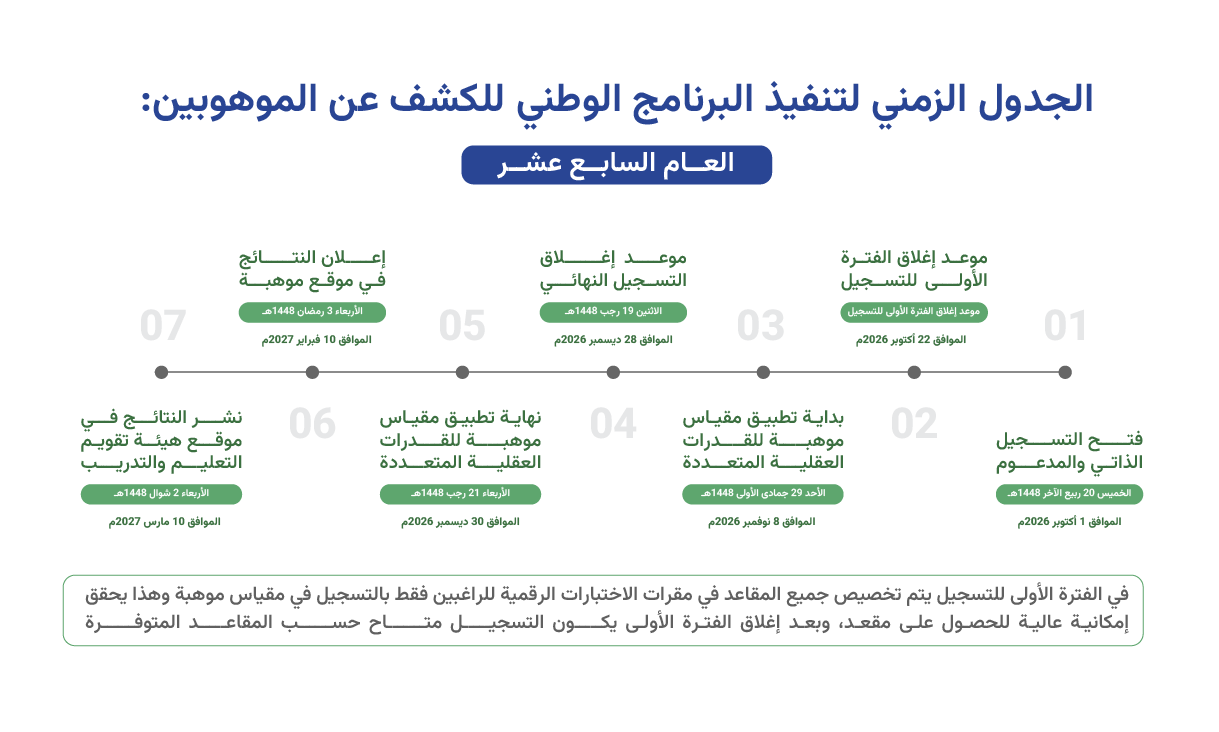
- 1 October to 28 December 2026 on the Sadeed platform; the first phase closed on 22 October, and seats after that depend on availability Source
- Results
- Announced on the Mawhiba website on 10 February 2027 and published on ETEC's website on 10 March 2027 Source
- Retakes
- Once only per level, whatever the test language Source
- Validity
- Until the student moves up to a new level of the test Source
Last verified: 2026-11-01
Where other sources differ
- Some parents think a student can resit the following year in the other language. Mawhiba says each student gets one attempt per level, whatever the test language.
- The score is not just the number of correct answers: Mawhiba says scoring takes each question's difficulty into account, and the weighted score differs between grades within the same level.
How to register
- Go to ETEC's Sadeed platform (sadeed.etec.gov.sa), create an account or sign in, and complete the profile.
- Choose the "Mawhiba Multiple Mental Abilities Test" from the list of tests, then pick a test centre and date.
- Accept the terms and pay SAR 200 for self-nomination. Students with supported (school) nomination pay nothing, but must confirm attendance and choose a centre and date before the deadline, or the registration is cancelled.
- Register the student in their actual school grade: Level 1 is for grades 3, 4 and 5 (primary). Sitting the test in the wrong grade cancels the score.
- The result appears in the student's record on the Mawhiba website when announced, and the score stays valid until the student moves up to the next level.
Exam body
King Abdulaziz & His Companions Foundation for Giftedness and Creativity (Mawhiba), with the Education and Training Evaluation Commission (ETEC): Official website: King Abdulaziz & His Companions Foundation for Giftedness and Creativity (Mawhiba), with the Education and Training Evaluation Commission (ETEC)
Study guides
Frequently asked questions
How many questions are in Mawhiba Level 1 and how long is it?
64 multiple-choice questions in 103 minutes, for students in grades 3, 4 and 5 (primary). The test is computer-based at test centres, in Arabic or English as you choose at registration. Our full mock exams have the same number of questions and time.
Can I try Mawhiba Level 1 questions for free?
Yes. Free questions: a 10-question diagnostic test covering the main units, no sign-up; at the end you get your score and your weakest units. The free practice test page lists the same questions with answers and an explanation for every option. The rest of the questions and the full mock exams come with a pass from SAR 26.
What makes this Mawhiba Level 1 question bank different?
Question bank: full mock exams of 64 questions in 103 minutes, like the real test with a result for every unit, plus 342 explained questions across 4 units, every option explained, a review of your mistakes, and two ways to practise: see the answer right away, or sit a full timed mock. Every question is reviewed and referenced, ready to practise on your phone. Try the free questions and read the explanations before buying full access.
What does the Mawhiba test measure?
Four domains, according to Mawhiba: verbal reasoning and reading comprehension, mathematical and spatial reasoning, scientific and mechanical reasoning, and mental flexibility (producing varied ideas and changing how you approach a problem). Our questions are split evenly across the four domains, and your score is broken down by domain.
What score does my child need?
There is no pass mark. The score runs from 1000 to 2000, and each Mawhiba program sets its own qualifying score on its page. The weighted score is calculated differently for each grade within the level, and qualifying students are classed as exceptionally gifted, gifted or promising.
Can my child resit the test?
No. Each student gets one attempt per level, even in the other language. Sitting the test in a grade other than the student's actual grade cancels the score. If your child does not reach the score needed, they can sit the next level or take part in Mawhiba's competitions.
When are registration and the test, and what does it cost?
According to the 17th-year timeline: registration runs from 1 October to 28 December 2026 on the Sadeed platform, the test runs from 8 November to 30 December 2026, and results come out on the Mawhiba website on 10 February 2027. The fee is SAR 200 for self-nomination; supported (school) nominations are exempt.
Is the mock exam score here an official score?
No. This is an independent website, not affiliated with Mawhiba, ETEC or any government body, and its results are for practice only. Your score here is the share of our questions answered correctly, split by the four domains, so you can see where your child loses marks. The official 1000–2000 score is calculated by the test organisers in a way that accounts for each question's difficulty and the student's grade.
Is this an official site, and how do I pay?
It is an independent site, not part of Qiyas or any government body, and every question is reviewed before it is published. You pay once, with no automatic renewal, through Waffo Pancake (the merchant of record) by Visa, Mastercard, Apple Pay or Google Pay, and your statement shows "WAFFO". If you were charged twice or the pass did not open, email support@saudiexams.com.
Study material sample: Verbal Reasoning and Reading Comprehension
Summary
Verbal reasoning and reading comprehension is the ability to use language to process the information available, and to apply language rules to what is read in order to infer, extract, reorganise and use meanings (the Mawhiba test's definition). Our question set has about 16 of the 64 questions for each domain. At Level 1 your child meets five question types: verbal analogies, sentence completion, contextual error, vocabulary and word classification, and reading comprehension. The words are familiar to a child in grades 3 to 5, with an occasional formal word. The passages are short. The difficulty is in thinking about the relation and the meaning, not in memorising rare words.
What the exam focuses on
- Verbal analogies: say the relation between the two words in a short sentence (a pen is used for writing), then find the pair where the same sentence works.
- Sentence completion: read the whole sentence first, then try each choice in the blank and ask whether it fits the meaning.
- Contextual error: find the word that goes against the meaning of the sentence. The mistake is in meaning, not in spelling.
Show 4 more
- Odd word out: first name what three words share (all are animals that live in water), and the fourth is the odd one.
- Word meaning in a sentence: put each choice in place of the word and check whether the sentence keeps its meaning.
- Reading comprehension: read the passage once, then the question, then go back and find the sentence that answers it.
- Main idea: it is the idea that holds all the sentences together, not one detail.
Common traps
- Picking a word that only matches the topic of the question. In an analogy the relation must be the same, not just the topic.
- Reversing the order of the pair: part and whole (wheel : car) is not the same as whole and part (car : wheel).
- Taking the first choice that looks acceptable without reading the others. A second choice may fit partly, but only one fits best.
Show 4 more
- Worrying about spelling and grammar in a contextual-error question. The target is a word whose meaning does not suit the sentence.
- Answering from what the child already knows instead of the passage. If the sentence is not in the passage, the answer is wrong even when it is true in real life.
- Mixing up the main idea and a detail. A choice that states one fact from the text is usually a detail, not the main idea.
- Ignoring linking words such as but, so and although. They show which way the meaning of the sentence goes at the blank.
Try the flashcards
Tap a card to see the answer
What sentence do we say to solve a verbal analogy?
"A is linked to B in this way", then we try the same sentence with each choice.
What is the relation in: scissors : cutting?
A tool and its use. Scissors are used for cutting.
What is the relation in: page : book?
Part and whole. A page is part of a book.
What does the word "but" signal in a sentence?
That what follows goes against what came before.
What does the word "so" (لذلك) signal?
That what follows is a result of what came before.
In a contextual-error question, where is the mistake?
In meaning: a word that does not suit the sentence. It is not in spelling or grammar.
How do we find the odd word out?
We name what three words share, and the fourth is the one that does not fit.
What is the difference between a synonym and an antonym?
A synonym has a close meaning (big : huge), an antonym has the opposite meaning (big : small).
Why you can trust these questions
- Published questions: 342. We reviewed every one before publishing it: the answer, the explanation of each option and the source.
- Exam facts last checked against the organiser’s website: 2026-11-01. We check them again every three months and two weeks before each test.
- Found a mistake? Tap "Report an error" under any question in the practice area, or email us at support@saudiexams.com
- Independent website. Not affiliated with ETEC (Qiyas), the Financial Academy or any government body.
Update log
- 2026-11-01 Published the test facts and the 17th-year dates from Mawhiba's pages.