

Mawhiba Level 1 Study Plan: A Parent's Guide by Days Left
A parent's plan for Mawhiba Level 1 by time left: 4+ weeks, 2 to 3 weeks, the last week, the day before and test day, with about 97 seconds per question.
- Next test
- 8 November – 30 December 2026 Add the date to your calendar
- Questions and time
- 64 questions · 103 minutes
- Pass mark
- No pass mark; the score runs from 1000 to 2000 and decides which programs the student qualifies for
- Exam fee
- SAR 200 for self-nominated students; students with supported (school) nomination are exempt
Start with 10 free questions to find what needs more work. No sign-up, with answer explanations.
Try 10 free questions and see your levelPut what you just read into practice
Start with 10 free questions to find what needs more work. No sign-up, with answer explanations.
Try 10 free questions and see your levelLast verified: 1 November 2026. The question count, the duration and the test window in this plan come from the national gifted identification program page on the Mawhiba website and from the 17th-year timeline. They may change, so check before the test. This is an independent guide, not affiliated with the Mawhiba foundation, the Education and Training Evaluation Commission or any government body, and it does not promise any score.
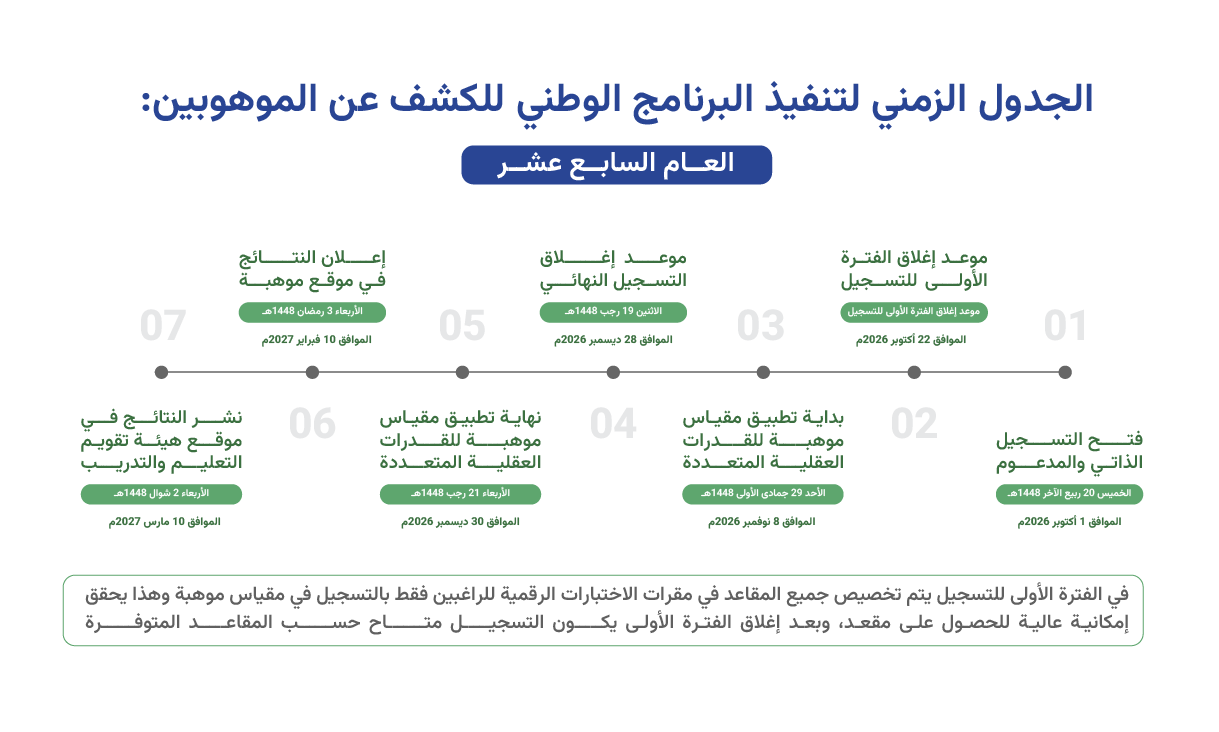
This guide is a plan for a parent who wants to help their child with Level 1 (grades 3, 4 and 5) in the weeks that remain. Your child gets only one attempt at this level, and the score runs from 1000 to 2000 with no pass mark, so the plan is not built around clearing a minimum. Its aim is for your child to know the questions, to see where marks are lost and to arrive at the test relaxed. The four domains, with an example of each, are explained in the syllabus guide, and the sign-up steps are in the registration guide.
What one 25-minute session looks like
- 5 minutes: read two mistakes from the mistakes notebook with your child, and ask them to explain the right method in their own words.
- 12 minutes: ten questions in that day's domain, with a timer running on screen.
- 8 minutes: go over the questions they got wrong. First ask: why did you choose this answer? Then read the explanation together.
This order turns every mistake into a small lesson, and keeps the session too short for a child in grade 3, 4 or 5 to get tired of it.
The numbers the plan is built on
| Item | Level 1 | What it means for your plan |
|---|---|---|
| Questions | 64 | Our mock exams have 16 questions in each of the four domains |
| Duration | 103 minutes | About 97 seconds per question and about 26 minutes per domain |
| Test window | 8 November to 30 December 2026, computer-based at test centres | You choose your child's date when registering, so count your weeks from that date |
| Resits | One attempt per level only | Level 1 cannot be repeated, so let the practice happen on the site's questions, not on the test itself |
The first step at any point: 10 free questions
Before any revision, sit with your child and do the 10 free questions on the Level 1 page. No sign-up is needed. Afterwards you see your child's score in each of the four domains and know which is weakest. This gives you two things: where to start, and what does not need much time. Some children are strong in verbal reasoning and stumble on figures, and the reverse is also true, and you cannot tell until they have solved the questions.
If there are 4 weeks or more left
- Week 1: get to know the test. The 10 free questions, then read the study material for the weakest domain with your child. Twenty minutes a day, 4 days a week, is enough.
- Weeks 2 and 3: practice by domain. One domain per day in rotation, with the weakest domain getting two sessions a week. Make each session ten explained questions, then read the explanation of each mistake together. Ask your child to say aloud how they thought, because speaking the reasoning exposes the error faster than looking at the answer.
- Week 4: time. Start shortening the time gradually: ten questions in about 16 minutes, which is about 97 seconds a question. At the end of the week your child takes a full mock exam of 64 questions in 103 minutes (paid content), and you go through the score in all four domains together.
If there are 2 or 3 weeks left
- Do the 10 free questions on day one and identify the weakest domain.
- Make the first week daily sessions of 20 to 25 minutes: two days on the weakest domain, one day on each of the others and one day to review the mistakes notebook.
- In the second week begin timing, and end it with a full mock exam in real time. After it, give two days to the weakest domain that showed up.
In the last week
Add no new topics. This week needs three things: ten questions on the weakest domain almost every day, a review of the mistakes notebook, and a full mock exam at least two or three days before the real test so that you still have time to work on what it showed. If your child's mock score comes out lower than you expected, remember that it is the share of correct answers in our practice questions, not the Mawhiba score of 1000 to 2000, which is calculated in a way that accounts for each question's difficulty and the student's grade. Use it to see where marks are lost, not to judge the outcome.
The day before the test
- No full mock exam. One short session of 10 to 15 minutes on questions your child got wrong before, then stop.
- Check in your Sadeed account the test centre and date you chose, and confirm the student's details are correct. The student is responsible for the accuracy of the data entered.
- Have the student's proof of identity ready: the registration guide asks students to arrive at the centre in good time with proof of identity.
- An early night and a light breakfast. Do not ask your child about the test more than once.
Test day
The test is computer-based and lasts 103 minutes. Leave a comfortable amount of time to reach the centre, and say one sentence to your child before they go in: "Do what you can, and if a question is hard, move on." Afterwards do not go through the questions together, since nothing can be changed and your child needs rest. Results are announced on the Mawhiba website on 10 February 2027.
How to help your child with time
- The two-minute rule. If your child does not know the answer after two minutes, they pick the closest answer and move on. One question should not eat the time of several.
- A clock or timer in every session. Your child gets used to the feel of time without the pressure of the test.
- Drawn questions on paper first. For spatial questions and matrices, your child sketches the shape on paper before answering, then sketches less as it becomes familiar.
How to ease the pressure on your child
- Keep sessions short: 20 to 30 minutes is enough for a child this age.
- Do not compare your child with siblings or classmates, and do not call this their "only chance". The single attempt is something you know about, not a burden for your child.
- Welcome explained mistakes: a mistake in practice is exactly what we want to find before the test.
- Give each session a clear end: ten questions, then a game or a break.
Start with the free questions on the Level 1 page.
Finished reading? Try a set of questions
Start with 10 free questions to find your weakest units. Keep practising with the full question bank and mock exams from SAR 26.
Sources and references
- موهبة: البرنامج الوطني للكشف عن الموهوبين mawhiba.sa
- موهبة: الجدول الزمني للعام السابع عشر mawhiba.sa