Try the questions in the test above first, then open each one here to see the correct answer and why every other option is wrong.
01brave : reckless
Practice question Unit: Verbal Reasoning and Reading Comprehension
Arich : poor
Rich is the opposite of poor, which is an opposite relation.
Bthrifty : stingy ✓ Correct answer
Bravery taken too far becomes recklessness, and thrift taken too far becomes stinginess, so the relation is a good quality and its excess.
Cgenerous : giving
Generous and giving are close in meaning, which is a synonym relation.
Dmerchant : money
A merchant deals with money, which is a profession and thing relation.
Reference: Mawhiba, National Program for Gifted Identification page: test components – Verbal Reasoning and Reading Comprehension, verbal analogies
Ask a friend
02Although the news was ______ to everyone, the teacher kept his ______ and reassured the students.
Practice question Unit: Verbal Reasoning and Reading Comprehension
Ajoyful – calm
"Although" needs a contrast, and joyful news does not contrast with calm.
Bshocking – excitement
Excitement does not reassure students.
Cjoyful – enthusiasm
There is no contrast between joyful news and enthusiasm.
Dshocking – calm ✓ Correct answer
Shocking news contrasts clearly with staying calm, and calm is what reassures students.
Reference: Mawhiba, National Program for Gifted Identification page: test components – Verbal Reasoning and Reading Comprehension
Ask a friend
03Which of the marked words does not fit the meaning of the sentence?
A tree's «shadow» is long in early «morning» because the «sun» is «high» and close to the horizon.
Practice question Unit: Verbal Reasoning and Reading Comprehension
Ahigh ✓ Correct answer
A sun close to the horizon is low, not high, and that is what makes the shadow long. The word «high» contradicts the meaning.
Bsun
The sun is the light source that makes the shadow, and the word does not clash with the sentence.
Cshadow
A shadow is what changes length during the day, and the word fits the context.
Dmorning
Early morning is when the sun is near the horizon, so the word is right.
Reference: Mawhiba, National Program for Gifted Identification page: test components – Verbal Reasoning and Reading Comprehension
Ask a friend
04A square has a perimeter of 36 centimetres. A rectangle has the same perimeter and is 12 centimetres long. How many centimetres wide is the rectangle?
Practice question Unit: Mathematical and Spatial Reasoning
A9 centimetres
This is the side of the square (36 ÷ 4), not the width of the rectangle.
B12 centimetres
This is the given length of the rectangle, not its width.
C24 centimetres
This subtracts the length from the whole perimeter (36 − 12) and ignores that length and width each appear twice.
D6 centimetres ✓ Correct answer
Half the perimeter is 36 ÷ 2 = 18, so the width is 18 − 12 = 6 centimetres.
Reference: Mawhiba, National Program for Gifted Identification page: test components – Mathematical and Spatial Reasoning
Ask a friend
05Complete the number sequence: 2, 6, 7, 21, 22, 66, ?
Practice question Unit: Mathematical and Spatial Reasoning
A198
198 would be ×3 again, but the last step was ×3, so +1 is next.
B69
69 would be +3, which is not a step in the rule.
C67 ✓ Correct answer
The steps alternate: ×3 then +1 (2→6, 6→7, 7→21, 21→22, 22→66). The step now is +1, so 66 + 1 = 67.
D132
132 would be ×2, but the multiplying step here is ×3.
Reference: Mawhiba, National Program for Gifted Identification page: test components – Mathematical and Spatial Reasoning
Ask a friend
06Which figure is the given figure turned (without flipping it)?
Practice question Unit: Mathematical and Spatial Reasoning
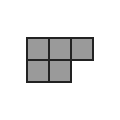
A Figure A
Wrong: this is the mirror image (flipped); no amount of turning alone can produce it.
B Figure B ✓ Correct answer
Correct: this is the same figure turned a quarter turn clockwise, not flipped.
C Figure C
Wrong: this is the mirror image (flipped); no amount of turning alone can produce it.
D Figure D
Wrong: this is the mirror image (flipped); no amount of turning alone can produce it.
Reference: Mawhiba, National Program for Gifted Identification page: test components – mathematical and spatial reasoning
07The Moon seems to change shape from a thin crescent to a full circle. What is the best explanation?
Practice question Unit: Scientific and Mechanical Reasoning
Aeach night we see a different part of its lit half ✓ Correct answer
Half the Moon is always lit, and its changing position shows us a different part of that half.
Bthe Moon really grows and shrinks every week depending on how near Earth it is
The Moon's size is fixed; what changes is how much of it we see.
Cclouds cover part of the Moon in roughly the same order every night
Clouds do not repeat in a fixed pattern, and the shapes change even in clear skies.
DEarth's shadow covers the Moon in a different shape every night of the month
Earth's shadow causes eclipses only now and then, not every night.
Reference: Mawhiba, National Program for Gifted Identification page: test components – Scientific and Mechanical Reasoning, concept: phases of the Moon
Ask a friend
08Reem threw the same paper plane four times. It flew 5 m, 9 m, 6 m and 8 m. She wants to report one distance for her plane. Which method gives the more reliable result, and why?
Practice question Unit: Scientific and Mechanical Reasoning
A9 m, the best throw, because it shows the farthest the plane can fly at its best
A single throw may be affected by chance or wind, and does not show what the plane usually does.
B5 m, the shortest throw, because it is least affected by the wind
This is also one throw affected by chance, with no reason to choose it.
C8 m, the last throw, because Reem had practised by then and threw better
The last throw may improve with practice, but one throw does not represent the plane as well as the average.
D7 m, the average of the throws, because it reduces the effect of chance ✓ Correct answer
The average: 5 + 9 + 6 + 8 = 28, and 28 ÷ 4 = 7 m. Repeating and averaging reduces the effect of errors and chance.
Reference: Mawhiba, National Program for Gifted Identification page: test components – Scientific and Mechanical Reasoning, concept: experiments and reading data
Ask a friend
09In a secret code, the number 23 is written 56, 14 is written 54 and 33 is written 69. How is 42 written?
Practice question Unit: Mental Flexibility
A86
This answer writes the product first and the sum second, but the examples write the sum first.
B62
This answer writes the sum and then the difference (4−2=2), but the examples use the product.
C66
This answer repeats the sum twice and never works out the product.
D68 ✓ Correct answer
The rule: write the sum of the two digits, then their product. 4+2=6 and 4×2=8, giving 68.
Reference: Mawhiba, National Program for Gifted Identification page: test components – Mental Flexibility
Ask a friend
10★ + ★ + ◆ = 17, ★ + ◆ + ◆ = 16
What is the value of ★ × ◆?
Practice question Unit: Mental Flexibility
A24
The values 6 and 4 give 6 + 6 + 4 = 16, not 17, so they fail the first equation.
B30 ✓ Correct answer
Adding the equations gives ★ + ◆ = 11, so ★ = 17 − 11 = 6 and ◆ = 5, and the product is 30.
C35
The values 7 and 5 give 7 + 7 + 5 = 19, not 17.
D36
The values 6 and 6 give 6 + 6 + 6 = 18, not 17.
Reference: Mawhiba, National Program for Gifted Identification page: test components – Mental Flexibility, symbol equations and number puzzles
Ask a friend

