PMI-PBA
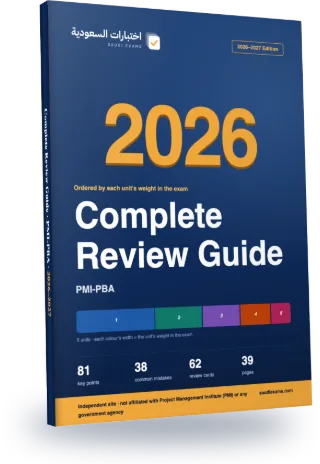
PMI-PBA Complete Review Guide 2026–2027
Every exam topic in a 39-page Arabic PDF, ordered from the heaviest unit to the lightest. The first three chapters alone cover about 75% of the exam questions.
- 39Pages
- 81Key points
- 38Common mistakes
- 62Flashcards
Guide map
Each chapter is one exam unit, ordered by its weight in the real exam.
| Chapter | Unit | Weight | Exam questions | Key points |
|---|---|---|---|---|
| 1 | Analysis | 35% | 70 | 17 |
| 2 | Planning | 22% | 44 | 15 |
| 3 | Needs Assessment | 18% | 36 | 15 |
| 4 | Traceability and Monitoring | 15% | 30 | 17 |
| 5 | Evaluation | 10% | 20 | 17 |
Chapter 1 in full: Analysis
35% of the exam, about 70 questions. These are its key points, as in the guide.
- (Task 1) When a requirement is elicited, record its origin (who asked for it), its rationale (why it is needed) and its supporting details; this makes it traceable and reviewable later.
- (Task 1) Individual elicitation techniques: interviews, observation, document analysis, questionnaires. Group techniques: brainstorming, focus groups, facilitated workshops.
- (Task 1) Surveys reach many people at low cost but allow no follow-up questions; an interview allows depth and clarification but takes more time per person.
The rest of chapter 1, on this page
- (Task 1) Observation shows what users actually do, which can differ from what they say in an interview; document analysis starts from existing systems, procedures and reports.
- (Task 2) Decomposition splits a large requirement into smaller parts that can be understood and estimated; progressive elaboration adds detail as better information becomes available.
- (Task 2) Dependency analysis identifies requirements that cannot be delivered before others or that affect one another, and feeds into ordering and scheduling.
- (Task 2) Interface analysis examines points of interaction between the system, its users and other systems; its tools include prototyping, storyboarding and interoperability checks.
- (Task 2) Data modeling uses a data model, a data dictionary and a state diagram; business rules are analyzed with a decision table, a decision tree or a rule catalog.
- (Task 3) Options analysis compares product alternatives and capabilities using valuation and decision-making techniques, and ends with a decision per requirement: accepted, deferred or rejected.
- (Task 3) Decision-making techniques include Delphi, which collects expert opinions over rounds without tying each opinion to its author, multi-voting, and consensus building.
- (Task 4) Allocation balances scope, schedule, budget and resource constraints against the value proposition, using prioritization and dependency analysis, and produces the requirements baseline.
- (Task 4) In MoSCoW prioritization requirements fall into Must, Should, Could and Won't (this time); in agile work, items are ordered in a backlog.
- (Task 5) Sign-off on the baseline uses decision-making techniques that build consensus among stakeholders; afterwards any proposed change is compared with the baseline and goes through change control.
- (Task 6) Specifications are written as use cases, which describe a user's interaction with the system to reach a goal, or as user stories in the form «As a ..., I want ..., so that ...», with data and interface details.
- (Task 6) A good requirement is measurable and actionable, meaning developers can build from it without guessing; vague wording is replaced with specific values and conditions.
- (Task 7) Validating requirements ensures they are complete, accurate and aligned with goals and the value proposition, through document review, prototypes, demos and similar methods.
- (Task 8) Metrics and acceptance criteria are elaborated with measurement tools to decide whether the solution meets the requirements; a service level agreement (SLA) is one example, and the wording should be testable with a clear pass or fail.
Common mistakes in this chapter
- Mixing up elicitation (Task 1) and analysis (Task 2): elicitation gathers requirements from sources, analysis breaks them down, elaborates them and reveals their relationships.
- Confusing options evaluation (Task 3) with allocation (Task 4): the first decides accept, defer or reject, the second places the accepted and deferred ones within scope, schedule, budget and resource limits.
- Treating the baseline as frozen forever: it is the agreed version that later changes are compared against, and changes to it go through the change control plan.
- Confusing validation of requirements (are these the right requirements, aligned with goals?) with testing the finished solution against requirements, which belongs to the Evaluation domain.
- Writing a vague requirement such as «fast» or «user friendly» with no measure; a good requirement is measurable and can be judged against a clear acceptance criterion.
- Confusing a use case (a sequence of interactions between a user and the system to reach a goal) with a user story (a short statement of a user need and its benefit, detailed later with acceptance criteria).
- Choosing an individual technique (interview) when the situation needs several parties to talk a disagreement through, or the reverse: a workshop for a sensitive topic that needs a one-to-one interview.
- Mixing up dependency analysis (relationships between requirements) with interface analysis (points of interaction between the system and users or other systems).
The other chapters are in the full guide
One purchase · lifetime access · review guide included
7-day review plan
The chapters are spread over 6 days by weight so each day carries a similar load. Day 7 is a full exam.
Day 1 · 35% of the exam
Chapter 1: Analysis
Day 2 · 22% of the exam
Chapter 2: Planning
Day 3 · 18% of the exam
Chapter 3: Needs Assessment
Day 4 · 15% of the exam
Chapter 4: Traceability and Monitoring
Day 5 · 10% of the exam
Chapter 5: Evaluation
Day 6
Full mock exam: 200 questions in 240 minutes, then review the common mistakes in the units where you lost marks.
Before you read: see your score today
10 free questions from the main units, no sign-up. Then you know which chapter to start with.
Try 10 free questions and see your levelA look at each chapter
The first three key points of each chapter, as they appear in the guide (in Arabic in the PDF).
Chapter 1: Analysis
- (Task 1) When a requirement is elicited, record its origin (who asked for it)…
- (Task 1) Individual elicitation techniques
- (Task 1) Surveys reach many people at low cost but allow no follow-up questions;…
Chapter 2: Planning
- (Task 1) Reviewing the business case and the goals and objectives comes before the…
- (Task 1) If a requirement or plan conflicts with the project goals and the…
- (Task 2) A requirements traceability matrix is a common tool that links each requirement…
Chapter 3: Needs Assessment
- (Task 1) A problem is an existing condition that blocks a desired outcome; an…
- (Task 1) Root cause analysis looks beneath the symptom. The Ishikawa (fishbone) diagram groups…
- (Task 1) Problem and opportunity identification tools named in the outline include brainstorming, value…
Chapter 4: Traceability and Monitoring
- (Task 1) A requirements traceability matrix links each requirement to its source and to…
- (Task 1) Attributes commonly recorded per requirement
- (Task 1) The purpose of tracing
Chapter 5: Evaluation
- (Task 1) Goal
- (Task 1) A good acceptance criterion is measurable and testable, and can be written…
- (Task 1) User Acceptance Testing (UAT) is carried out by users or their representatives…
The full guide comes with lifetime access
The full guide (39 pages) is included with lifetime access to this exam, together with every question and full mock exam. Chapter 1 is free for everyone.
Questions about the guide
Is the guide free?
Chapter 1 is free to read on the guide page. The full guide comes with lifetime access to this exam; 7-day access does not include it.
Is it up to date for 2026–2027?
Yes. Unit weights and exam facts follow what the exam body last published, and the last check date is printed in the guide. If the standards change we update the file and buyers download the new version.
Does the guide have questions?
No. The guide covers key points and common mistakes; scoring, weak-area practice and full mock exams are on the site.
Can I read it on my phone?
Yes. A5 pages in a single column, with chapters linked from the contents.
- Pages
- 39
- Edition
- 1448 AH · 2026–2027
- Language
- Arabic
- Last updated
All Management & Project Exams review guides
Back to PMI Professional in Business Analysis (PMI-PBA) Exam
Full prep for this exam
All of this in one purchase.
- Full mock exam, same as the real one200 questions in 240 minutes. You get a total score and a score for every unit.
- Practice unit by unit542 questions, every option explained with its source. Starts with your weakest units.
- Complete Review Guide 2026–2027 (PDF)Ordered by each unit's weight in the exam. With lifetime access only.
Choose your access
Continue with your Google account and you go straight to the payment page.
You pay on the Waffo Pancake checkout page (in English). The amount is in US dollars and your bank converts it to riyals. One payment with no automatic renewal, by Visa, Mastercard (a mada card with either logo works too), Apple Pay or Google Pay. Your statement shows "WAFFO". Purchases are not refundable.