SCFHS Physiotherapy Technician Exam
SCFHS Physiotherapy Technician Exam — Number of questions: 150 questions. Exam time: 3 hours. Pass mark: 55%. Calculator: The SCFHS content guideline does not say whether a calculator is allowed. Exam fee: Paid to SCFHS online when you apply through Mumaris Plus; the amount is shown in your application. Source: Saudi Commission for Health Specialties (SCFHS) (Last verified: 2026-11-15). Question bank: full mock exams of 150 questions in 180 minutes, like the real test with a result for every unit, plus 553 explained questions across 10 units, every option explained, a review of your mistakes, and two ways to practise: see the answer right away, or sit a full timed mock. Free questions: a 10-question diagnostic test covering the main units, no sign-up; at the end we compare your score with the pass mark and show your weakest units. With lifetime access: the Complete Review Guide, a 65-page PDF ordered by unit weight; chapter 1 is free to read on the guide page.
Last verified on the Saudi Commission for Health Specialties (SCFHS) website: 15 November 2026
If you sat the exam today, what would you score?
10 free questions · no sign-up · your score as soon as you finish
Question 1 of 10
Capsular tightness limits a patient's shoulder abduction. The convex humeral head moves on the fixed concave glenoid. Which glide of the humeral head should be mobilized to improve abduction?
All 10 free questions with answers and an explanation for every option
Where the questions come from
- Kinesiology, Biomechanics and Ergonomics12 questions
- Anatomy and Physiology18 questions
- Clinical Decision Making and Differential Diagnosis12 questions
- Physical Agents (Electrotherapy and Hydrotherapy)15 questions
- Therapeutic Exercises and Techniques15 questions
- Physical Therapy in Special Population (OBGYN, Paediatrics, Geriatrics)18 questions
- Cardiopulmonary Physical Therapy12 questions
- Sports Physical Therapy12 questions
- Neurorehabilitation18 questions
- Musculoskeletal Rehabilitation18 questions
Exam facts
- Exam language
- English
- Number of questions
- 150 questions Source
- Exam time
- 3 hours Source
- Pass mark
- 55% Source
- Calculator
- The SCFHS content guideline does not say whether a calculator is allowed Source
- Exam fee
- Paid to SCFHS online when you apply through Mumaris Plus; the amount is shown in your application Source
- Registration
- Apply through the Professional Classification service in Mumaris Plus; SCFHS has not published a separate window calendar for the physiotherapy technician exam Source
- Retakes
- If you do not pass you get further attempts under SCFHS regulations and pay the evaluation fee Source
Last verified: 2026-11-15
Where other sources differ
- The pass mark is 55% in the content guideline. Section weights may differ by up to 5% in each category, and percentages and content may change at any time.
- Ten sections: anatomy and physiology, special populations, neurorehabilitation and musculoskeletal rehabilitation (12% each); physical agents and therapeutic exercises and techniques (10% each); kinesiology, clinical decision making, cardiopulmonary and sports physical therapy (8% each).
Exam body
Saudi Commission for Health Specialties (SCFHS): Official website: Saudi Commission for Health Specialties (SCFHS)
How to register
- Choose the Professional Classification service in the Mumaris Plus system and submit your application with your certificate and documents.
- Once your application is accepted you are referred to an electronic written exam delivered through Prometric or Pearson VUE.
- Pay the evaluation fee shown in your application.
- Book your slot at a test centre through the booking service SCFHS opens in your application.
- On exam day bring your ID or passport and your booking confirmation.
Study guides (3)
Frequently asked questions
How many questions are there and how long is the exam?
150 multiple-choice questions in 3 hours, according to the SCFHS Physiotherapy Technician content guideline.
Can I try Physio Technician questions for free?
Yes. Free questions: a 10-question diagnostic test covering the main units, no sign-up; at the end we compare your score with the pass mark and show your weakest units. The free practice test page lists the same questions with answers and an explanation for every option. The rest of the questions and the full mock exams come with a pass from SAR 26.
What makes this Physio Technician question bank different?
Question bank: full mock exams of 150 questions in 180 minutes, like the real test with a result for every unit, plus 553 explained questions across 10 units, every option explained, a review of your mistakes, and two ways to practise: see the answer right away, or sit a full timed mock. Practice questions and explanations are ready to use on your phone. Try the free questions and read the explanations before you buy.
Is there a PDF review guide for Physio Technician?
Yes. "Physio Technician Complete Review Guide 2026–2027" is a 65-page Arabic PDF: 10 units ordered from the heaviest in the exam to the lightest, each chapter with key points, common mistakes and review cards, plus a 7-day plan. Chapter 1 is free to read on the guide page; the full guide comes with lifetime access to this exam and is not part of 7-day access. The guide has no questions: scoring, practice and mock exams are on the site.
What is the pass mark?
55% according to the guideline. On our site your result shows your percentage in each section so you can see where you lose points.
What language is the exam in?
The guideline and its reference books are in English, so our questions are in English, every option is explained in English.
Which sections does the exam cover?
Ten sections: kinesiology and biomechanics (8%), anatomy and physiology (12%), clinical decision making (8%), physical agents (10%), therapeutic exercises (10%), special populations (12%), cardiopulmonary (8%), sports (8%), neurorehabilitation (12%), musculoskeletal rehabilitation (12%).
How is it different from the physiotherapy specialist exam?
This is the technician exam: 150 questions, ten sections and a 55% pass mark. The physiotherapy specialist exam has its own content guideline and a 60% pass mark, and its own page on our site.
Is this site part of SCFHS?
No. This is an independent exam preparation site with no link to SCFHS, Prometric or any government body. Always rely on what SCFHS announces.
Is this an official site, and how do I pay?
It is an independent site, not part of Qiyas, this exam's regulator or any government body, with practice questions and answer explanations. You pay once, with no automatic renewal, through Waffo Pancake (the merchant of record) by Visa, Mastercard, Apple Pay or Google Pay, and your statement shows "WAFFO". If you were charged twice or the pass did not open, email support@saudiexams.com.
Physio Technician Complete Review Guide 2026–2027
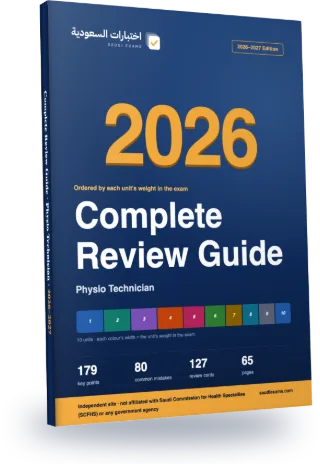
65-page · 179 key points · 80 common mistakes · 127 review cards
The first three chapters alone cover about 36% of the exam. Short on time? Start there.
About the question bank
Know your score before the SCFHS Physiotherapy Technician exam. We picked 553 questions across kinesiology, anatomy, physical agents, therapeutic exercise, neurorehabilitation, musculoskeletal rehab and more, so you see where you lose points before test day.
- 150 questions in 180 min, like the real test
- 553 questions covering the main scoring topics, with explanations
- 55% pass mark, with targeted practice on your weak spots
See the gap to your target score Practise the units costing you the most marks A full mock exam like the real one
Every option explained so you understand why
What you get
- 553questions in the bankPractise with the answer shown right away, or sit a full timed mock
- 10unitsSplit by the exam syllabus
- 127flashcardsTo lock in terms and definitions
- 179quick review pointsEach unit in a few key lines
Study material sample: Kinesiology, Biomechanics and Ergonomics
Summary
This unit is 8% of the exam, about 12 of the 150 questions. It has five sections: joint structure, arthrokinematics and the planes and axes of motion; levers, torque and forces; muscle action and types of contraction; posture and normal gait analysis; and ergonomics, body mechanics and manual handling. Most questions are applied. You name the plane and axis of a movement, the class of a lever, the type of contraction in a short clinical example, or the phase of gait. The exam rewards understanding the concept and applying it to a short case rather than memorizing isolated definitions.
What the exam focuses on · Common traps · Try the flashcards
What the exam focuses on
- The three cardinal planes (sagittal, frontal, transverse) and the axis perpendicular to each for any given movement.
- Osteokinematics (bone swing) versus arthrokinematics (roll, glide, spin inside the joint).
- Classifying first, second and third class levers by the position of the axis, effort and resistance.
Show 5 more
- Torque equals force times the perpendicular moment arm, and how it changes with joint angle.
- Isometric, concentric and eccentric contractions identified in movement examples.
- Agonist, antagonist, synergist and stabilizer roles in a movement.
- Gait cycle phases, stance versus swing, and muscle activity in each phase.
- Safe body mechanics for lifting and transfers and how to reduce load on the low back.
Common traps
- Mixing up plane and axis: flexion and extension occur in the sagittal plane around a frontal axis, while abduction and adduction occur in the frontal plane around a sagittal axis.
- Confusing roll and glide: for a convex surface moving on a concave one, glide is opposite to the bone movement; for a concave on a convex, glide is in the same direction.
- Thinking an eccentric contraction produces no force: the muscle generates tension while lengthening under a load that exceeds it, as in lowering slowly into a chair.
Show 5 more
- Confusing second and third class levers: in a second class lever the resistance lies between axis and effort; in a third class lever the effort lies between axis and resistance.
- Forgetting that torque depends on the perpendicular distance, not the length of the bone itself; torque is greatest when the force acts at 90 degrees to the segment.
- Mixing up stance and swing: stance is the period of foot contact with the ground and is the longer part of the cycle.
- Treating a bent back with straight legs as acceptable for light loads; safe lifting starts with bent knees and the load held close to the body.
- Confusing ergonomics with body mechanics: ergonomics adapts the workplace and tools to the worker, while body mechanics is how a person uses their own body.
Try the flashcards
Tap a card to see the answer
In which plane do flexion and extension occur, and around which axis?
The sagittal plane, around a frontal (side to side) axis.
Which plane contains internal and external rotation?
The transverse plane, around a vertical axis.
A convex surface moves on a concave one: which way does it glide?
Opposite to the direction of bone movement.
What is a first class lever?
The axis lies between effort and resistance, as with the head tilting on the spine.
Which lever class is most common in the body?
Third class, where the effort lies between the axis and the resistance.
What is the torque formula?
Torque = force × perpendicular moment arm.
What is an eccentric contraction?
The muscle produces tension while lengthening, as when lowering a load slowly.
What is an isometric contraction?
Tension with no change in muscle length and no joint movement.
Why you can trust these questions
- Published questions: 553. Read the explanations and references, and report any error from the question.
- Exam facts last checked against the organiser’s website: 2026-11-15. We check them again every three months and two weeks before each test.
- Found a mistake? Tap "Report an error" under any question in the practice area, or email us at support@saudiexams.com
- Independent website. Not affiliated with ETEC (Qiyas), the Financial Academy or any government body.
Update log
- 2026-11-15 Added the exam from the Physiotherapy Technician content guideline (150 questions, 3 hours, 55% pass mark) and the SCFHS classification exams page.
Full prep for this exam
All of this in one purchase.
- Full mock exam, same as the real one150 questions in 180 minutes. You get a total score and a score for every unit.
- Practice unit by unit553 questions, every option explained with its source. Starts with your weakest units.
- Complete Review Guide 2026–2027 (PDF)Ordered by each unit's weight in the exam. With lifetime access only.
Choose your access
Continue with your Google account and you go straight to the payment page.