Physio Technician Syllabus: 10 Sections and Their Weights
The ten Physiotherapy Technician exam sections with official weights, what each covers, how our 150-question mock exam splits them, and the official reference books.
- Questions and time
- 150 questions · 3 hours
- Pass mark
- 55%
- correct answers to pass (55%)
- 83 of 150
- Exam fee
- Paid to SCFHS online when you apply through Mumaris Plus; the amount is shown in your application
Start with 10 free questions to find what needs more work. No sign-up, with answer explanations.
Try 10 free questions and see your levelPut what you just read into practice
Start with 10 free questions to find what needs more work. No sign-up, with answer explanations.
Try 10 free questions and see your levelLast verified: 15 November 2026. Weights and content can change at any time, so check the SCFHS classification exams page and the Physiotherapy Technician content guideline (PDF) before you start studying. This is an independent site with no link to SCFHS, Prometric or Pearson VUE.
The SCFHS Physiotherapy Technician exam is one exam with ten sections. Four of them (anatomy and physiology, special populations, neurorehabilitation and musculoskeletal rehabilitation) are 12% each, which is 48% of the exam. Use this page to decide where to start.
Exam format at a glance
| Item | Details |
|---|---|
| Questions | 150 multiple-choice questions |
| Time | 3 hours |
| Pass mark | 55% |
| Question distribution | The actual split in each section may differ from the published weights by up to 5% either way |
| Exam language | SCFHS does not state it. The guideline and all its reference books are in English, so our questions are in English |
| Fee and dates | As SCFHS shows in your application through Mumaris Plus |
The ten sections and their weights
SCFHS publishes a weight for each section. The last column is the split we use in our full mock exams (150 questions): the official percentage times 150, which comes out as whole numbers and totals 150.
| Section | Official weight | Questions in our mock exam |
|---|---|---|
| 1. Kinesiology, Biomechanics and Ergonomics | 8% | 12 |
| 2. Anatomy and Physiology | 12% | 18 |
| 3. Clinical Decision Making and Differential Diagnosis | 8% | 12 |
| 4. Physical Agents (Electrotherapy and Hydrotherapy) | 10% | 15 |
| 5. Therapeutic Exercises and Techniques | 10% | 15 |
| 6. Physical Therapy in Special Population (OBGYN, Paediatrics, Geriatrics) | 12% | 18 |
| 7. Cardiopulmonary Physical Therapy | 8% | 12 |
| 8. Sports Physical Therapy | 8% | 12 |
| 9. Neurorehabilitation | 12% | 18 |
| 10. Musculoskeletal Rehabilitation | 12% | 18 |
| Total | 100% | 150 |
The four 12% sections are 72 of the 150 questions, the two 10% sections are 30, and the four 8% sections are 48. Our practice questions follow the same split and show your result in each section separately.
A note on detail: the SCFHS guideline lists only the ten sections, their weights and the reference list. It has no detailed topic list. The topic lists below are our own breakdown, built from the section names and the reference books SCFHS cites, and are not an official breakdown.
What to study first
Start with anatomy and physiology, because the other sections rest on it, then neurorehabilitation, musculoskeletal rehabilitation and special populations. After that come physical agents and therapeutic exercises, and the four 8% sections get a faster review. Take our free questions first: your result in each section shows where to begin.
Section 1: Kinesiology, Biomechanics and Ergonomics (8%, 12 questions)
- Joints and motion: joint structure, arthrokinematics, planes and axes of motion.
- Mechanics: levers, torque, forces and Newton's laws applied to the body.
- Muscle action: types of contraction, length-tension and agonist/antagonist roles.
- Posture and gait: posture and normal gait analysis.
- Ergonomics: body mechanics and manual handling of loads.
How to prepare: Start with the three lever classes and a body example of each, then the contraction types. Link each phase of the gait cycle to the muscles working in it, and sketch the cycle until you can repeat it from memory.
Section 2: Anatomy and Physiology (12%, 18 questions)
- Musculoskeletal system: bones, joints, muscles and their innervation.
- Nervous system: anatomy, function, dermatomes and reflexes.
- Heart and lungs: cardiovascular and respiratory anatomy and physiology.
- Tissue physiology: muscle, bone and connective tissue, and how they heal.
- Exercise physiology: energy systems and metabolism.
- Other systems: endocrine, renal, GI and skin basics relevant to rehabilitation.
How to prepare: This is one of the largest sections and every other section builds on it. Put each joint's muscles, nerves and actions in one table, memorise dermatomes and nerve roots and quiz yourself on them, and learn the stages of tissue healing in time order.
Section 3: Clinical Decision Making and Differential Diagnosis (8%, 12 questions)
- History and screening: subjective history, systems review and red flags.
- Objective examination: ROM, manual muscle testing, special tests and outcome measures.
- Differential diagnosis: referral and contraindications.
- Planning: goal setting, prognosis and plan of care (ICF framework).
- Professional practice: documentation, ethics, safety and evidence-based practice.
How to prepare: Questions here are scenarios: a patient is in front of you and you decide what to do first. Learn the red flags that mean referral or stopping treatment, practise the manual muscle testing grades, and review the ICF levels.
Section 4: Physical Agents (Electrotherapy and Hydrotherapy) (10%, 15 questions)
- Heat and cold: thermotherapy and cryotherapy.
- Deep heating: therapeutic ultrasound and shortwave diathermy.
- Electrical stimulation: TENS, interferential, NMES and others.
- Light: low-level laser, UV and other light therapy.
- Other agents: hydrotherapy, traction, compression and paraffin.
- Safety: indications, contraindications and dosage.
How to prepare: Build one table per agent: physiological effect, indications, contraindications, precautions. Contraindication questions come up often, so learn them specifically: what rules out heat, what rules out electrical stimulation, what rules out ultrasound.
Section 5: Therapeutic Exercises and Techniques (10%, 15 questions)
- Flexibility and motion: range of motion, stretching and joint mobilization.
- Strengthening: resistance, open and closed chain, isometric and isokinetic.
- Balance and fitness: proprioception, coordination and aerobic conditioning.
- Manual techniques: soft tissue mobilization, massage and PNF.
- Gait and transfers: gait training, assistive devices, transfers and positioning.
- Exercise prescription: FITT, progression and precautions.
How to prepare: Learn open versus closed chain and concentric versus eccentric work with an example of each. Practise assistive device questions: which cane or walker for which condition, and which gait pattern for which weight-bearing status.
Section 6: Physical Therapy in Special Population (OBGYN, Paediatrics, Geriatrics) (12%, 18 questions)
- Women's health: pregnancy, postpartum, pelvic floor and incontinence.
- Child development: reflexes and milestones.
- Paediatric conditions: cerebral palsy, DMD, spina bifida, torticollis and clubfoot.
- Older adults: falls, osteoporosis and frailty.
- Exercise prescription: older adults and chronic disease.
- Special groups: lymphedema, oncology, amputation and burns.
How to prepare: This is a wide section with three strands: women, children and older adults. Memorise the table of milestones and primitive reflexes with the ages they appear and fade, then give sessions to fall risk, osteoporosis and exercise in pregnancy.
Section 7: Cardiopulmonary Physical Therapy (8%, 12 questions)
- Cardiac rehabilitation: phases, exercise testing and ECG basics.
- Chronic lung disease: COPD, asthma and pulmonary rehabilitation.
- Chest assessment: auscultation and oxygen therapy.
- Airway clearance: breathing exercises and drainage positions.
- Critical care: mechanical ventilation and post-operative chest care.
How to prepare: Start with breath sounds and what each one means, then the drainage positions for each lung lobe. For cardiac rehab, learn the phases and the signs to stop exercise, and how to read pulse, blood pressure and oxygen saturation during effort.
Section 8: Sports Physical Therapy (8%, 12 questions)
- Common injuries: ligament, muscle, tendon and bone.
- Acute injury: PRICE/POLICE and the stages of tissue healing.
- Return to sport: criteria, conditioning and plyometrics.
- Prevention: taping, bracing and pre-participation screening.
- Emergencies: concussion, heat illness and sports emergencies.
How to prepare: Link each injury to its mechanism, grades and management at each stage. Learn the signs of concussion and heat illness and what to do at once, since these are quick-decision questions.
Section 9: Neurorehabilitation (12%, 18 questions)
- Stroke: motor recovery, tone, Bobath and task-oriented approaches.
- Spinal cord injury: levels, ASIA scale, autonomic dysreflexia and rehab goals.
- Degenerative disease: Parkinson disease, multiple sclerosis and ALS.
- Other conditions: traumatic brain injury, peripheral nerve injury and Guillain-Barre.
- Assessment: tone, reflexes, balance and outcome scales.
- Motor control: motor learning, vestibular and balance rehabilitation.
How to prepare: Start with stroke and spinal cord injury, which appear most. Learn the cord levels by what the patient can do at each one, the Ashworth tone scale, and stroke patterns by affected artery.
Section 10: Musculoskeletal Rehabilitation (12%, 18 questions)
- Spine: low back pain, cervical conditions, disc, stenosis and scoliosis.
- Upper limb: shoulder, elbow, wrist and hand.
- Lower limb: hip, knee, ankle and foot.
- After surgery: arthroplasty, ACL and fracture fixation.
- Joint disease: fractures, osteoarthritis and rheumatoid arthritis.
- Pain: pain science, chronic pain and soft tissue disorders.
How to prepare: Study by body region. For each region learn the common conditions, their special tests and the rehab plan. Do not skip post-operative protocols (knee, hip, ACL): the questions are practical and repeat.
Official reference list
SCFHS lists these nine books on page 3 of the content guideline as a study aid only. It states that the list does not imply endorsement of these references, and that exam questions are not necessarily taken from them.
- Thompson, Prevention Practice: A Physical Therapist's Guide to Health, Fitness and Wellness
- Kisner, Therapeutic Exercise: Foundations and Techniques
- Tidy's Physiotherapy
- Clayton's Electrotherapy and Actinotherapy
- Mohanty and Pattnaik, Physiotherapy Secrets
- Cameron, Physical Agents in Rehabilitation (2017)
- Neumann (working group), Musculoskeletal Rehabilitation
- Comfort and Abrahamson, Sports Rehabilitation and Injury Prevention
- Schuchmann, Physical Medicine and Rehabilitation
How it differs from the physiotherapy specialist exam
This is the technician exam: 150 questions, ten sections and a 55% pass mark. The physiotherapy specialist exam has its own content guideline, a 60% pass mark and its own page on our site. Do not study from the specialist guide for this exam.
How our practice follows this syllabus
Our questions are in English, as in the content guideline. The section split in our full mock exam is the one in the table above, and every practice set ends with your result in each section so you know where to start.
Finished reading? Try a set of questions
Start with 10 free questions to find your weakest units. Keep practising with the full question bank and mock exams from SAR 26.
Put the plan to work here
SAR 34 $9
One purchase · lifetime access · review guide included
- 553 questions, every option explained with its source
- Full mock exams: 150 questions in 180 minutes, like the real one
- Practice that starts with your weakest units, plus a review of your mistakes
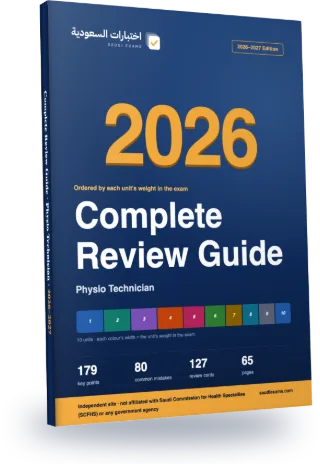 Complete Review Guide 2026–2027 included (PDF)Ordered by the weight of each unit in the examBuy now · SAR 34or 7 days for SAR 26
See everything included
Full mock exams like the real one and 553 explained questions that find your weak spots and train them
- Unlimited full mock exams to practise your pace and check your performance across the whole exam
- Practise 10 weak-area questions, starting where you lose the most marks
- 553 questions explaining why every option is right or wrong
- Arabic and English with one pass
- Unit notes and flashcards, then questions to check your understanding
This exam is part of professional classification as a physiotherapy technician, and you cannot get a practice licence without classification. If you do not pass you get further attempts under SCFHS rules and pay the evaluation fee. Source Last verified: 2026-11-15