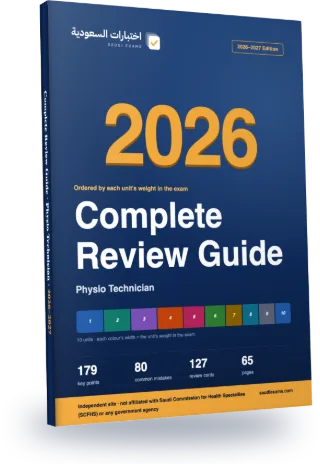
Physio Technician Complete Review Guide 2026–2027
Every exam topic in a 65-page Arabic PDF, ordered from the heaviest unit to the lightest. The first three chapters alone cover about 36% of the exam questions.
- 65Pages
- 179Key points
- 80Common mistakes
- 127Flashcards
Guide map
Each chapter is one exam unit, ordered by its weight in the real exam.
| Chapter | Unit | Weight | Exam questions | Key points |
|---|---|---|---|---|
| 1 | Anatomy and Physiology | 12% | 18 | 18 |
| 2 | Physical Therapy in Special Population (OBGYN, Paediatrics, Geriatrics) | 12% | 18 | 18 |
| 3 | Neurorehabilitation | 12% | 18 | 17 |
| 4 | Musculoskeletal Rehabilitation | 12% | 18 | 18 |
| 5 | Physical Agents (Electrotherapy and Hydrotherapy) | 10% | 15 | 18 |
| 6 | Therapeutic Exercises and Techniques | 10% | 15 | 18 |
| 7 | Kinesiology, Biomechanics and Ergonomics | 8% | 12 | 18 |
| 8 | Clinical Decision Making and Differential Diagnosis | 8% | 12 | 18 |
| 9 | Cardiopulmonary Physical Therapy | 8% | 12 | 18 |
| 10 | Sports Physical Therapy | 8% | 12 | 18 |
Chapter 1 in full: Anatomy and Physiology
12% of the exam, about 18 questions. These are its key points, as in the guide.
- (Musculoskeletal anatomy) The axillary nerve (C5-C6) supplies deltoid and teres minor, the musculocutaneous nerve supplies biceps brachii and brachialis, and the radial nerve supplies triceps and the wrist and finger extensors.
- (Musculoskeletal anatomy) The rotator cuff is supraspinatus, infraspinatus, teres minor and subscapularis (SITS). Supraspinatus starts abduction, infraspinatus and teres minor rotate the arm externally, and subscapularis rotates it internally.
- (Musculoskeletal anatomy) In the lower limb, the femoral nerve supplies quadriceps, the sciatic nerve supplies the hamstrings, and the common peroneal nerve supplies the ankle dorsiflexors, so its injury causes foot drop. Gluteus medius weakness (superior gluteal nerve) gives a positive Trendelenburg sign.
The rest of chapter 1, on this page
- (Nervous system) Roots linked to the tendon reflexes: biceps C5-C6, brachioradialis C6, triceps C7, patellar L3-L4, Achilles S1. Comparing the two sides is more useful than the absolute grade.
- (Nervous system) Dermatomes: C6 thumb, C7 middle finger, C8 little finger, L4 medial leg, L5 dorsum of the foot and great toe, S1 lateral foot.
- (Nervous system) An upper motor neuron lesion gives spasticity, hyperreflexia and a positive Babinski sign. A lower motor neuron lesion gives flaccidity, atrophy, fasciculations and reduced reflexes.
- (Cardiorespiratory) Blood flow: right atrium, tricuspid valve, right ventricle, pulmonary valve, lungs, left atrium, mitral valve, left ventricle, aortic valve, aorta. The SA node is the natural pacemaker.
- (Cardiorespiratory) Cardiac output = heart rate x stroke volume (HR x SV). Blood pressure depends on cardiac output and peripheral resistance, and the Frank-Starling law links greater filling to a stronger contraction.
- (Cardiorespiratory) The diaphragm is the main inspiratory muscle, supplied by the phrenic nerve (C3-C5). Quiet inspiration uses the diaphragm and external intercostals, and quiet expiration is passive. The right lung has three lobes and the left lung has two.
- (Tissue physiology and healing) Soft tissue healing has three overlapping phases: inflammation, proliferation, then remodeling. Type III collagen is laid down early and is later replaced by type I.
- (Tissue physiology and healing) Bone healing: hematoma, soft callus, hard callus, then remodeling. Wolff's law says bone adapts to the loads placed on it, and loses density when unloaded.
- (Tissue physiology and healing) Articular cartilage has no blood supply and heals slowly, and tendons and ligaments have a limited supply, so they need longer than muscle. Prolonged immobilization causes atrophy, contracture and loss of bone density.
- (Exercise physiology) Energy systems: the phosphagen system (ATP-PC) for very short, high-intensity effort, the anaerobic glycolytic system for high-intensity effort of moderate duration (it produces lactate), and the aerobic system for long, lower-intensity effort.
- (Exercise physiology) Aerobic training increases stroke volume, lowers resting heart rate and raises maximal oxygen uptake (VO2max). Resting oxygen use equals 1 MET. The Borg scale (RPE) rates perceived effort.
- (Endocrine, renal, GI, skin) Insulin lowers blood glucose and glucagon raises it. A patient with diabetes needs glucose checks before and after exercise, attention to hypoglycemia signs (shakiness, sweating, confusion) and foot care because of neuropathy.
- (Endocrine, renal, GI, skin) Chronic excess cortisol weakens muscle and causes osteoporosis. The thyroid regulates metabolic rate, and parathyroid hormone raises blood calcium.
- (Endocrine, renal, GI, skin) The kidneys filter blood, regulate fluid and blood pressure (renin), produce erythropoietin and activate vitamin D. In a dialysis patient, do not measure blood pressure on or press the fistula arm.
- (Endocrine, renal, GI, skin) The skin has three layers: epidermis, dermis and hypodermis. Pressure injuries appear over bony prominences, and sweating is the skin's main way of regulating temperature.
Common mistakes in this chapter
- Mixing up the axillary nerve (deltoid, teres minor) with the suprascapular nerve (supraspinatus, infraspinatus).
- Confusing the radial nerve (wrist drop), ulnar nerve (claw hand) and median nerve (ape hand, carpal tunnel syndrome).
- Treating hyperreflexia and spasticity as lower motor neuron signs. They point to an upper motor neuron lesion.
- Confusing the dorsal column pathway (proprioception, fine touch) with the spinothalamic pathway (pain, temperature), and where each one crosses.
- Believing quiet expiration needs active muscle contraction. At rest it is passive.
- Mixing up residual volume (not measured by spirometry alone) with vital capacity.
- Confusing fast-healing, well-vascularized tissue (muscle, bone) with poorly vascularized tissue (cartilage, tendon, ligament).
- Mixing up insulin (lowers blood glucose) and glucagon (raises it), and ignoring the risk of hypoglycemia during exercise.
The other chapters are in the full guide
One purchase · lifetime access · review guide included
7-day review plan
The chapters are spread over 6 days by weight so each day carries a similar load. Day 7 is a full exam.
Day 1 · 20% of the exam
Chapter 1: Anatomy and Physiology
Chapter 9: Cardiopulmonary Physical TherapyDay 2 · 20% of the exam
Chapter 2: Physical Therapy in Special Population (OBGYN, Paediatrics, Geriatrics)
Chapter 10: Sports Physical TherapyDay 3 · 12% of the exam
Chapter 3: Neurorehabilitation
Day 4 · 12% of the exam
Chapter 4: Musculoskeletal Rehabilitation
Day 5 · 18% of the exam
Chapter 5: Physical Agents (Electrotherapy and Hydrotherapy)
Chapter 7: Kinesiology, Biomechanics and ErgonomicsDay 6 · 18% of the exam
Chapter 6: Therapeutic Exercises and Techniques
Chapter 8: Clinical Decision Making and Differential DiagnosisDay 7
Full mock exam: 150 questions in 180 minutes, then review the common mistakes in the units where you lost marks.
How many correct answers do you need?
- Pass mark 55%83 correct out of 150
Before you read: see your score today
10 free questions from the main units, no sign-up. Then you know which chapter to start with.
Try 10 free questions and see your levelA look at each chapter
The first three key points of each chapter, as they appear in the guide (in Arabic in the PDF).
Chapter 1: Anatomy and Physiology
- (Musculoskeletal anatomy) The axillary nerve (C5-C6) supplies deltoid and teres minor, the musculocutaneous nerve…
- (Musculoskeletal anatomy) The rotator cuff is supraspinatus, infraspinatus, teres minor and subscapularis (SITS). Supraspinatus…
- (Musculoskeletal anatomy) In the lower limb, the femoral nerve supplies quadriceps, the sciatic nerve…
Chapter 2: Physical Therapy in Special Population (OBGYN, Paediatrics, Geriatrics)
- (Women's health) Relaxin raises ligament laxity in pregnancy, so joints, especially the pelvis and…
- (Women's health) Reasons to stop or avoid exercise in pregnancy include pre-eclampsia, persistent bleeding…
- (Women's health) Diastasis recti is checked postpartum, and loaded abdominal crunching is avoided until…
Chapter 3: Neurorehabilitation
- (Stroke) Recovery often starts with flaccidity, then spasticity and synergies appear, and isolated movement…
- (Stroke) Task-oriented training repeats real functional tasks such as sitting, standing and walking, and…
- (Stroke) The Bobath approach emphasises facilitating normal movement and modulating tone. Support the affected…
Chapter 4: Musculoskeletal Rehabilitation
- (Spine) Non-specific low back pain is the most common type, and core treatment rests…
- (Spine) Core stability exercise trains transversus abdominis and multifidus to work before and during…
- (Spine) In lumbar disc herniation, extension (McKenzie) usually eases symptoms in patients with an…
Chapter 5: Physical Agents (Electrotherapy and Hydrotherapy)
- (Thermotherapy and cryotherapy) Heat raises blood flow, metabolism and collagen extensibility, and reduces pain…
- (Thermotherapy and cryotherapy) Heat contraindications
- (Thermotherapy and cryotherapy) Cold causes vasoconstriction and lowers metabolism, oedema and nerve conduction velocity;…
Chapter 6: Therapeutic Exercises and Techniques
- (ROM, stretching and mobilization) PROM is moved by an outside force, AAROM has partial…
- (ROM, stretching and mobilization) Static stretching holds a position without bouncing and is the…
- (ROM, stretching and mobilization) Convex-concave rule
Chapter 7: Kinesiology, Biomechanics and Ergonomics
- (Joint structure and arthrokinematics) The sagittal plane divides the body into right and left…
- (Joint structure and arthrokinematics) Each movement occurs in a plane around an axis perpendicular…
- (Joint structure and arthrokinematics) The three basic accessory motions are roll, glide and spin…
Chapter 8: Clinical Decision Making and Differential Diagnosis
- (History and red flags) The history starts with the chief complaint, onset and mechanism…
- (History and red flags) The systems review screens for symptoms outside the musculoskeletal system…
- (History and red flags) Common red flags
Chapter 9: Cardiopulmonary Physical Therapy
- (Cardiac rehab
- (Cardiac rehab
- (Cardiac rehab
Chapter 10: Sports Physical Therapy
- (Common sports injuries) A sprain is a ligament injury; classic examples are lateral ankle…
- (Common sports injuries) A muscle strain often occurs in two-joint muscles contracting eccentrically, such…
- (Common sports injuries) Common tendinopathies include the Achilles tendon, patellar tendon (jumper's knee), rotator…
The full guide comes with lifetime access
The full guide (65 pages) is included with lifetime access to this exam, together with every question and full mock exam. Chapter 1 is free for everyone.
Questions about the guide
Is the guide free?
Chapter 1 is free to read on the guide page. The full guide comes with lifetime access to this exam; 7-day access does not include it.
Is it up to date for 2026–2027?
Yes. Unit weights and exam facts follow what the exam body last published, and the last check date is printed in the guide. If the standards change we update the file and buyers download the new version.
Does the guide have questions?
No. The guide covers key points and common mistakes; scoring, weak-area practice and full mock exams are on the site.
Can I read it on my phone?
Yes. A5 pages in a single column, with chapters linked from the contents.
- Pages
- 65
- Edition
- 1448 AH · 2026–2027
- Language
- Arabic
- Last updated
Full prep for this exam
All of this in one purchase.
- Full mock exam, same as the real one150 questions in 180 minutes. You get a total score and a score for every unit.
- Practice unit by unit553 questions, every option explained with its source. Starts with your weakest units.
- Complete Review Guide 2026–2027 (PDF)Ordered by each unit's weight in the exam. With lifetime access only.
Choose your access
Continue with your Google account and you go straight to the payment page.