Kangaroo Mawhiba Mathematics Competition – Grades 5–6
Kangaroo Mawhiba Mathematics Competition – Grades 5–6 — Number of questions: 30 questions. Exam time: 90 minutes. Pass mark: No pass mark; the score is out of 120 and gold, silver and bronze medals are awarded. Exam fee: SAR 60 guardian contribution. Source: King Abdulaziz & His Companions Foundation for Giftedness and Creativity (Mawhiba) (Last verified: 2026-11-16). Question bank: full mock exams of 30 questions in 90 minutes, like the real test with a result for every unit, plus 512 explained questions across 4 units, every option explained, a review of your mistakes, and two ways to practise: see the answer right away, or sit a full timed mock. Free questions: a 10-question diagnostic test covering the main units, no sign-up; at the end you get your score and your weakest units. With lifetime access: the Complete Review Guide, a 25-page PDF ordered by unit weight; chapter 1 is free to read on the guide page.
Last verified on the King Abdulaziz & His Companions Foundation for Giftedness and Creativity (Mawhiba) website: 16 November 2026
If you sat the exam today, what would you score?
10 free questions · no sign-up · your score as soon as you finish
Question 1 of 10
We call a 3-digit number nice if its middle digit is greater than the sum of its first and last digits. What is the largest possible number of consecutive nice 3-digit numbers?
All 10 free questions with answers and an explanation for every option
Where the questions come from
- Numbers and operations8 questions
- Geometry and measurement8 questions
- Logic and patterns7 questions
- Counting and word problems7 questions
Exam facts
- Exam language
- Arabic or English
- Number of questions
- 30 questions Source
- Exam time
- 90 minutes Source
- Pass mark
- No pass mark; the score is out of 120 and gold, silver and bronze medals are awarded Source
- Exam fee
- SAR 60 guardian contribution Source
- Registration
- For the 2026 edition registration opened on 2 February and closed on 7 April 2026. The 2027 registration dates have not been announced yet Source
- Results
- The score out of 120 is shown at the end of the test and results are announced officially (28 April in the 2026 edition); the medal table follows within two weeks of the competition Source
Last verified: 2026-11-16
Where other sources differ
- The questions come in Arabic and English together, and the test is taken remotely on an online platform, not in an exam hall. Under the service terms the student must be enrolled in a public school in the Kingdom.
- This is a competition, not a pass-or-fail test: there is no pass mark, and gold, silver and bronze medals are the prizes. The competition has not published the score needed for each medal, so we do not make up a number.
Exam body
King Abdulaziz & His Companions Foundation for Giftedness and Creativity (Mawhiba): Official website: King Abdulaziz & His Companions Foundation for Giftedness and Creativity (Mawhiba)
How to register
- Go to the Kangaroo Mawhiba website (kangarooksa.org) and sign in with your Mawhiba account.
- Check your profile details, especially your email and mobile number, because the login details for the question page are sent to them.
- Register for the competition through the service system and accept the terms and conditions.
- Pay the guardian contribution of SAR 60.
- On competition day, open the question page at your grade's time slot from a desktop or laptop computer; mobile phones and tablets are not allowed, and audio and video recording must be enabled during the test.
Study guides (3)
Frequently asked questions
How many questions are in Kangaroo for Grades 5–6 and how long is it?
30 questions in 90 minutes, each with five choices (A to E): ten worth 3 points, ten worth 4 and ten worth 5, 120 points in all. The questions appear in Arabic and English together. Our full mock exams use the same number of questions and the same time.
Can I try Kangaroo Math 5–6 questions for free?
Yes. Free questions: a 10-question diagnostic test covering the main units, no sign-up; at the end you get your score and your weakest units. The free practice test page lists the same questions with answers and an explanation for every option. The rest of the questions and the full mock exams come with a pass from SAR 26.
What makes this Kangaroo Math 5–6 question bank different?
Question bank: full mock exams of 30 questions in 90 minutes, like the real test with a result for every unit, plus 512 explained questions across 4 units, every option explained, a review of your mistakes, and two ways to practise: see the answer right away, or sit a full timed mock. Practice questions and explanations are ready to use on your phone. Try the free questions and read the explanations before you buy.
Is there a PDF review guide for Kangaroo Math 5–6?
Yes. "Kangaroo Math 5–6 Complete Review Guide 2026–2027" is a 25-page Arabic PDF: 4 units ordered from the heaviest in the exam to the lightest, each chapter with key points, common mistakes and review cards, plus a 7-day plan. Chapter 1 is free to read on the guide page; the full guide comes with lifetime access to this exam and is not part of 7-day access. The guide has no questions: scoring, practice and mock exams are on the site.
What score is needed?
There is no pass mark, because this is a competition. You see your score out of 120 at the end of the test, and gold, silver and bronze medals are awarded; the competition has not published the score needed for each medal. So we show your approximate score out of 120 today and the kind of question where you lose points, so you can focus your practice there.
Are there questions from previous papers?
Yes. The competition publishes each year's papers with solutions, and our bank includes the Grade 5–6 questions from 2020 to 2025, labelled as previous questions, with every choice explained. The rest are practice questions in the style and level of the competition.
When are registration and the competition, and what does it cost?
In the 2026 edition registration opened on 2 February and closed on 7 April, the Grade 5–6 competition took place on 18 April 2026, and results were announced on 28 April. The 2027 dates have not been announced yet. The contribution is SAR 60, paid by the guardian.
Is the mock exam score here the official score?
No. This is an independent website, not affiliated with Mawhiba, the Kangaroo competition or any government body, and its results are for practice only. Your result here is the share of questions you answered correctly, shown with the unit where you lose the most, so you see roughly where you stand today and what to practise.
Is this an official site, and how do I pay?
It is an independent site, not part of Qiyas, this exam's regulator or any government body, with practice questions and answer explanations. You pay once, with no automatic renewal, through Waffo Pancake (the merchant of record) by Visa, Mastercard, Apple Pay or Google Pay, and your statement shows "WAFFO". If you were charged twice or the pass did not open, email support@saudiexams.com.
Kangaroo Math 5–6 Complete Review Guide 2026–2027
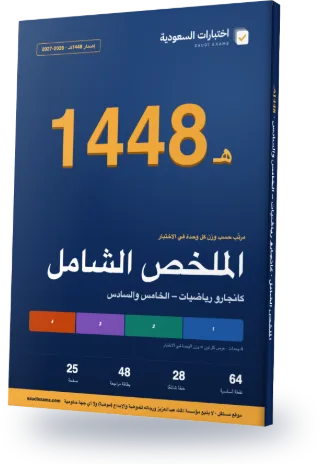
25-page · 64 key points · 28 common mistakes · 48 review cards
The first three chapters alone cover about 77% of the exam. Short on time? Start there.
About the question bank
Thirty questions in ninety minutes, 120 points in total. We picked 512 questions in the style of the competition, including questions from the previous Grade 5–6 papers, so you see how many points you would score today and which kind of question costs you points.
- 512 questions in the bank
- 30 questions in 90 min per mock
- 48 flashcards
Past exam questions with every option explained
What you get
- 512questions in the bankPractise with the answer shown right away, or sit a full timed mock
- 4unitsSplit by the exam syllabus
- 48flashcardsTo lock in terms and definitions
- 64quick review pointsEach unit in a few key lines
Study material sample: Numbers and operations
Summary
This unit covers numbers and the operations on them, with about 8 of the 30 questions in our set. This is an estimate based on sorting the questions of the 2020 to 2025 papers by type, not an official split, because the organiser does not publish a topic breakdown. It has four parts: arithmetic operations, their order and estimation; digits, place value and number properties; fractions, ratios and comparison; number puzzles and early algebra. The calculation is mostly simple. The difficulty is the idea behind the question: spotting a pattern, estimating cleverly, or testing the five choices. You need the times tables, divisibility rules, fractions over a common denominator, and the order of operations.
What the exam focuses on · Common traps · Try the flashcards
What the exam focuses on
- Order of operations: brackets first, then multiplication and division, then addition and subtraction from left to right.
- Estimate before you calculate: round the numbers to the nearest ten or hundred, then cross out choices far from the estimate.
- Divisibility rules: by 2 (even last digit), by 3 (digit sum), by 5 (last digit 0 or 5), by 9 (digit sum), by 4 (last two digits), by 10 (last digit 0).
Show 5 more
- Place value: in 4 072 the digit 4 is worth 4 000, and the zero holds the place and cannot be dropped.
- Comparing fractions: use a common denominator, convert to decimals, or compare each fraction with one half.
- A fraction of a number: divide by the denominator, then multiply by the numerator. For percentages: 10% is a tenth, 50% a half, 25% a quarter.
- Number puzzles: use a box or a letter for the unknown and write the equation, or work backwards from the result to the start.
- Testing the choices: with five choices, substitute each into the problem. This is often faster than solving directly.
Common traps
- Doing the operations strictly left to right and ignoring multiplication: 2 + 3 × 4 is 14, not 20.
- Forgetting that a zero inside a number holds a place: 3 005 is not 305, and subtracting from 1 000 needs careful borrowing.
- Mixing up "even" and "divisible by 4": every multiple of 4 is even, but not the other way round (6 is even and not divisible by 4).
Show 4 more
- Counting 1 as a prime: a prime has exactly two divisors, 1 has only one, and 2 is the only even prime.
- Comparing fractions by denominators alone: 1/8 is smaller than 1/5 although 8 is bigger than 5. With equal numerators, a bigger denominator means a smaller part.
- Adding numerators and denominators: 1/2 + 1/3 is not 2/5 but 5/6 after finding a common denominator.
- Taking the first matching choice without checking the rest, or missing that the question asks for the smallest or the one that is not true.
Try the flashcards
Tap a card to see the answer
What is 2 + 3 × 4?
14, because multiplication comes first: 3 × 4 = 12, then 2 + 12.
How do we know a number is divisible by 9?
If its digit sum is divisible by 9, as in 738: 7 + 3 + 8 = 18.
What is the rule for divisibility by 4?
Look at the last two digits: if they are divisible by 4 so is the whole number, as in 316 because 16 is.
Which is the only even prime?
The number 2. And 1 is not a prime.
Which is bigger: 3/5 or 4/7?
3/5, because 21/35 is bigger than 20/35 over a common denominator.
What is three quarters of 36?
27, because 36 ÷ 4 = 9, then 9 × 3.
How do we split 60 in the ratio 1 : 2 : 3?
The parts add to 6 and one part is 10, so the shares are 10, 20 and 30.
How do we solve: ? + 15 = 4 × 6?
Work out the right side, 24, then subtract 15, so the unknown is 9.
Why you can trust these questions
- Published questions: 512. Read the explanations and references, and report any error from the question.
- Exam facts last checked against the organiser’s website: 2026-11-16. We check them again every three months and two weeks before each test.
- Found a mistake? Tap "Report an error" under any question in the practice area, or email us at support@saudiexams.com
- Independent website. Not affiliated with ETEC (Qiyas), the Financial Academy or any government body.
Update log
- 2026-11-16 Added the competition and collected the 2020–2025 Grade 5–6 papers with explanations.
Full prep for this exam
All of this in one purchase.
- Full mock exam, same as the real one30 questions in 90 minutes. You get a total score and a score for every unit.
- Practice unit by unit512 questions, every option explained with its source. Starts with your weakest units.
- Complete Review Guide 2026–2027 (PDF)Ordered by each unit's weight in the exam. With lifetime access only.
Choose your access
Continue with your Google account and you go straight to the payment page.