Kangaroo Math 5–6 Study Plan: Measure, Fix, Measure Again
A three-step plan for Kangaroo Math Grades 5–6: 10 free questions to find your weakest unit, four weeks of practice, the last 3 days and competition day.
- Questions and time
- 30 questions · 90 minutes
- Pass mark
- No pass mark; the score is out of 120 and gold, silver and bronze medals are awarded
- Exam fee
- SAR 60 guardian contribution
Start with 10 free questions to find what needs more work. No sign-up, with answer explanations.
Try 10 free questions and see your levelPut what you just read into practice
Start with 10 free questions to find what needs more work. No sign-up, with answer explanations.
Try 10 free questions and see your levelLast verified: 16 November 2026. The duration and the points in this plan come from the competition page and the dates from the timeline. Everything else is our own general suggestion and not an official rule. This is an independent guide, not affiliated with Mawhiba, the organisers of the Kangaroo competition or any government body. The plan does not promise any score.
The plan has three steps: measure, fix the weakest area, then measure again. The competition has no pass mark, so your aim is to know your approximate score out of 120 today and which kind of question costs you points, then spend your remaining days where improvement is fastest. The units are explained in the syllabus guide, and sign-up is in the registration guide.
Step 1: Measure (day one)
Answer 10 free questions with no sign-up without help, then look at each unit: how many did you get right? The four units are numbers and operations, geometry and measurement, logic and patterns, and counting and word problems. Write down the two weakest units. They are the focus of the coming weeks.
Step 2: The four-week plan
This table is a suggestion for someone with about a month left. We suggest 25 to 30 minutes a day, five days a week, split like this: 5 minutes reviewing two mistakes from the mistakes notebook, 15 minutes solving timed questions and 10 minutes reading the explanation of what you got wrong.
| Week | Focus | What to do |
|---|---|---|
| 1 | The weakest unit | Practise only questions from the weakest unit, starting with the easier ones (3 points) until the basic ideas settle. Read the explanation of every wrong choice |
| 2 | The second weakest unit | Repeat the same method on the second unit, and at the end of the week redo 10 questions from week one's mistakes |
| 3 | The harder questions (4 and 5 points) | Pick 4-point and 5-point questions from each unit. The goal here is method, not speed: draw, try cases and rule out impossible choices |
| 4 | Measuring under time | Solve a full 30-question exam in 90 minutes once at the start of the week and once before the end, and compare the two scores out of 120 and the units that improved |
Step 3: Measure again
After the full exam, go back to the four units: which went up and which stayed weak? Give your last days to the unit that stayed weak and to the questions where you repeated the same mistake.
The last 3 days
- Three days before: one full timed exam, then review every mistake.
- Two days before: review only the mistakes notebook and do not start new topics.
- One day before: a light session, and try the computer, internet, camera and microphone, because the test is remote and requires audio and video recording. Then sleep early.
Competition day: how to split 90 minutes
The test is 30 questions in 90 minutes, which is three minutes per question on average. These are general suggestions and not official rules:
| Suggested time | What to do |
|---|---|
| About 25 minutes | Questions 1 to 10 (3 points): usually the easiest on the paper, so do not lose a point here through haste |
| About 30 minutes | Questions 11 to 20 (4 points) |
| About 25 minutes | Questions 21 to 30 (5 points): start with the ones you understand |
| Last 10 minutes | Go back to the questions you skipped, then check the ones you doubt |
- If you are stuck on a question for more than about three minutes, mark it and move on, and come back if time remains.
- Read the whole question, because wrong choices are designed for someone who read half of it.
- Rule out the choices that cannot be right before you choose.
- Keep a few minutes at the end to check your calculations.
The score you see on our site is an approximate practice score out of 120, not the official result.
Finished reading? Try a set of questions
Start with 10 free questions to find your weakest units. Keep practising with the full question bank and mock exams from SAR 26.
Put the plan to work here
SAR 34 $9
One purchase · lifetime access · review guide included
- 512 questions, every option explained with its source
- Full mock exams: 30 questions in 90 minutes, like the real one
- Practice that starts with your weakest units, plus a review of your mistakes
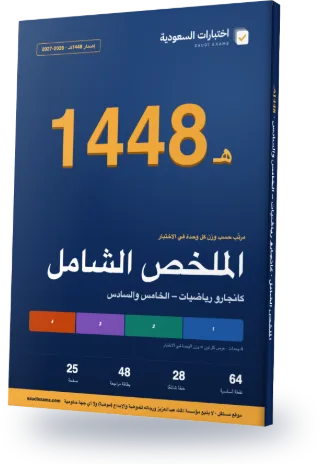 Complete Review Guide 2026–2027 included (PDF)Ordered by the weight of each unit in the examBuy now · SAR 34or 7 days for SAR 26
See everything included
Full mock exams like the real one and 512 explained questions that find your weak spots and train them
- Unlimited full mock exams to practise your pace and check your performance across the whole exam
- Practise 10 weak-area questions, starting where you lose the most marks
- 512 questions explaining why every option is right or wrong
- Arabic and English with one pass
- Unit notes and flashcards, then questions to check your understanding
Sources and references
- [object Object] kangarooksa.org
- [object Object] kangarooksa.org