Try the questions in the test above first, then open each one here to see the correct answer and why every other option is wrong.
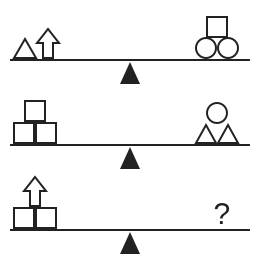
01Which of the following options will definitely balance the third scale if put in place of the question mark?
Past exam question Unit: Numbers and operations
A4 triangles and a square
With weights that fit the first two scales (square 3, triangle 4, circle 1, arrow 1) the arrow with two squares weighs 7 but this option weighs 19, so it does not always balance.
B3 triangles and a circle
With the same weights (square 3, triangle 4, circle 1, arrow 1) this option weighs 13 against 7, so it does not always balance.
C1 triangle and 3 circles ✓ Correct answer
From the second scale 3 squares = circle + 2 triangles, and from the first arrow + triangle = square + 2 circles, so arrow + 2 squares = triangle + 3 circles in every case.
D1 triangle and 4 squares
With weights square 3, triangle 4, circle 1, arrow 1 this option weighs 16 against 7, so it does not always balance.
E2 circles and a square
With weights square 3, triangle 4, circle 1, arrow 1 this option weighs 5 against 7, so it does not always balance.
Reference: Kangaroo Mawhiba Mathematics Competition 2020, Grades 5–6, question 24
02We call a 3-digit number nice if its middle digit is greater than the sum of its first and last digits. What is the largest possible number of consecutive nice 3-digit numbers?
Past exam question Unit: Numbers and operations
A5
Five consecutive nice numbers is possible, but a longer run exists: 190 to 197 are all nice.
B6
Six is possible, but a longer run exists: 190 to 197.
C7
Seven is possible, but there is a longer run: 190 to 197, eight numbers.
D8 ✓ Correct answer
A nice number cannot end in 8 or 9, because the middle digit is at most 9 while the sum is at least 9. So the longest run uses last digits 0 to 7, which is 8 numbers, for example 190 to 197.
E9
Nine consecutive numbers would include one ending in 8 or 9, which cannot be nice because the middle digit would not exceed the sum of the other two.
Reference: Kangaroo Mawhiba Mathematics Competition 2020, Grades 5–6, question 26
Ask a friend
03Ahmed has to play 15 games in a chess tournament. At some point he has won half of the games he has played, lost a third of them and drawn two. How many games does Ahmed still have to play?
Past exam question Unit: Numbers and operations
A2
If 2 games remained he would have played 13, a number that is not divisible by 2 or by 3.
B3 ✓ Correct answer
If he has played n games then n/2 + n/3 + 2 = n, so n/6 = 2 and n = 12, leaving 15 − 12 = 3 games.
C4
If 4 games remained he would have played 11, which is not divisible by 2 or by 3.
D5
If 5 games remained he would have played 10, which is not divisible by 3.
E6
If 6 games remained he would have played 9, which is not divisible by 2.
Reference: Kangaroo Mawhiba Mathematics Competition 2020, Grades 5–6, question 27
Ask a friend
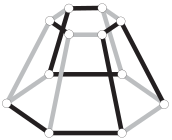
04What does the object in the picture look like when viewed from above?
Past exam question Unit: Geometry and measurement
A Figure A
In the model, the corner where two grey outer sticks meet has a black stick going to the inner hexagon; in this view that stick is grey.
B Figure B ✓ Correct answer
Turned round, this view matches the model stick for stick: the outer hexagon, the inner hexagon and the six sticks joining them all have the colours seen from above.
C Figure C
At the two neighbouring black outer sticks, the black joining stick should sit at the end of the one beside a grey inner stick; here it sits at the other end.
D Figure D
In the model, the black outer stick that stands alone lies beside a black stick of the inner hexagon; here it lies beside a grey one.
E Figure E
Here the black outer stick that stands alone lies beside a grey stick of the inner hexagon, but in the model it lies beside a black one.
Reference: Kangaroo Mawhiba Mathematics Competition 2020, Grades 5–6, question 21
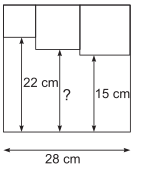
05Three small squares are drawn inside a larger square as shown. What is the length of the line marked with a question mark?
Past exam question Unit: Geometry and measurement
A17 cm
17 cm would mean the middle square has side 11 cm, making the three sides add to 6 + 11 + 13 = 30 instead of 28.
B17.5 cm
17.5 cm would mean a side of 10.5 cm and a total of 29.5 instead of 28.
C18 cm
18 cm would mean a side of 10 cm and a total of 29 instead of 28.
D18.5 cm
18.5 cm would mean a side of 9.5 cm and a total of 28.5 instead of 28.
E19 cm ✓ Correct answer
The third square has side 28 − 15 = 13 and the first 28 − 22 = 6, so the middle one is 28 − 6 − 13 = 9, and the required length is 28 − 9 = 19 cm.
Reference: Kangaroo Mawhiba Mathematics Competition 2020, Grades 5–6, question 22
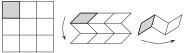
06Badr has a square sheet of paper divided into nine cells. He folds it in a zigzag at the two horizontal lines so that the first row is on top and the third at the bottom, then folds it at the two vertical lines in the same way, as shown, so that the grey cell ends on top. He wants to write the numbers 1 to 9 in the cells so that, once folded, the numbers run in increasing order from the top of the stack to the bottom, with 1 in the grey cell. In the grid, 1 is in the top-left cell, a is to its right, c is in the right cell of the middle row and b is in the middle cell of the bottom row. What numbers should he write instead of a, b and c?
Past exam question Unit: Geometry and measurement
Aa = 6, b = 4, c = 8 ✓ Correct answer
After folding, the stack runs: the first column (1, 2, 3 from top to bottom), then the middle column turned over (4 in the bottom row, 5 in the middle row, 6 in the top row), then the third column (7, 8, 9). So a = 6, b = 4, c = 8.
Ba = 4, b = 6, c = 8
Here a and b are swapped, but the top middle cell holds 6 and the bottom middle cell holds 4.
Ca = 5, b = 7, c = 9
These numbers from 5 to 9 do not fit the marked cells; the number 4 sits in the bottom middle cell.
Da = 4, b = 5, c = 7
Here a = 4 although the top middle cell holds 6, b = 5 although the bottom middle cell holds 4, and c = 7 although the middle-right cell holds 8.
Ea = 6, b = 4, c = 7
a and b are right, but 7 belongs in the top-right cell and the number in the c cell is 8.
Reference: Kangaroo Mawhiba Mathematics Competition 2020, Grades 5–6, question 28
07Ahmed, Badr, Khalid, David and Hashim are sitting at a round table. Ahmed is not next to Badr, David is next to Hashim and Badr is not next to David. Which two people are sitting next to Khalid?
Past exam question Unit: Logic and patterns
AAhmed and Badr ✓ Correct answer
Badr's neighbours must be Khalid and Hashim; after Hashim comes David, then Ahmed, so Khalid sits between Ahmed and Badr.
BBadr and David
If Khalid sat between Badr and David, Ahmed and Hashim would fill the other side, and since David must be next to Hashim, Ahmed would end up next to Badr, which the clues forbid.
CDavid and Hashim
David and Hashim are neighbours, so Khalid cannot also sit between them in a ring of five.
DHashim and Ahmed
If Khalid sat between Hashim and Ahmed, Badr and David would fill the other side, putting them next to each other, which the clues forbid (and David would no longer be next to Hashim).
EIt is not possible to be certain
The clues are enough: the only possible seating plan fixes Khalid's neighbours.
Reference: Kangaroo Mawhiba Mathematics Competition 2021, Grades 5–6, question 21
Ask a friend
08On a table there is a tower of blocks numbered 1 to 50, with 50 at the top. Iman builds a new tower: she takes the top two blocks and puts them on the table as the base of the new tower, keeping their order, and keeps taking the top two blocks of what remains and putting them on top of the new tower. So the new tower reads, from the bottom, 49 and 50, then 47 and 48, and so on up to 1 and 2 at the top. Which of the following pairs of numbers sits on adjacent blocks in the new tower?
Past exam question Unit: Logic and patterns
A29, 28
Block 28 touches blocks 27 and 25, and block 29 touches blocks 32 and 30, so they are not neighbours.
B34, 35
Block 34 touches blocks 33 and 31, and block 35 touches blocks 38 and 36, so they are not neighbours.
C29, 26
Block 29 touches blocks 32 and 30, and block 26 touches blocks 25 and 23, so they are not neighbours.
D31, 33
Each odd block touches two even blocks, so two odd numbers such as 31 and 33 can never sit next to each other.
E27, 30 ✓ Correct answer
Block 30 sits above block 29 and below block 27, because the block above an even n is n − 3, so 27 and 30 are neighbours.
Reference: Kangaroo Mawhiba Mathematics Competition 2023, Grades 5–6, question 25
Ask a friend
09An apple and an orange weigh as much as a pear and a peach. An apple and a pear weigh less than an orange and a peach, and a pear and an orange weigh less than an apple and a peach. Which of the pieces of fruit is the heaviest?
Past exam question Unit: Counting and word problems
AApple
The apple is lighter than the peach: the first two conditions together make the peach heavier than the apple.
BOrange
The orange equals pear + peach − apple, so it is lighter than the peach because the pear is lighter than the apple.
CPeach ✓ Correct answer
From the conditions: pear < apple < peach and orange < peach, so the peach is the heaviest.
DPear
The third condition makes the pear lighter than the apple, so it is the lightest, not the heaviest.
EImpossible to determine
The conditions are enough to find the heaviest, and it is the peach.
Reference: Kangaroo Mawhiba Mathematics Competition 2021, Grades 5–6, question 24
Ask a friend
10The four villages A, B, C and D lie along a road in that order, with 10 km between neighbouring villages. 10 students live in A, 20 in B, 30 in C and 40 in D. Where should the school be built so that the total distance travelled by all the students is as small as possible?
Past exam question Unit: Counting and word problems
AIn A
The total distance here is 20 × 10 + 30 × 20 + 40 × 30 = 2000 km, the largest of all.
BIn B
The total distance here is 10 × 10 + 30 × 10 + 40 × 20 = 1200 km.
CHalfway between B and C
The total distance here is 10 × 15 + 20 × 5 + 30 × 5 + 40 × 15 = 1000 km, which is more than 800.
DIn C ✓ Correct answer
The total distance at C is 10 × 20 + 20 × 10 + 40 × 10 = 800 km, the smallest of all the sites.
EIn D
The total distance here is 10 × 30 + 20 × 20 + 30 × 10 = 1000 km, which is more than 800.
Reference: Kangaroo Mawhiba Mathematics Competition 2022, Grades 5–6, question 28
Ask a friend