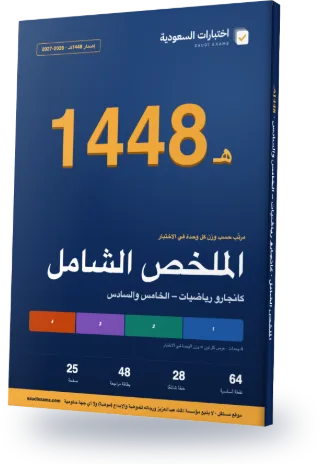
Kangaroo Math 5–6 Complete Review Guide 2026–2027
Every exam topic in a 25-page Arabic PDF, ordered from the heaviest unit to the lightest. The first three chapters alone cover about 77% of the exam questions.
- 25Pages
- 64Key points
- 28Common mistakes
- 48Flashcards
Guide map
Each chapter is one exam unit, ordered by its weight in the real exam.
| Chapter | Unit | Weight | Exam questions | Key points |
|---|---|---|---|---|
| 1 | Numbers and operations | 27% | 8 | 16 |
| 2 | Geometry and measurement | 27% | 8 | 16 |
| 3 | Logic and patterns | 23% | 7 | 16 |
| 4 | Counting and word problems | 23% | 7 | 16 |
Chapter 1 in full: Numbers and operations
27% of the exam, about 8 questions. These are its key points, as in the guide.
- (Arithmetic operations, their order and estimation) Multiply or divide before adding or subtracting, and brackets come before both: (8 − 2) × 3 = 18 while 8 − 2 × 3 = 2.
- (Arithmetic operations, their order and estimation) To estimate, round each number to one place: 398 × 21 is close to 400 × 20 = 8 000, enough to remove far-off choices.
- (Arithmetic operations, their order and estimation) Add by grouping complements of 10 or 100: 47 + 38 + 53 = (47 + 53) + 38 = 138.
The rest of chapter 1, on this page
- (Arithmetic operations, their order and estimation) To ease a product, split one factor: 25 × 16 = 25 × 4 × 4 = 100 × 4 = 400, and a number times 99 is the number times 100 minus the number once.
- (Digits, place value and number properties (even/odd, divisibility, primes)) A number is even if it ends in 0, 2, 4, 6 or 8, otherwise odd. Even + even = even, odd + odd = even, even + odd = odd.
- (Digits, place value and number properties (even/odd, divisibility, primes)) A number is divisible by 3 or 9 if its digit sum is: 4 725 has digit sum 18, so it is divisible by 9 and by 3.
- (Digits, place value and number properties (even/odd, divisibility, primes)) The first primes: 2, 3, 5, 7, 11, 13, 17, 19, 23. To factorise a number, divide it by the primes in order.
- (Digits, place value and number properties (even/odd, divisibility, primes)) To make the biggest or smallest number from given digits, order digits from the left; for the smallest, do not start with zero. In a four-digit number the thousands digit has the largest effect.
- (Fractions, ratios, percentages and comparison) To compare two fractions, use a common denominator: 3/4 and 5/6 become 9/12 and 10/12, so the second is bigger. Or compare each with one half or with one.
- (Fractions, ratios, percentages and comparison) A fraction of a number: three fifths of 40 is 40 ÷ 5 × 3 = 24. The remaining fraction is 1 minus the fraction taken.
- (Fractions, ratios, percentages and comparison) The ratio 2 : 3 means every 5 equal parts hold 2 of the first and 3 of the second. Divide the total by 5 to get one part.
- (Fractions, ratios, percentages and comparison) Useful equivalents: 50% = 1/2, 25% = 1/4, 75% = 3/4, 10% = 1/10, 20% = 1/5. For 15% of a number add 10% and 5%.
- (Number puzzles and early algebra) For a simple equation work backwards: if box × 3 + 4 = 22 then box = (22 − 4) ÷ 3 = 6.
- (Number puzzles and early algebra) In magic squares and grids every row, column and diagonal has the same sum; first complete a line missing only one cell.
- (Number puzzles and early algebra) In letter puzzles (each letter is a different digit) start from the cell with the fewest options: the units column of the sum, or a leading digit that cannot be zero.
- (Number puzzles and early algebra) If consecutive numbers are added, their average is the middle number: 7 + 8 + 9 + 10 + 11 = 5 × 9 = 45.
Common mistakes in this chapter
- Doing the operations strictly left to right and ignoring multiplication: 2 + 3 × 4 is 14, not 20.
- Forgetting that a zero inside a number holds a place: 3 005 is not 305, and subtracting from 1 000 needs careful borrowing.
- Mixing up "even" and "divisible by 4": every multiple of 4 is even, but not the other way round (6 is even and not divisible by 4).
- Counting 1 as a prime: a prime has exactly two divisors, 1 has only one, and 2 is the only even prime.
- Comparing fractions by denominators alone: 1/8 is smaller than 1/5 although 8 is bigger than 5. With equal numerators, a bigger denominator means a smaller part.
- Adding numerators and denominators: 1/2 + 1/3 is not 2/5 but 5/6 after finding a common denominator.
- Taking the first matching choice without checking the rest, or missing that the question asks for the smallest or the one that is not true.
The other chapters are in the full guide
One purchase · lifetime access · review guide included
7-day review plan
The chapters are spread over 6 days by weight so each day carries a similar load. Day 7 is a full exam.
Day 1 · 27% of the exam
Chapter 1: Numbers and operations
Day 2 · 27% of the exam
Chapter 2: Geometry and measurement
Day 3 · 23% of the exam
Chapter 3: Logic and patterns
Day 4 · 23% of the exam
Chapter 4: Counting and word problems
Day 5
Full mock exam: 30 questions in 90 minutes, then review the common mistakes in the units where you lost marks.
Before you read: see your score today
10 free questions from the main units, no sign-up. Then you know which chapter to start with.
Try 10 free questions and see your levelA look at each chapter
The first three key points of each chapter, as they appear in the guide (in Arabic in the PDF).
Chapter 1: Numbers and operations
- (Arithmetic operations, their order and estimation) Multiply or divide before adding or subtracting, and…
- (Arithmetic operations, their order and estimation) To estimate, round each number to one place…
- (Arithmetic operations, their order and estimation) Add by grouping complements of 10 or 100…
Chapter 2: Geometry and measurement
- (Plane shapes
- (Plane shapes
- (Plane shapes
Chapter 3: Logic and patterns
- (Logical deduction, truth-tellers and liars) A deduction table: names in rows, options in columns…
- (Logical deduction, truth-tellers and liars) To sort truth-tellers from liars, test each possible number…
- (Logical deduction, truth-tellers and liars) "If ... then ..." does not mean its reverse…
Chapter 4: Counting and word problems
- (Systematic counting and simple combinations) To count numbers built from certain digits, fix a…
- (Systematic counting and simple combinations) Handshakes among n people, once each: number = n…
- (Systematic counting and simple combinations) To count rectangles or squares in a grid figure…
The full guide comes with lifetime access
The full guide (25 pages) is included with lifetime access to this exam, together with every question and full mock exam. Chapter 1 is free for everyone.
Questions about the guide
Is the guide free?
Chapter 1 is free to read on the guide page. The full guide comes with lifetime access to this exam; 7-day access does not include it.
Is it up to date for 2026–2027?
Yes. Unit weights and exam facts follow what the exam body last published, and the last check date is printed in the guide. If the standards change we update the file and buyers download the new version.
Does the guide have questions?
No. The guide covers key points and common mistakes; scoring, weak-area practice and full mock exams are on the site.
Can I read it on my phone?
Yes. A5 pages in a single column, with chapters linked from the contents.
- Pages
- 25
- Edition
- 1448 AH · 2026–2027
- Language
- Arabic
- Last updated
All School Student Exams review guides
Back to Kangaroo Mawhiba Mathematics Competition – Grades 5–6
Full prep for this exam
All of this in one purchase.
- Full mock exam, same as the real one30 questions in 90 minutes. You get a total score and a score for every unit.
- Practice unit by unit512 questions, every option explained with its source. Starts with your weakest units.
- Complete Review Guide 2026–2027 (PDF)Ordered by each unit's weight in the exam. With lifetime access only.
Choose your access
Continue with your Google account and you go straight to the payment page.