EMT Basic Syllabus: 7 Sections and Their Weights
The seven sections of the SCFHS EMT Basic exam with official weights, what each covers, how our 150-question mock exam splits them, and the reference list.
- Questions and time
- 150 questions · 3 hours
- Pass mark
- 55%
- correct answers to pass (55%)
- 83 of 150
- Exam fee
- Paid to SCFHS online when you apply through Mumaris Plus; the amount is shown in your application
Start with 10 free questions to find what needs more work. No sign-up, with answer explanations.
Try 10 free questions and see your levelPut what you just read into practice
Start with 10 free questions to find what needs more work. No sign-up, with answer explanations.
Try 10 free questions and see your levelInformation last checked: 15 November 2026. Exam details can change, so check the SCFHS classification exams page and the official content guideline (PDF) before you start studying. This is an independent website. It has no connection with the Saudi Commission for Health Specialties (SCFHS), Prometric or any government body.
The Emergency Medical Technician Basic exam is a separate exam with its own content guideline. It has seven sections. Trauma is the largest at 25%, and Trauma, Preparatory and Patient assessment together carry 58%. Use the weights on this page to decide what to study first.
Exam format at a glance
| Item | Details |
|---|---|
| Questions | 150 multiple-choice questions |
| Time | 3 hours |
| Passing score | 55% |
| Language | English (the guideline and its reference books are in English; SCFHS does not state the exam language on the page we checked) |
SCFHS says the real distribution can differ by up to 5% in each category, and that percentages and content can change at any time. SCFHS has not published the exam fee amount or the dates for this exam on the pages we checked, so confirm them in your Mumaris Plus account.
The seven sections and their weights
The middle column is the official share. The last column is how many of the 150 questions each section gets in our mock exam, rounded from those percentages so the total is 150:
| Section | Official share | Questions in our mock exam |
|---|---|---|
| 1. Airway, Breathing and Cardiac (ABC) | 12% | 18 |
| 2. Infants and Children | 10% | 15 |
| 3. Medical/Behavioral Emergencies and Obstetrics/Gynecology | 14% | 21 |
| 4. Operations | 6% | 9 |
| 5. Patient assessment | 15% | 23 |
| 6. Preparatory | 18% | 27 |
| 7. Trauma | 25% | 37 |
| Total | 100% | 150 |
What each section covers
The official guideline lists only the seven section names and weights. It does not give a topic outline. The topics below are our own breakdown of what an EMT Basic course covers, and they are not an official list.
Section 1: Airway, Breathing and Cardiac (ABC) (12%)
- Airway anatomy, head-tilt and jaw-thrust maneuvers, oral and nasal airways, suction
- Oxygen delivery, bag-mask ventilation, basics of supraglottic airways, pulse oximetry
- Respiratory emergencies: asthma, COPD, pulmonary edema, pneumonia, choking
- Adult basic life support: high-quality CPR and using an AED
- Chest pain, acute coronary syndrome, heart failure, aspirin and nitroglycerin
- Special cardiac arrest situations: pregnancy, drowning, hypothermia and care after return of pulse
Section 2: Infants and Children (10%)
- Children's anatomy, physiology and vital signs, and the Pediatric Assessment Triangle
- Airway and breathing emergencies in children: croup, epiglottitis, bronchiolitis, foreign body
- Infant and child basic life support, compression ratios, PALS basics
- Resuscitation of the newborn and newborn care
- Seizures, fever, low blood sugar, shock and dehydration in children
- Child abuse, BRUE and SIDS, injuries in children, children with special needs
Section 3: Medical/Behavioral Emergencies and Obstetrics/Gynecology (14%)
- Diabetes, altered mental status, low and high blood sugar
- Stroke, seizures and fainting
- Anaphylaxis, poisoning, overdose and antidotes
- Environmental emergencies: heat, cold, drowning, bites and stings
- Acute abdomen, gastrointestinal, urinary and kidney emergencies, infectious diseases
- Behavioral emergencies, suicide risk and restraint
- Normal delivery and its complications, bleeding before and after birth, preeclampsia and eclampsia
- Gynecologic emergencies, sexual assault and the emergency medications an EMT gives
Section 4: Operations (6%)
- Ambulance operations, safe driving and transport
- Incident command, mass-casualty incidents and START triage
- Hazardous materials and scene safety
- Extrication, rescue and air medical transport
Section 5: Patient assessment (15%)
- Scene size-up, standard precautions and mechanism of injury
- Primary assessment, general impression, AVPU and GCS
- Taking a history: SAMPLE and OPQRST
- Secondary assessment, vital signs and monitoring devices
- Reassessment, priorities and the decision to transport
- Communication, the patient care report (PCR) and handoff
Section 6: Preparatory (18%)
- EMS systems, roles and quality improvement
- Legal issues: consent, refusal, DNR, scope of practice and confidentiality
- Ethics, duty to act and negligence
- Provider safety, infection control, protective equipment and stress
- Anatomy, physiology and medical terminology
- Lifting and moving patients, body mechanics and equipment
- Pharmacology basics and medication routes
- Life-span development and the older patient
Section 7: Trauma (25%)
- Bleeding, shock and tourniquet use
- Soft tissue injuries and burns
- Chest and abdominal injuries (pneumothorax, flail chest)
- Head and spine injuries and spinal motion restriction
- Bone and joint injuries and splinting
- Eye, face and neck injuries, amputation, crush and electrical injuries
- Trauma assessment, triage criteria and special groups (pregnant, child, older adult)
Official reference list
SCFHS lists these references on page 3 of the guideline as a study aid. It says the list does not imply endorsement and that exam questions are not necessarily taken from these sources.
- BLS (American Heart Association)
- Mosby's Paramedic Textbook
- Nancy Caroline's Emergency Care in the Streets (listed as "Nancy's emergency care on street")
- Foundations of Paramedic Care (listed as "Foundation of paramedic care")
- PALS and neonatal resuscitation
- First Aid for the OB/GYN Clerkship
- Critical Care Transport
- The AHA pregnancy cardiac arrest algorithm
- The Walls Manual of Emergency Airway Management
This is not the Paramedics Specialist exam
Do not mix this exam up with the SCFHS Paramedics Specialist exam. That one is a different exam with its own guideline and a 60% passing score. The Basic exam on this page has a 55% passing score and the seven sections above. If you are preparing for the Specialist level, use the content guideline for that exam.
How to use the weights
Start with Trauma (25%), Preparatory (18%) and Patient assessment (15%), which add up to 58% of the exam. Then cover Medical/Behavioral Emergencies and Obstetrics/Gynecology (14%), ABC (12%) and Infants and Children (10%). Operations is only 6%, so leave it for last, but do not skip it. Our practice questions follow the same split, and your result shows a percentage for each section.
Finished reading? Try a set of questions
Start with 10 free questions to find your weakest units. Keep practising with the full question bank and mock exams from SAR 26.
Put the plan to work here
SAR 34 $9
One purchase · lifetime access · review guide included
- 687 questions, every option explained with its source
- Full mock exams: 150 questions in 180 minutes, like the real one
- Practice that starts with your weakest units, plus a review of your mistakes
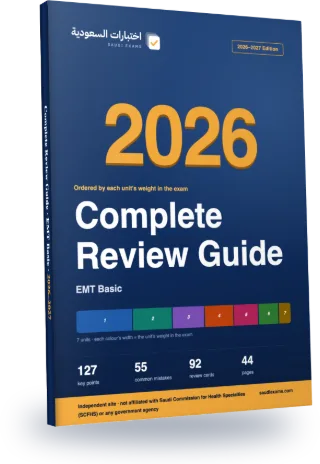 Complete Review Guide 2026–2027 included (PDF)Ordered by the weight of each unit in the examBuy now · SAR 34or 7 days for SAR 26
See everything included
Full mock exams like the real one and 687 explained questions that find your weak spots and train them
- Unlimited full mock exams to practise your pace and check your performance across the whole exam
- Practise 10 weak-area questions, starting where you lose the most marks
- 687 questions explaining why every option is right or wrong
- Arabic and English with one pass
- Unit notes and flashcards, then questions to check your understanding
This exam is part of professional classification as an emergency medical technician (basic), and you cannot get a practice licence without classification. If you do not pass you get further attempts under SCFHS rules and pay the evaluation fee. Source Last verified: 2026-11-15