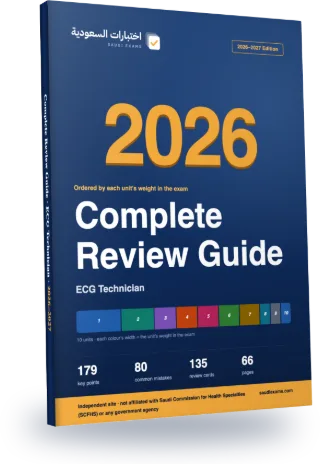
ECG Technician Complete Review Guide 2026–2027
Every exam topic in a 66-page Arabic PDF, ordered from the heaviest unit to the lightest. The first three chapters alone cover about 45% of the exam questions.
- 66Pages
- 179Key points
- 80Common mistakes
- 135Flashcards
Guide map
Each chapter is one exam unit, ordered by its weight in the real exam.
| Chapter | Unit | Weight | Exam questions | Key points |
|---|---|---|---|---|
| 1 | Basic Life Support | 20% | 30 | 18 |
| 2 | Technical aspect of 12 LEAD ECG | 15% | 22 | 18 |
| 3 | Cardiac Electro-physiology | 10% | 15 | 18 |
| 4 | Ischemic Heart Disease | 10% | 15 | 17 |
| 5 | Tachy-arrhythmias | 10% | 15 | 18 |
| 6 | Brady-arrhythmias | 10% | 15 | 18 |
| 7 | Pacemakers and Defibrillators | 10% | 15 | 18 |
| 8 | Cardiac Anatomy | 5% | 8 | 18 |
| 9 | Pharmacotherapy | 5% | 7 | 18 |
| 10 | Valvular Heart Disease | 5% | 8 | 18 |
Chapter 1 in full: Basic Life Support
20% of the exam, about 30 questions. These are its key points, as in the guide.
- (Chain of survival) First links: early recognition and calling for help, immediate CPR, then an AED as early as possible. Bystander CPR with an AED raises survival two to four times.
- (Chain of survival) After the heartbeat returns the patient is monitored in hospital, with care aimed at protecting organs, especially the brain. Naloxone is given when an opioid overdose is suspected.
- (Recognition) Check safety, then response by voice and touch, call for help, then assess breathing. Slow, laboured, panting or agonal breathing is abnormal.
The rest of chapter 1, on this page
- (Recognition) Seizure-like movements can occur at the start of cardiac arrest, so assess breathing once they stop. An athlete may show near-normal breathing early on. If in doubt, assume cardiac arrest.
- (Adult CPR) Hands on the lower half of the sternum, heel of one hand with the other on top and fingers interlocked, arms straight, shoulders directly over the chest.
- (Adult CPR) Depth 5 to 6 cm, rate 100 to 120 per minute, full recoil, fewest possible pauses, firm surface. Continue until help takes over, the person responds or the rescuer is exhausted.
- (Rescue breaths) 30 compressions then 2 breaths. Give just enough air to start the chest rising and avoid too much. If the chest will not rise after two attempts, think of a foreign body.
- (Rescue breaths) A rescuer who is untrained or unwilling gives continuous compressions without a pause. The risk of harm from CPR to someone not in arrest is low.
- (Child and infant BLS) Child is 1 to 12 years, infant up to 1 year, adolescent 13 to 18. Stimulate by voice and touch only, never painful stimuli.
- (Child and infant BLS) Open the airway with head tilt chin lift: neutral position in an infant, more tilt in a child, full extension in an adolescent. Assess breathing for no more than 10 seconds.
- (Child and infant BLS) Five initial breaths, each about 1 second and enough to raise the chest. For an infant the rescuer covers mouth and nose together.
- (Child and infant BLS) Compress the lower half of the sternum at every age, 100 to 120 per minute, at least one third of chest depth and no more than 6 cm. Infant: two thumbs encircling. Child: one or two hands.
- (Child and infant BLS) A lone rescuer calls and starts CPR before fetching an AED. With a second rescuer, that person brings the AED. In hospital a lone rescuer without a phone does CPR for 1 minute before seeking help.
- (AED and teamwork) Sequence: power on, attach pads, let the device analyse, stand clear, shock if advised, then compressions immediately. Keep compressing while pads are attached if more than one rescuer is present.
- (AED and teamwork) A fully automatic AED shocks by itself. A semi-automatic one waits for the rescuer to press the button. If a bra blocks pad placement, remove it.
- (AED and teamwork) Child AED: paediatric mode for under 25 kg (about 8 years), with antero-posterior pads. Larger children, or a device with no child instructions: adult mode.
- (Airway obstruction) Adult choking: ask whether the person is choking, encourage coughing, five back blows, five abdominal thrusts, alternating. After success the person is checked medically. In a child or infant, the sign is being unable to speak or cry.
- (Special situations) Drowning: five initial breaths with oxygen if available, then standard CPR. Pregnancy over 20 weeks: manual left uterine displacement. Hypothermia: check vital signs for up to 1 minute.
Common mistakes in this chapter
- Do not delay the call to check breathing. Call first, then assess breathing while waiting for an answer.
- Initial breaths in a child or infant are five, not two as in the adult ratio.
- Never go deeper than 6 cm at any age. Child depth is one third of chest diameter and an adolescent uses the adult depth (5 to 6 cm).
- Leaning on the chest between compressions is an error. Allow full recoil and keep pauses short.
- Do not move the patient from a bed to the floor just to start. Start on the bed and compress deeper if needed.
- Do not give back blows to someone coughing effectively, and do not use blind finger sweeps to remove a foreign body.
- For a child under 25 kg use antero-posterior pads and paediatric mode if available. Above that use adult mode.
- Do not stop CPR except for clear signs of life, AED instructions or handover to a professional team.
The other chapters are in the full guide
One purchase · lifetime access · review guide included
7-day review plan
The chapters are spread over 6 days by weight so each day carries a similar load. Day 7 is a full exam.
Day 1 · 20% of the exam
Chapter 1: Basic Life Support
Day 2 · 15% of the exam
Chapter 2: Technical aspect of 12 LEAD ECG
Day 3 · 20% of the exam
Chapter 3: Cardiac Electro-physiology
Chapter 7: Pacemakers and DefibrillatorsDay 4 · 15% of the exam
Chapter 4: Ischemic Heart Disease
Chapter 8: Cardiac AnatomyDay 5 · 15% of the exam
Chapter 5: Tachy-arrhythmias
Chapter 9: PharmacotherapyDay 6 · 15% of the exam
Chapter 6: Brady-arrhythmias
Chapter 10: Valvular Heart DiseaseDay 7
Full mock exam: 150 questions in 180 minutes, then review the common mistakes in the units where you lost marks.
How many correct answers do you need?
- Pass mark 55%83 correct out of 150
Before you read: see your score today
10 free questions from the main units, no sign-up. Then you know which chapter to start with.
Try 10 free questions and see your levelA look at each chapter
The first three key points of each chapter, as they appear in the guide (in Arabic in the PDF).
Chapter 1: Basic Life Support
- (Chain of survival) First links
- (Chain of survival) After the heartbeat returns the patient is monitored in hospital, with…
- (Recognition) Check safety, then response by voice and touch, call for help, then assess…
Chapter 2: Technical aspect of 12 LEAD ECG
- (Paper speed and calibration) Standard speed is 25 mm/s
- (Paper speed and calibration) At 50 mm/s a small square is 0.02 s and…
- (Paper speed and calibration) Standard calibration is 10 mm/mV (a pulse 5 mm wide…
Chapter 3: Cardiac Electro-physiology
- (Action potential) SA node cell
- (Action potential) Muscle cell
- (Action potential) The absolute refractory period is about 200 ms and the relative one…
Chapter 4: Ischemic Heart Disease
- (Acute coronary syndrome) Acute coronary syndrome includes STEMI, NSTEMI and unstable angina. The last…
- (Ischemia signs) Horizontal or downsloping ST ≥ 0.5 mm in 2 contiguous leads is…
- (Ischemia signs) Significant T inversion
Chapter 5: Tachy-arrhythmias
- (Sinus tachycardia) Sinus tachycardia is sinus rhythm above 100 bpm in adults; normal rates…
- (Premature beats) PAC
- (Premature beats) A blocked PAC is an abnormal P wave with no QRS after…
Chapter 6: Brady-arrhythmias
- (Sinus bradycardia) Rate below 60 bpm in adults; the normal range differs by age…
- (Sinus bradycardia) Causes include sleep, athletes, vagal stimulation (such as pain), inferior MI, hypothyroidism…
- (Sick sinus syndrome) Sinus node dysfunction; the commonest intrinsic cause is degenerative fibrosis, and…
Chapter 7: Pacemakers and Defibrillators
- (NBG code) Positions
- (NBG code) Parts of a pacemaker
- (Pacing modes) AAI paces and senses the atrium, used in sinus node dysfunction with…
Chapter 8: Cardiac Anatomy
- (Chambers, valves and septum) The heart has four chambers
- (Chambers, valves and septum) The right ventricle pumps low-oxygen blood into the pulmonary trunk…
- (Chambers, valves and septum) The tricuspid valve lies between the right atrium and right…
Chapter 9: Pharmacotherapy
- (Antiarrhythmic classes) Class Ia
- (Antiarrhythmic classes) Class III
- (Amiodarone) Used for ventricular arrhythmias and unstable tachycardia. Warnings: lung damage, liver damage, and…
Chapter 10: Valvular Heart Disease
- (Stenosis) Stenosis means the valve becomes rigid and may calcify, so the heart must…
- (Stenosis) Aortic stenosis is common in older adults
- (Stenosis) Mitral stenosis is the classic cause of left atrial enlargement, which makes the…
The full guide comes with lifetime access
The full guide (66 pages) is included with lifetime access to this exam, together with every question and full mock exam. Chapter 1 is free for everyone.
Questions about the guide
Is the guide free?
Chapter 1 is free to read on the guide page. The full guide comes with lifetime access to this exam; 7-day access does not include it.
Is it up to date for 2026–2027?
Yes. Unit weights and exam facts follow what the exam body last published, and the last check date is printed in the guide. If the standards change we update the file and buyers download the new version.
Does the guide have questions?
No. The guide covers key points and common mistakes; scoring, weak-area practice and full mock exams are on the site.
Can I read it on my phone?
Yes. A5 pages in a single column, with chapters linked from the contents.
- Pages
- 66
- Edition
- 1448 AH · 2026–2027
- Language
- Arabic
- Last updated
Full prep for this exam
All of this in one purchase.
- Full mock exam, same as the real one150 questions in 180 minutes. You get a total score and a score for every unit.
- Practice unit by unit562 questions, every option explained with its source. Starts with your weakest units.
- Complete Review Guide 2026–2027 (PDF)Ordered by each unit's weight in the exam. With lifetime access only.
Choose your access
Continue with your Google account and you go straight to the payment page.