Saudi Licensure Examination: Respiratory Therapy Technician
Saudi Licensure Examination: Respiratory Therapy Technician — Number of questions: 150 questions. Exam time: 180 minutes. Pass mark: 55%. Exam fee: Check the current fee when you apply for eligibility and book through the approved channels. Source: Saudi Commission for Health Specialties (Last verified: 2026-11-17). Question bank: full mock exams of 150 questions in 180 minutes, like the real test with a result for every unit, plus 577 explained questions across 11 units, every option explained, a review of your mistakes, and two ways to practise: see the answer right away, or sit a full timed mock. Free questions: a 10-question diagnostic test covering the main units, no sign-up; at the end we compare your score with the pass mark and show your weakest units. With lifetime access: the Complete Review Guide, a 98-page PDF ordered by unit weight; chapter 1 is free to read on the guide page.
Last verified on the Saudi Commission for Health Specialties website: 17 November 2026
If you sat the exam today, what would you score?
10 free questions · no sign-up · your score as soon as you finish
Question 1 of 10
A 24% Venturi mask is run at 2 L/min of oxygen and delivers a total gas flow of 51 L/min. How much room air is entrained each minute?
All 10 free questions with answers and an explanation for every option
Where the questions come from
- Patient Data12 questions
- Assessment and Evaluation23 questions
- Equipment Manipulation, Troubleshooting and Quality Control22 questions
- Therapeutic Procedures21 questions
- Airway Patency and Care18 questions
- Bronchial Hygiene Techniques9 questions
- Infection Control8 questions
- Mechanical Ventilation18 questions
- Pulmonary Rehabilitation and Home Care7 questions
- Patient Education4 questions
- Patient Safety8 questions
Exam facts
- Exam language
- English
- Number of questions
- 150 questions Source
- Exam time
- 180 minutes Source
- Pass mark
- 55% Source
- Exam fee
- Check the current fee when you apply for eligibility and book through the approved channels. Source
Last verified: 2026-11-17
Exam body
Saudi Commission for Health Specialties: Official website: Saudi Commission for Health Specialties
How to register
- Apply for eligibility on Mumaris+ at the Saudi Commission for Health Specialties with your respiratory therapy qualification (check the qualification requirement in your application).
- Once approved, you receive a scheduling permit.
- Book your appointment with Prometric inside the permitted window.
Study guides (3)
Frequently asked questions
How many questions are in the Respiratory Therapy Technician exam, and how long is it?
150 multiple-choice questions in 3 hours, according to the SCFHS content guideline.
Can I try Respiratory Therapy Technician (SCFHS) questions for free?
Yes. Free questions: a 10-question diagnostic test covering the main units, no sign-up; at the end we compare your score with the pass mark and show your weakest units. The free practice test page lists the same questions with answers and an explanation for every option. The rest of the questions and the full mock exams come with a pass from SAR 26.
What makes this Respiratory Therapy Technician (SCFHS) question bank different?
Question bank: full mock exams of 150 questions in 180 minutes, like the real test with a result for every unit, plus 577 explained questions across 11 units, every option explained, a review of your mistakes, and two ways to practise: see the answer right away, or sit a full timed mock. Practice questions and explanations are ready to use on your phone. Try the free questions and read the explanations before you buy.
Is there a PDF review guide for Respiratory Therapy Technician (SCFHS)?
Yes. "Respiratory Therapy Technician (SCFHS) Complete Review Guide 2026–2027" is a 98-page Arabic PDF: 11 units ordered from the heaviest in the exam to the lightest, each chapter with key points, common mistakes and review cards, plus a 7-day plan. Chapter 1 is free to read on the guide page; the full guide comes with lifetime access to this exam and is not part of 7-day access. The guide has no questions: scoring, practice and mock exams are on the site.
What is the passing score?
55%, according to the SCFHS content guideline.
Which sections does the exam cover?
Patient data 8%, assessment and evaluation 15%, equipment manipulation, troubleshooting and quality control 15%, therapeutic procedures 14%, airway patency and care 12%, bronchial hygiene 6%, infection control 5%, mechanical ventilation 12%, pulmonary rehabilitation and home care 5%, patient education 3% and patient safety 5%. Each share can differ by up to 5 percentage points.
How is this different from the Respiratory Therapy Specialist exam?
They are separate exams with their own content guidelines. The technician exam is 150 questions in 3 hours with a 55% pass mark; the specialist exam is longer and structured differently. Check your classification level with SCFHS.
Is this website affiliated with SCFHS?
No. This is an independent website, unaffiliated with SCFHS or any government agency. The questions are our own practice items, not actual exam questions.
What language is the exam in?
English. The content guideline does not state a language, so we follow the usual SCFHS practice of English-language health exams.
How much does the exam cost?
The content guideline does not publish a fee. Check the fee shown when you apply and book.
How do I register?
Apply for eligibility on Mumaris+ at the Saudi Commission for Health Specialties. After approval you receive a scheduling permit and book your appointment with Prometric.
Is this an official site, and how do I pay?
It is an independent site, not part of Qiyas, this exam's regulator or any government body, with practice questions and answer explanations. You pay once, with no automatic renewal, through Waffo Pancake (the merchant of record) by Visa, Mastercard, Apple Pay or Google Pay, and your statement shows "WAFFO". If you were charged twice or the pass did not open, email support@saudiexams.com.
Respiratory Therapy Technician (SCFHS) Complete Review Guide 2026–2027
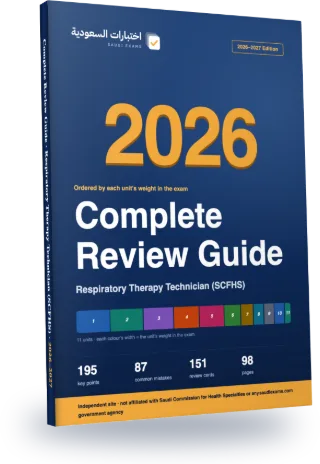
98-page · 195 key points · 87 common mistakes · 151 review cards
The first three chapters alone cover about 44% of the exam. Short on time? Start there.
About the question bank
Practise patient assessment, blood gases, oxygen therapy, airway care and mechanical ventilation with every option explained.
- 150 questions in 180 min, like the real test
- 577 questions covering the main scoring topics, with explanations
- 55% pass mark, with targeted practice on your weak spots
See the gap to your target score Practise the units costing you the most marks A full mock exam like the real one
Every option explained so you understand why
What you get
- 577questions in the bankPractise with the answer shown right away, or sit a full timed mock
- 11unitsSplit by the exam syllabus
- 151flashcardsTo lock in terms and definitions
- 195quick review pointsEach unit in a few key lines
Study material sample: Patient Data
Summary
Patient Data makes up about 12 of the 150 questions (8%). It covers what a respiratory therapist reads before and during care. Chart review and patient history: pack-years, exposures, red-flag symptoms, and the contraindications and labeling rules that decide whether a test goes ahead. Vital signs and physical findings: SpO2 as the fifth vital sign, target saturation ranges, monitoring frequency, and warning scores such as NEWS and qSOFA. Orders, labs and imaging data: reading blood gases (consistency check, anion gap, compensation, expected PaO2), oxygen transport, lactate and MAP. Most questions give a short case and ask what the data mean or what to do next.
What the exam focuses on · Common traps · Try the flashcards
What the exam focuses on
- Pack-years = packs per day x years smoked; more than 20 pack-years, recurrent chest infections or early-life events make spirometry worth considering for COPD case finding (GOLD 2025).
- Contraindication checks before a test: spirometry relative contraindications (for example eye surgery within 1 week), methacholine challenge (heart attack or stroke within 3 months), exercise testing (myocardial infarction within 4 weeks), bronchoscopy (no consent outside an emergency).
- Arterial puncture: modified Allen test, no puncture through or distal to a surgical shunt, and anticoagulation or coagulopathy as a relative contraindication.
Show 4 more
- Blood gas specimen handling: full name plus a second unique identifier on the label, and inspired oxygen or flow, body temperature and sample site documented with the result.
- BTS oxygen targets: 94-98% for most acutely ill patients, 88-92% for those at risk of hypercapnic respiratory failure; SpO2 is the fifth vital sign and a target range is prescribed at admission.
- ABG reading order: check consistency (modified Henderson), find the primary disorder, check compensation, calculate the anion gap, then judge oxygenation against the FiO2.
- Sepsis screening data: qSOFA uses respiratory rate, systolic pressure and mental status and is not a stand-alone screen; lactate is measured when sepsis is suspected; initial MAP target is 65 mm Hg.
Common traps
- Counting only years smoked: pack-years multiply daily packs by years, so 1.5 packs for 22 years is 33 pack-years, and quitting does not erase the history.
- Treating a normal SpO2 as proof of safety: carboxyhemoglobin can make oximetry look normal in carbon monoxide poisoning, and oximetry does not show PCO2 or pH.
- Confusing absolute and relative contraindications: anticoagulation is only a relative contraindication to arterial puncture, while a heart attack within 3 months is absolute for methacholine challenge.
Show 4 more
- Going ahead with a test on your own: when chart review finds a contraindication, the therapist notifies the ordering physician rather than deciding alone.
- Using the 94-98% target for every COPD patient: those at risk of hypercapnia get 88-92%, and a 24% Venturi mask at 2-3 L/min is used until blood gas results are known.
- Forgetting potassium in the anion gap: the normal range is 8 +/- 4 when K+ is omitted and 12 +/- 4 when it is included, so use the matching range.
- Reading oxygenation from PaO2 alone: judge it against the FiO2 (expected PaO2 is about five times the FiO2 in percent), and remember that anemia lowers oxygen content with a normal PaO2 and SpO2.
Try the flashcards
Tap a card to see the answer
How do you calculate pack-years?
Packs per day x years smoked. 1.5 packs x 22 years = 33 pack-years.
At what smoking history does GOLD say spirometry should be considered for early case finding?
More than 20 pack-years, or symptoms and risk factors such as recurrent chest infections.
A therapist finds a contraindication to a test during chart review. What is the action?
Do not proceed on your own; notify the ordering physician.
Which history item is an absolute contraindication to methacholine challenge?
Heart attack or stroke within the previous 3 months.
Which site is suitable for ABG in a dialysis patient with a left forearm fistula?
The other arm (for example right radial) after a normal modified Allen test.
What must a blood gas specimen label contain?
Full patient name plus another unique identifier, such as a medical record number.
What does BTS call SpO2?
The fifth vital sign.
What are the BTS target saturation ranges?
94-98% for most acutely ill patients; 88-92% for those at risk of hypercapnic respiratory failure.
Why you can trust these questions
- Published questions: 577. Read the explanations and references, and report any error from the question.
- Exam facts last checked against the organiser’s website: 2026-11-17. We check them again every three months and two weeks before each test.
- Found a mistake? Tap "Report an error" under any question in the practice area, or email us at support@saudiexams.com
- Independent website. Not affiliated with ETEC (Qiyas), the Financial Academy, ACAMS, the ACFE, Saudi Aramco or any government body.
Update log
- 2026-11-17 Added the Respiratory Therapy Technician question bank, course notes and syllabus guide.
Full prep for this exam
All of this in one purchase.
- Full mock exam, same as the real one150 questions in 180 minutes. You get a total score and a score for every unit.
- Practice unit by unit577 questions, every option explained with its source. Starts with your weakest units.
- Complete Review Guide 2026–2027 (PDF)Ordered by each unit's weight in the exam. With lifetime access only.
Choose your access
Continue with your Google account and you go straight to the payment page.