Respiratory Technician Syllabus: Sections and Weights
The 11 sections of the SCFHS Respiratory Therapy Technician exam, their weights and what each covers.
- Questions and time
- 150 questions · 180 minutes
- Pass mark
- 55%
- correct answers to pass (55%)
- 83 of 150
- Exam fee
- Check the current fee when you apply for eligibility and book through the approved channels.
Start with 10 free questions to find what needs more work. No sign-up, with answer explanations.
Try 10 free questions and see your levelPut what you just read into practice
Respiratory Therapy Technician (SCFHS)
Start with 10 free questions to find what needs more work. No sign-up, with answer explanations.
Try 10 free questions and see your levelLast checked: 17 November 2026. This is an independent guide. It is not affiliated with the Saudi Commission for Health Specialties or any government body. Details can change, so check the SCFHS website before relying on anything here.
Exam format
The Respiratory Therapy Technician exam has 150 multiple-choice questions and lasts 3 hours. The passing score is 55%. The content guideline says each section's share can differ by up to 5 percentage points, and that percentages and content can change at any time.
Section weights
| Section | Weight | Questions out of 150 |
|---|---|---|
| Patient Data | 8% | about 12 |
| Assessment and Evaluation | 15% | about 23 |
| Equipment Manipulation, Troubleshooting and Quality Control | 15% | about 22 |
| Therapeutic Procedures | 14% | about 21 |
| Airway Patency and Care | 12% | about 18 |
| Bronchial Hygiene Techniques | 6% | about 9 |
| Infection Control | 5% | about 8 |
| Mechanical Ventilation | 12% | about 18 |
| Pulmonary Rehabilitation and Home Care | 5% | about 7 |
| Patient Education | 3% | about 4 |
| Patient Safety | 5% | about 8 |
The question counts are our rounding of the published percentages so that they total 150.
What to study in each section
The SCFHS guideline does not list sub-topics under each section. The topics below are how our question bank groups each section, based on the section names. The guideline names reference books as study aids only, not as the source of the questions: Egan's Fundamentals of Respiratory Care, Pilbeam's Mechanical Ventilation and Wilkins' Clinical Assessment in Respiratory Care.
- Patient Data: Chart review and patient history; Vital signs and physical findings; Reading orders, labs and imaging data.
- Assessment and Evaluation: Physical assessment and auscultation; Arterial blood gas sampling and interpretation; Pulse oximetry and capnography; Pulmonary function testing; Chest radiograph basics.
- Equipment Manipulation, Troubleshooting and Quality Control: Oxygen delivery devices and gas supply; Humidification and aerosol generators; Ventilator and circuit checks, alarms; Blood gas analyzer and equipment quality control.
- Therapeutic Procedures: Oxygen therapy; Aerosolized medications and bronchodilators; Lung expansion therapy and CPAP/BiPAP; Asthma, COPD and emergency respiratory care.
- Airway Patency and Care: Airway positioning and adjuncts; Endotracheal intubation and extubation; Tracheostomy care; Suctioning and cuff management.
- Bronchial Hygiene Techniques: Postural drainage, percussion and vibration; Cough techniques, PEP and airway clearance devices.
- Infection Control: Standard and transmission-based precautions; Equipment disinfection and sterilization; Ventilator-associated pneumonia prevention.
- Mechanical Ventilation: Indications, modes and settings; Ventilator graphics, mechanics and alarms; ARDS and lung-protective ventilation; Weaning and extubation.
- Pulmonary Rehabilitation and Home Care: Pulmonary rehabilitation; Home oxygen and home ventilation.
- Patient Education: Inhaler technique and disease self-management; Smoking cessation and communication.
- Patient Safety: Oxygen, fire and gas cylinder safety; Basic and advanced life support; Hand hygiene, error prevention and ethics.
How to use the question bank
Start with the 10 free questions to see where you stand. Then work through your weakest section: Assessment and Evaluation and Equipment Manipulation are the largest (15% each), followed by Therapeutic Procedures (14%), then Airway Patency and Care and Mechanical Ventilation (12% each).
Finished reading? Try a set of questions
Start with 10 free questions to find your weakest units. Keep practising with the full question bank and mock exams from SAR 26.
Put the plan to work here
SAR 34 $9
One purchase · lifetime access · review guide included
- 577 questions, every option explained with its source
- Full mock exams: 150 questions in 180 minutes, like the real one
- Practice that starts with your weakest units, plus a review of your mistakes
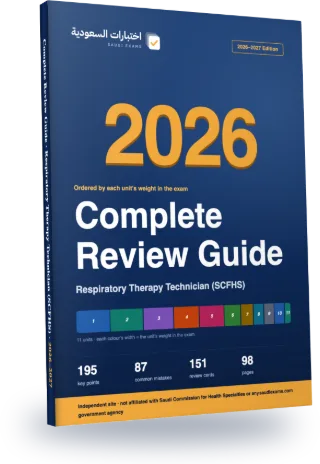 Complete Review Guide 2026–2027 included (PDF)Ordered by the weight of each unit in the examBuy now · SAR 34or 7 days for SAR 26
See everything included
Full mock exams like the real one and 577 explained questions that find your weak spots and train them
- Unlimited full mock exams to practise your pace and check your performance across the whole exam
- Practise 10 weak-area questions, starting where you lose the most marks
- 577 questions explaining why every option is right or wrong
- Arabic and English with one pass
- Unit notes and flashcards, then questions to check your understanding