SCFHS Midwifery Technician Exam
SCFHS Midwifery Technician Exam — Number of questions: 150 questions. Exam time: 3 hours. Pass mark: 55%. Calculator: The SCFHS content guideline does not say whether a calculator is allowed. Exam fee: Paid to SCFHS online when you apply through Mumaris Plus; the amount is shown in your application. Source: Saudi Commission for Health Specialties (SCFHS) (Last verified: 2026-11-17). Question bank: full mock exams of 150 questions in 180 minutes, like the real test with a result for every unit, plus 547 explained questions across 10 units, every option explained, a review of your mistakes, and two ways to practise: see the answer right away, or sit a full timed mock. Free questions: a 10-question diagnostic test covering the main units, no sign-up; at the end we compare your score with the pass mark and show your weakest units. With lifetime access: the Complete Review Guide, a 77-page PDF ordered by unit weight; chapter 1 is free to read on the guide page.
Last verified on the Saudi Commission for Health Specialties (SCFHS) website: 17 November 2026
If you sat the exam today, what would you score?
10 free questions · no sign-up · your score as soon as you finish
Question 1 of 10
A woman with chronic hypertension (blood pressure 160/105) and asthma has uterine atony. Oxytocin infusion is running but heavy bleeding continues. Which additional uterotonic is most suitable?
All 10 free questions with answers and an explanation for every option
Where the questions come from
- Antenatal Care8 questions
- Intrapartum Care60 questions
- Antepartum Care15 questions
- Postpartum Care22 questions
- Newborn Care7 questions
- Gynecological Care8 questions
- Pharmacology in Midwifery8 questions
- Counseling and Education7 questions
- Patient Safety8 questions
- Professionalism and Ethics7 questions
Exam facts
- Exam language
- English
- Number of questions
- 150 questions Source
- Exam time
- 3 hours Source
- Pass mark
- 55% Source
- Calculator
- The SCFHS content guideline does not say whether a calculator is allowed Source
- Exam fee
- Paid to SCFHS online when you apply through Mumaris Plus; the amount is shown in your application Source
- Registration
- Apply through the Professional Classification service in Mumaris Plus; SCFHS has not published a separate window calendar for the midwifery technician exam Source
- Retakes
- If you do not pass you get further attempts under SCFHS regulations and pay the evaluation fee Source
Last verified: 2026-11-17
Where other sources differ
- The pass mark is 55% for technicians in the content guideline. Section weights may differ by up to 5% in each category, and percentages and content can change at any time.
- Ten sections: intrapartum care 40%, postpartum care 15%, antepartum care 10%, and seven sections at 5% each: antenatal care, newborn care, gynecological care, pharmacology, counseling and education, patient safety, and professionalism and ethics.
Exam body
Saudi Commission for Health Specialties (SCFHS): Official website: Saudi Commission for Health Specialties (SCFHS)
How to register
- Choose the Professional Classification service in the Mumaris Plus system and submit your application with your certificate and documents.
- Once your application is accepted you are referred to an electronic written exam delivered through Prometric or Pearson VUE.
- Pay the evaluation fee shown in your application.
- Book your slot at a test centre through the booking service SCFHS opens in your application.
- On exam day bring your ID or passport and your booking confirmation.
Study guides (3)
Frequently asked questions
How many questions are there and how long is the exam?
150 multiple-choice questions in 3 hours, according to the SCFHS Midwifery Technician content guideline.
Can I try Midwifery Technician questions for free?
Yes. Free questions: a 10-question diagnostic test covering the main units, no sign-up; at the end we compare your score with the pass mark and show your weakest units. The free practice test page lists the same questions with answers and an explanation for every option. The rest of the questions and the full mock exams come with a pass from SAR 26.
What makes this Midwifery Technician question bank different?
Question bank: full mock exams of 150 questions in 180 minutes, like the real test with a result for every unit, plus 547 explained questions across 10 units, every option explained, a review of your mistakes, and two ways to practise: see the answer right away, or sit a full timed mock. Practice questions and explanations are ready to use on your phone. Try the free questions and read the explanations before you buy.
Is there a PDF review guide for Midwifery Technician?
Yes. "Midwifery Technician Complete Review Guide 2026–2027" is a 77-page Arabic PDF: 10 units ordered from the heaviest in the exam to the lightest, each chapter with key points, common mistakes and review cards, plus a 7-day plan. Chapter 1 is free to read on the guide page; the full guide comes with lifetime access to this exam and is not part of 7-day access. The guide has no questions: scoring, practice and mock exams are on the site.
What is the pass mark?
55% for technicians according to the guideline. On our site your result shows your percentage in each section so you can see where you lose points.
What language is the exam in?
SCFHS does not state the exam language explicitly, but the guideline and its reference books are in English, so our questions are in English and every option is explained in English.
Which sections does the exam cover?
Ten sections: intrapartum care (40%), postpartum care (15%), antepartum care (10%), and seven sections at 5% each: antenatal care, newborn care, gynecological care, pharmacology, counseling and education, patient safety, and professionalism and ethics.
How is it different from the midwifery specialist exam?
This is the technician exam: 150 questions, ten sections and a 55% pass mark. The midwifery specialist exam has its own content guideline with five sections and is on a separate page here.
Is this site part of SCFHS?
No. This is an independent exam preparation site with no link to SCFHS, Prometric or any government body. Always rely on what SCFHS announces.
Is this an official site, and how do I pay?
It is an independent site, not part of Qiyas, this exam's regulator or any government body, with practice questions and answer explanations. You pay once, with no automatic renewal, through Waffo Pancake (the merchant of record) by Visa, Mastercard, Apple Pay or Google Pay, and your statement shows "WAFFO". If you were charged twice or the pass did not open, email support@saudiexams.com.
Midwifery Technician Complete Review Guide 2026–2027
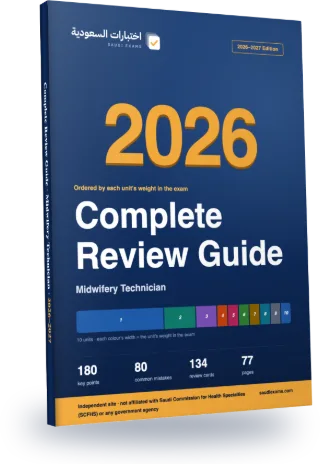
77-page · 180 key points · 80 common mistakes · 134 review cards
The first three chapters alone cover about 65% of the exam. Short on time? Start there.
About the question bank
Know your score before the SCFHS Midwifery Technician exam. We picked 547 questions across intrapartum, antenatal, postpartum and newborn care, pharmacology and patient safety, so you see where you lose points before test day.
- 150 questions in 180 min, like the real test
- 547 questions covering the main scoring topics, with explanations
- 55% pass mark, with targeted practice on your weak spots
See the gap to your target score Practise the units costing you the most marks A full mock exam like the real one
Every option explained so you understand why
What you get
- 547questions in the bankPractise with the answer shown right away, or sit a full timed mock
- 10unitsSplit by the exam syllabus
- 134flashcardsTo lock in terms and definitions
- 180quick review pointsEach unit in a few key lines
Study material sample: Antenatal Care
Summary
Antenatal Care covers routine care for a normal pregnancy and carries about 8 of the 150 questions (5% of the exam). It has four parts. Booking visit and routine screening covers the visit schedule, history, blood and urine tests, HIV and syphilis testing and early ultrasound. Physical examination covers fundal height, fetal growth and fetal movements. Nutrition, supplements and immunization covers iron and folic acid, calcium, tetanus toxoid and relief of common discomforts. Danger signs and birth preparedness covers when a woman must seek care at once and how to build a birth and emergency plan. Questions are short and practical: pick the right advice, the right dose or the right time.
What the exam focuses on · Common traps · Try the flashcards
What the exam focuses on
- WHO 2016 recommends antenatal care models with a minimum of eight contacts, and the first contact should be as early in pregnancy as possible.
- Daily oral iron and folic acid: 30 to 60 mg elemental iron plus 400 micrograms (0.4 mg) folic acid, to prevent maternal anaemia, puerperal sepsis, low birth weight and preterm birth.
- Folic acid should start as early as possible, ideally before conception, to prevent neural tube defects.
Show 5 more
- Screen every woman for pre-eclampsia (blood pressure and urine protein), anaemia, syphilis and HIV; test for syphilis and HIV at the first visit.
- One ultrasound scan before 24 weeks is recommended to estimate gestational age and detect fetal anomalies and multiple pregnancies.
- Tetanus toxoid depends on previous vaccination: an unknown status means TT1 now and TT2 at least 4 weeks later.
- Danger signs needing immediate care: vaginal bleeding, convulsions, severe headache with blurred vision, fever with weakness, severe abdominal pain, fast or difficult breathing.
- A birth and emergency plan is made at the first visit and reviewed at every follow-up visit: place of birth, transport, cost, companion and who looks after the home.
Common traps
- Daily fetal movement counting with kick charts is recommended by WHO 2016 only in the context of rigorous research, not as routine care.
- Routine antenatal cardiotocography and routine Doppler ultrasound are not recommended for healthy pregnant women.
- WHO 2016 says replacing abdominal palpation with symphysis-fundal height measurement is not recommended to improve perinatal outcomes, and a change from the usual local practice is not advised.
Show 5 more
- Vitamin A in pregnancy is only for areas where vitamin A deficiency is a severe public health problem, and its purpose is to prevent night blindness.
- Calcium supplementation of 1.5 to 2.0 g elemental calcium daily is for populations with low dietary calcium intake, to reduce pre-eclampsia risk, not for every woman.
- Do not mix up the PCPNC and WHO 2016 schedules: PCPNC (2015) lists 4 routine visits, while WHO 2016 recommends a minimum of 8 contacts.
- High-protein supplementation is not recommended in undernourished populations; balanced energy and protein supplementation is the option that is recommended.
- A woman with asymptomatic bacteriuria needs a seven-day antibiotic regimen, and midstream urine culture is the preferred test.
Try the flashcards
Tap a card to see the answer
What is the minimum number of antenatal contacts WHO 2016 recommends?
A minimum of eight contacts, to reduce perinatal mortality and improve women's experience of care.
What daily iron and folic acid dose does WHO 2016 recommend in pregnancy?
30 to 60 mg of elemental iron and 400 micrograms (0.4 mg) of folic acid.
When should folic acid be started?
As early as possible, ideally before conception, to prevent neural tube defects.
Is routine antenatal cardiotocography recommended?
No. WHO 2016 does not recommend it for pregnant women to improve maternal and perinatal outcomes.
How many ultrasound scans does WHO 2016 recommend, and when?
One scan before 24 weeks of gestation.
What is the WHO 2016 position on daily fetal movement counting with kick charts?
It is only recommended in the context of rigorous research.
Which test is preferred to diagnose anaemia in pregnancy?
Full blood count; if unavailable, a haemoglobinometer rather than the colour scale.
What treatment does a pregnant woman with asymptomatic bacteriuria need?
A seven-day antibiotic regimen; midstream urine culture is the preferred test.
Why you can trust these questions
- Published questions: 547. Read the explanations and references, and report any error from the question.
- Exam facts last checked against the organiser’s website: 2026-11-17. We check them again every three months and two weeks before each test.
- Found a mistake? Tap "Report an error" under any question in the practice area, or email us at support@saudiexams.com
- Independent website. Not affiliated with ETEC (Qiyas), the Financial Academy, ACAMS, the ACFE, Saudi Aramco or any government body.
Update log
- 2026-11-17 Added the exam from the Midwifery Technician content guideline (150 questions, 3 hours, 55% pass mark) and the SCFHS classification exams page.
Full prep for this exam
All of this in one purchase.
- Full mock exam, same as the real one150 questions in 180 minutes. You get a total score and a score for every unit.
- Practice unit by unit547 questions, every option explained with its source. Starts with your weakest units.
- Complete Review Guide 2026–2027 (PDF)Ordered by each unit's weight in the exam. With lifetime access only.
Choose your access
Continue with your Google account and you go straight to the payment page.