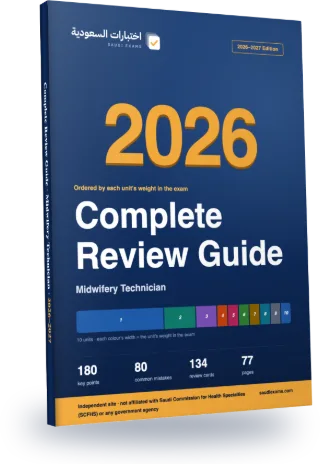
Midwifery Technician Complete Review Guide 2026–2027
Every exam topic in a 77-page Arabic PDF, ordered from the heaviest unit to the lightest. The first three chapters alone cover about 65% of the exam questions.
- 77Pages
- 180Key points
- 80Common mistakes
- 134Flashcards
Guide map
Each chapter is one exam unit, ordered by its weight in the real exam.
| Chapter | Unit | Weight | Exam questions | Key points |
|---|---|---|---|---|
| 1 | Intrapartum Care | 40% | 60 | 18 |
| 2 | Postpartum Care | 15% | 22 | 18 |
| 3 | Antepartum Care | 10% | 15 | 18 |
| 4 | Antenatal Care | 5% | 8 | 18 |
| 5 | Newborn Care | 5% | 7 | 18 |
| 6 | Gynecological Care | 5% | 8 | 18 |
| 7 | Pharmacology in Midwifery | 5% | 8 | 18 |
| 8 | Counseling and Education | 5% | 7 | 18 |
| 9 | Patient Safety | 5% | 8 | 18 |
| 10 | Professionalism and Ethics | 5% | 7 | 18 |
Chapter 1 in full: Intrapartum Care
40% of the exam, about 60 questions. These are its key points, as in the guide.
- (Physiology of labour, stages, fetal lie, presentation and mechanism of labour) WHO 2018: the latent first stage has painful contractions and slower dilatation up to 5 cm; the active first stage has regular painful contractions and faster dilatation from 5 cm to full dilatation.
- (Physiology of labour, stages, fetal lie, presentation and mechanism of labour) The second stage runs from full cervical dilatation to birth of the baby; it is usually completed within 3 hours in first labours and within 2 hours in later labours.
- (Admission assessment, vaginal examination and the partograph) On admission, assess fetal well-being by Doppler or Pinard auscultation. Routine admission CTG, clinical pelvimetry, pubic shaving and enema are not recommended for healthy women.
The rest of chapter 1, on this page
- (Admission assessment, vaginal examination and the partograph) For low-risk women, digital vaginal examination every 4 hours is recommended in active first stage. WHO 2018 does not recommend a 1 cm/hour alert line to identify women at risk.
- (Admission assessment, vaginal examination and the partograph) The WHO Labour Care Guide uses alert values: fetal heart rate below 110 or 160 and above, and contractions 2 or fewer or more than 5 per 10 minutes. Second stage alert is 3 hours or more in first labours and 2 hours or more in later labours.
- (Fetal heart monitoring and CTG interpretation) WHO intermittent auscultation protocol: every 15-30 minutes in active first stage and every 5 minutes in second stage, for at least 1 minute, during and for 30 seconds after a contraction.
- (Fetal heart monitoring and CTG interpretation) NICE: a stable baseline of 110-160 bpm with normal variability means usual care can continue; variability is usually 5-25 bpm, and absent variability is a very concerning feature.
- (Fetal heart monitoring and CTG interpretation) NICE acute bradycardia or a single prolonged deceleration of 3 minutes or more needs urgent obstetric review; expedite birth if the bradycardia persists for 9 minutes (sooner with significant risk factors).
- (Supportive care, positions and pain relief in labour) For low-risk women WHO 2018 recommends oral fluids and food, mobility and upright positions, and companionship. Relaxation techniques, massage and warm packs are recommended options on request.
- (Supportive care, positions and pain relief in labour) Epidural analgesia and parenteral opioids such as pethidine are recommended options on the woman's request, but pain relief is not given to prevent labour delay. With an epidural, pushing may be delayed 1-2 hours or until the urge returns where resources allow.
- (Second stage care, birth, perineal care and active management of the third stage) Second stage: the woman chooses her birth position and follows her own urge to push. Perineal massage, warm compresses and hands-on guarding reduce trauma; routine episiotomy and fundal pressure are not recommended.
- (Second stage care, birth, perineal care and active management of the third stage) Third stage prevention of PPH: oxytocin 10 IU IM/IV for all births; if oxytocin is unavailable use ergometrine, oxytocin plus ergometrine, or oral misoprostol 600 µg.
- (Second stage care, birth, perineal care and active management of the third stage) Delay cord clamping to not earlier than 1 minute after birth; keep the healthy newborn in skin-to-skin contact for the first hour; vitamin K 1 mg IM is given after that hour.
- (Induction, augmentation, prolonged labour, malpresentation and malposition) WHO induction advice: induce at 41 weeks or more, or with prelabour rupture of membranes at term. Oral misoprostol 25 µg 2-hourly or low-dose vaginal misoprostol 25 µg 6-hourly can be used, but misoprostol is not recommended after a previous caesarean.
- (Induction, augmentation, prolonged labour, malpresentation and malposition) Without prostaglandins, use IV oxytocin alone for induction; amniotomy alone is not recommended. External cephalic version for breech can be tried from 37 weeks when membranes are intact and there are no complications.
- (Obstetric emergencies: shoulder dystocia, cord prolapse, eclampsia, uterine rupture, haemorrhage) Eclampsia: magnesium sulfate IV regimen is a 4 g loading dose then 1 g/hour for 24 hours after birth or the last convulsion. Withhold if respiratory rate is under 16 per minute, patellar reflexes are absent or urine output is under 30 mL/hour; antidote is calcium gluconate 1 g IV slowly.
- (Obstetric emergencies: shoulder dystocia, cord prolapse, eclampsia, uterine rupture, haemorrhage) PPH is commonly defined as blood loss of 500 mL or more within 24 hours. Treatment includes uterine massage, and early IV tranexamic acid 1 g over 10 minutes within 3 hours of birth, repeated once after 30 minutes if bleeding continues.
- (Instrumental birth, caesarean birth and perioperative care) Give prophylactic antibiotics before skin incision for caesarean birth; do not shave pubic hair (trim if necessary). Routine antibiotics are not recommended after uncomplicated vaginal birth or vacuum birth.
Common mistakes in this chapter
- WHO 2018 starts active labour at 5 cm, but the WHO 2017 manual diagnoses a prolonged latent phase when the cervix is not dilated beyond 4 cm after 8 hours of regular contractions. Read which source or wording the question uses.
- A cervical dilatation rate slower than 1 cm/hour is not, by itself, an indication for intervention under WHO 2018; do not pick augmentation or caesarean on that alone.
- Sustained uterine massage is not recommended to prevent PPH in women who received oxytocin, but uterine massage is recommended for treating PPH.
- Second stage limits are different for first labours (3 hours) and later labours (2 hours); the usual active first stage limits (WHO 2018) are 12 hours and 10 hours.
- Fundal pressure is wrong in both shoulder dystocia and routine second stage care; suprapubic pressure is the correct manoeuvre.
- Ergometrine must not be given to women with pre-eclampsia or eclampsia; oxytocin is the first-choice uterotonic.
- Routine episiotomy, routine antibiotics after uncomplicated vaginal birth, and routine suctioning of a healthy newborn born through clear fluid are all not recommended.
- Vacuum use needs a vertex presentation, a fully dilated cervix and a head at 0 station or no more than 2/5 palpable above the symphysis; never use it for face or brow presentation.
The other chapters are in the full guide
One purchase · lifetime access · review guide included
7-day review plan
The chapters are spread over 6 days by weight so each day carries a similar load. Day 7 is a full exam.
Day 1 · 40% of the exam
Chapter 1: Intrapartum Care
Day 2 · 15% of the exam
Chapter 2: Postpartum Care
Day 3 · 15% of the exam
Chapter 3: Antepartum Care
Chapter 10: Professionalism and EthicsDay 4 · 10% of the exam
Chapter 4: Antenatal Care
Chapter 7: Pharmacology in MidwiferyDay 5 · 10% of the exam
Chapter 5: Newborn Care
Chapter 8: Counseling and EducationDay 6 · 10% of the exam
Chapter 6: Gynecological Care
Chapter 9: Patient SafetyDay 7
Full mock exam: 150 questions in 180 minutes, then review the common mistakes in the units where you lost marks.
How many correct answers do you need?
- Pass mark 55%83 correct out of 150
Before you read: see your score today
10 free questions from the main units, no sign-up. Then you know which chapter to start with.
Try 10 free questions and see your levelA look at each chapter
The first three key points of each chapter, as they appear in the guide (in Arabic in the PDF).
Chapter 1: Intrapartum Care
- (Physiology of labour, stages, fetal lie, presentation and mechanism of labour) WHO 2018: the…
- (Physiology of labour, stages, fetal lie, presentation and mechanism of labour) The second stage…
- (Admission assessment, vaginal examination and the partograph) On admission, assess fetal well-being by Doppler…
Chapter 2: Postpartum Care
- (Puerperal physiology) In the first 24 hours, regularly assess vaginal bleeding, uterine tonus, fundal…
- (Puerperal physiology) Measure blood pressure shortly after birth and repeat within 6 hours if…
- (Puerperal physiology) For perineal pain, local cooling such as ice packs can be offered…
Chapter 3: Antepartum Care
- (Pre-eclampsia and eclampsia) Gestational hypertension is two readings of 140–159 systolic and/or 90–109 diastolic…
- (Pre-eclampsia and eclampsia) Magnesium sulfate IM regimen (WHO 2017): 4 g of 20% solution…
- (Pre-eclampsia and eclampsia) Before each repeat magnesium sulfate dose, confirm respiratory rate of at…
Chapter 4: Antenatal Care
- (Booking visit, antenatal schedule, history and routine screening) WHO 2016 recommends antenatal care models…
- (Booking visit, antenatal schedule, history and routine screening) The PCPNC four-visit schedule is before…
- (Booking visit, antenatal schedule, history and routine screening) First-visit history covers last menstrual period…
Chapter 5: Newborn Care
- (Immediate newborn care, Apgar score and neonatal resuscitation) Immediate care after birth: dry the…
- (Immediate newborn care, Apgar score and neonatal resuscitation) Apgar or another standardised method is…
- (Immediate newborn care, Apgar score and neonatal resuscitation) If the baby is born through…
Chapter 6: Gynecological Care
- (Family planning and MEC) MEC Category 1 means no restriction on use; Category 2…
- (Family planning and MEC) MEC Category 3 means risks usually outweigh advantages, so the…
- (Family planning and MEC) With limited clinical resources, the four categories simplify to two…
Chapter 7: Pharmacology in Midwifery
- (Uterotonics and tocolytics) Oxytocin 10 IU IM or IV is the WHO-recommended uterotonic for…
- (Uterotonics and tocolytics) Where oxytocin is unavailable, WHO recommends ergometrine or methylergometrine, the oxytocin…
- (Uterotonics and tocolytics) For PPH treatment, oxytocin IV infusion of 20 units in 1…
Chapter 8: Counseling and Education
- (Counselling skills, communication and informed consent) Respect means valuing a woman's knowledge and decisions…
- (Counselling skills, communication and informed consent) Confidentiality means not discussing private issues where others…
- (Counselling skills, communication and informed consent) Forming an alliance, a partnership of trust with…
Chapter 9: Patient Safety
- (Hand hygiene) WHO's five moments are
- (Hand hygiene) WHO 2009 recommends alcohol-based handrub as the preferred means for routine hand…
- (Hand hygiene) Handrub technique
Chapter 10: Professionalism and Ethics
- (Ethical principles, confidentiality and informed consent) WHO 2018 defines respectful maternity care as care…
- (Ethical principles, confidentiality and informed consent) Components of respectful care named by women and…
- (Ethical principles, confidentiality and informed consent) Ask permission before undertaking an examination or test…
The full guide comes with lifetime access
The full guide (77 pages) is included with lifetime access to this exam, together with every question and full mock exam. Chapter 1 is free for everyone.
Questions about the guide
Is the guide free?
Chapter 1 is free to read on the guide page. The full guide comes with lifetime access to this exam; 7-day access does not include it.
Is it up to date for 2026–2027?
Yes. Unit weights and exam facts follow what the exam body last published, and the last check date is printed in the guide. If the standards change we update the file and buyers download the new version.
Does the guide have questions?
No. The guide covers key points and common mistakes; scoring, weak-area practice and full mock exams are on the site.
Can I read it on my phone?
Yes. A5 pages in a single column, with chapters linked from the contents.
- Pages
- 77
- Edition
- 1448 AH · 2026–2027
- Language
- Arabic
- Last updated
Full prep for this exam
All of this in one purchase.
- Full mock exam, same as the real one150 questions in 180 minutes. You get a total score and a score for every unit.
- Practice unit by unit547 questions, every option explained with its source. Starts with your weakest units.
- Complete Review Guide 2026–2027 (PDF)Ordered by each unit's weight in the exam. With lifetime access only.
Choose your access
Continue with your Google account and you go straight to the payment page.