CFE · CFE
Certified Fraud Examiner (CFE)
Certified Fraud Examiner (CFE) — Number of questions: 310 questions. Exam time: 390 minutes. Pass mark: 75%. Exam fee: Application fee US$480 (covers your first attempt at each section). Retake: US$110 per failed section. Rescheduling fees are paid to Prometric or ACFE. Source: ACFE (Association of Certified Fraud Examiners) (Last verified: 2026-11-17). Question bank: full mock exams of 310 questions in 390 minutes, like the real test with a result for every unit, plus 535 explained questions across 3 units, every option explained, a review of your mistakes, and two ways to practise: see the answer right away, or sit a full timed mock. Free questions: a 10-question diagnostic test covering the main units, no sign-up; at the end we compare your score with the pass mark and show your weakest units. With lifetime access: the Complete Review Guide, a 28-page PDF ordered by unit weight; chapter 1 is free to read on the guide page.
Last verified on the ACFE (Association of Certified Fraud Examiners) website: 17 November 2026
If you sat the exam today, what would you score?
10 free questions · no sign-up · your score as soon as you finish
Question 1 of 10
A sales vice president openly lets top performers pad expense reports, saying results matter more than paperwork. Staff soon conclude the rules do not apply to anyone who hits target, and several begin inflating claims. In the Report to the Nations classification of internal control weaknesses, which best describes the root cause?
All 10 free questions with answers and an explanation for every option
Where the questions come from
- Fraud Schemes and Financial Crimes120 questions
- Fraud Investigations and Legal Issues120 questions
- Fraud Prevention and Deterrence70 questions
Exam facts
- Exam code
- CFE · CFE
- Exam language
- English
- Number of questions
- 310 questions Source
- Exam time
- 390 minutes Source
- Pass mark
- 75% Source
- Exam fee
- Application fee US$480 (covers your first attempt at each section). Retake: US$110 per failed section. Rescheduling fees are paid to Prometric or ACFE. Source
- Registration
- ACFE Associate Membership and at least 40 eligibility points to sit the exam (50 points and two years of fraud-related professional experience to be certified). After your application is approved you activate eligibility and book each section through Prometric. Source
- Retakes
- Up to five attempts per section: no wait for the first three, 30 days for the fourth and fifth. A retake costs US$110 per failed section, with a new 60-day eligibility window. Source
- Validity
- Results are valid for five years from your last passed section. Passes in the old Financial Transactions and Fraud Schemes or Fraud Prevention and Deterrence sections carry over to the matching new section. Source
Last verified: 2026-11-17
Exam body
ACFE (Association of Certified Fraud Examiners): Official website: ACFE (Association of Certified Fraud Examiners)
How to register
- Check eligibility: ACFE Associate Membership and at least 40 eligibility points from education and fraud-related experience.
- Submit the CFE Exam Application in the ACFE certification portal and pay the US$480 fee, which covers your first attempt at each section.
- After approval, activate your eligibility: a 60-day window starts for scheduling and completing all three sections.
- Book each section as its own appointment through Prometric (online or at a test centre) and bring government photo ID that matches your account name.
Study guides (3)
Frequently asked questions
How many sections, questions and hours is the CFE exam?
Since 2 June 2026 it has three separate sections: Fraud Schemes and Financial Crimes (120 questions, 2.5 hours), Fraud Investigations and Legal Issues (120 questions, 2.5 hours) and Fraud Prevention and Deterrence (70 questions, 1.5 hours). It is closed-book and closed-notes, with multiple-choice and True/False questions.
Can I try CFE Fraud Examiner questions for free?
Yes. Free questions: a 10-question diagnostic test covering the main units, no sign-up; at the end we compare your score with the pass mark and show your weakest units. The free practice test page lists the same questions with answers and an explanation for every option. The rest of the questions and the full mock exams come with a pass from SAR 26.
What makes this CFE Fraud Examiner question bank different?
Question bank: full mock exams of 310 questions in 390 minutes, like the real test with a result for every unit, plus 535 explained questions across 3 units, every option explained, a review of your mistakes, and two ways to practise: see the answer right away, or sit a full timed mock. Practice questions and explanations are ready to use on your phone. Try the free questions and read the explanations before you buy.
Is there a PDF review guide for CFE Fraud Examiner?
Yes. "CFE Fraud Examiner Complete Review Guide 2026–2027" is a 28-page Arabic PDF: 3 units ordered from the heaviest in the exam to the lightest, each chapter with key points, common mistakes and review cards, plus a 7-day plan. Chapter 1 is free to read on the guide page; the full guide comes with lifetime access to this exam and is not part of 7-day access. The guide has no questions: scoring, practice and mock exams are on the site.
What is the passing score?
At least 75% of the questions in each section. Sections are scored separately, so a strong section does not make up for a weak one.
Is the old four-section exam still running?
No. ACFE retired the old version (Financial Transactions and Fraud Schemes, Law, Investigation, Fraud Prevention and Deterrence) and launched the new one on 2 June 2026; Law and Investigation were merged into one section. Our questions follow the new content outline (May 2026).
Is this site affiliated with ACFE?
No. This is an independent exam-prep site with no link to ACFE or any official body, and we do not use its logo. CFE and ACFE are trademarks of their owner, mentioned here only to describe the exam. Our questions are our own writing and do not reproduce live exam content or the Fraud Examiners Manual.
Is the CFE exam available in Arabic?
No. ACFE says the exam is English-only; translated key terms (including Arabic) come with its Fraud Examiners Manual and prep course. Our questions are therefore in English.
How much does the exam cost?
The application fee is US$480 and covers your first attempt at each section; a retake is US$110 per failed section. ACFE Associate Membership is required and paid separately.
Who can sit the exam?
Anyone with ACFE Associate Membership and at least 40 eligibility points from education and fraud-related experience whose application ACFE approves. To be certified you need 50 points and two years of professional experience.
Are these the real exam questions?
No. ACFE does not publish its exam questions and warns against materials claiming to hold actual content. Ours are practice questions written to the official content outline, with each answer explained and sourced. Your score here estimates where you are today and is not a promise of a pass.
Which country's law do the legal questions use?
The official outline centres on US law (for example the Foreign Corrupt Practices Act and the mail and wire fraud statutes), plus the UK Bribery Act and a comparison of common-law and civil-law systems. Every legal question here names the law or system it uses.
How do I know I am ready?
Start with the free questions to see where you stand, then practise your weakest section and move to the full mock exam. Because each section needs 75% on its own, watch your score in each section separately.
Is this an official site, and how do I pay?
It is an independent site, not part of Qiyas, this exam's regulator or any government body, with practice questions and answer explanations. You pay once, with no automatic renewal, through Waffo Pancake (the merchant of record) by Visa, Mastercard, Apple Pay or Google Pay, and your statement shows "WAFFO". If you were charged twice or the pass did not open, email support@saudiexams.com.
CFE Fraud Examiner Complete Review Guide 2026–2027
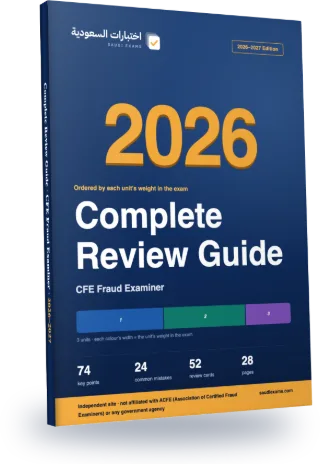
28-page · 74 key points · 24 common mistakes · 52 review cards
The first three chapters alone cover about 100% of the exam. Short on time? Start there.
About the question bank
An international exam in three separate sections, each with a 75% pass mark. Practise 535 explained questions across all three sections, with free questions and no sign-up.
- 310 questions in 390 min, like the real test
- 535 questions covering the main scoring topics, with explanations
- 75% pass mark, with targeted practice on your weak spots
See the gap to your target score Practise the units costing you the most marks A full mock exam like the real one
Every option explained so you understand why
What you get
- 535questions in the bankPractise with the answer shown right away, or sit a full timed mock
- 3unitsSplit by the exam syllabus
- 52flashcardsTo lock in terms and definitions
- 74quick review pointsEach unit in a few key lines
Study material sample: Fraud Schemes and Financial Crimes
Summary
Section 1 of the CFE exam, Fraud Schemes and Financial Crimes, has 120 questions, 38.7 percent of the 310-question exam, and is scored on its own. It covers 20 domains. The largest are Asset Misappropriation: Fraudulent Disbursements (15 questions, 13 percent) and Procurement Fraud (10, 8 percent), followed by Money Laundering (8). Corruption, Accounting Concepts, Payment Fraud and Cyberfraud have 7 each. Smaller domains are Financial Statement Fraud, Cash Receipts, Inventory and Other Assets, Data Theft, Identity Theft, Financial Institution Fraud, Securities Fraud, Insurance Fraud, Health Care Fraud, Consumer Fraud, Bankruptcy Fraud, Tax Fraud and Government Fraud. Legal topics are tested mainly under US law, with some UK Bribery Act material.
What the exam focuses on · Common traps · Try the flashcards
What the exam focuses on
- Classify disbursement schemes correctly: register, billing, payroll, check tampering and expense reimbursement branches.
- Tell skimming from cash larceny by whether the payment was recorded first.
- Know the bid-rigging patterns and the DOJ and FAR indicators of procurement collusion.
Show 5 more
- Know the Bank Secrecy Act basics: CTR threshold, structuring, SAR timing, beneficial ownership and the AML program pillars.
- Know the mental elements of the money laundering offenses in 18 U.S.C. §§ 1956 and 1957.
- Distinguish FCPA anti-bribery, facilitating payments and books and records from the UK Bribery Act.
- Match payment fraud rules to the right regime: Regulation E for debit cards and UCC Articles 3 and 4 for checks.
- Recognize financial statement fraud forms and ratio analysis that points to them.
Common traps
- Skimming happens before recording and cash larceny after it; do not swap them.
- A $10,000 cash deposit does not require a CTR; the rule applies to more than $10,000.
- Structuring is unlawful whatever the source of the cash; it needs intent to evade reporting.
Show 5 more
- Section 1957 needs knowledge of criminal derivation, not knowledge of which crime.
- The FCPA facilitating-payment exception is narrow, while the UK Bribery Act has no such exemption.
- Regulation E liability caps are $50 and $500 depending on timing; do not confuse them with credit card rules.
- Detected fraud understates real fraud: undetected and deterred cases are not counted.
- Indicators such as high bids or rising net worth are not proof of collusion or tax fraud without further evidence.
Try the flashcards
Tap a card to see the answer
What distinguishes skimming from cash larceny?
Skimming removes a payment before it is recorded, so books and deposits agree. Cash larceny removes cash after it has been recorded, which leaves a record trail.
Which scheme hides cash theft behind a void or refund entry on a register?
A register disbursements scheme. Because voids lower the register's expected cash, drawer counts balance, so voids must be tested independently against receipts.
Name the three branches of payroll schemes.
Ghost employee, falsified wages (such as unworked overtime) and commission schemes.
Name the four expense reimbursement scheme types.
Mischaracterized, overstated, fictitious and multiple reimbursements.
Which test best exposes a ghost employee?
Match payee bank accounts and addresses to HR files, and flag payees with no personnel record or shared accounts.
Which anti-fraud control was linked in the 2026 ACFE data to the largest drop in median fraud duration?
Surprise audits: about 8 months median duration with them against 16 months without.
What share of frauds were detected by tips in the 2026 ACFE Report to the Nations, and what is the implication?
43 percent. A reporting channel open to staff, vendors and customers is the most common route to detection.
What is the narrow FCPA facilitating-payment exception?
A small payment to speed routine governmental action the official must perform anyway. Duress payments and mislabeled bribes are different issues.
Why you can trust these questions
- Published questions: 535. Read the explanations and references, and report any error from the question.
- Exam facts last checked against the organiser’s website: 2026-11-17. We check them again every three months and two weeks before each test.
- Found a mistake? Tap "Report an error" under any question in the practice area, or email us at support@saudiexams.com
- Independent website. Not affiliated with ETEC (Qiyas), the Financial Academy, ACAMS, the ACFE, Saudi Aramco or any government body.
Update log
- 2026-11-17 First draft: the new three-section exam structure (launched 2 June 2026) and the official ACFE content outline (May 2026), with a question bank under review.
Full prep for this exam
All of this in one purchase.
- Full mock exam, same as the real one310 questions in 390 minutes. You get a total score and a score for every unit.
- Practice unit by unit535 questions, every option explained with its source. Starts with your weakest units.
- Complete Review Guide 2026–2027 (PDF)Ordered by each unit's weight in the exam. With lifetime access only.
Choose your access
Continue with your Google account and you go straight to the payment page.