CFE · CFE
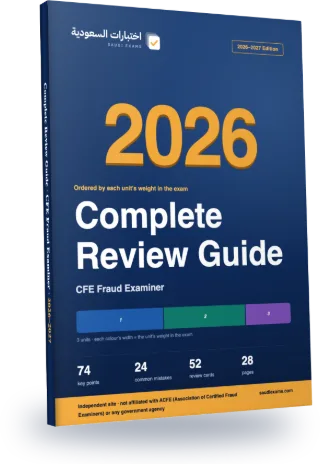
CFE Fraud Examiner Complete Review Guide 2026–2027
Every exam topic in a 28-page Arabic PDF, ordered from the heaviest unit to the lightest. The first three chapters alone cover about 100% of the exam questions.
- 28Pages
- 74Key points
- 24Common mistakes
- 52Flashcards
Guide map
Each chapter is one exam unit, ordered by its weight in the real exam.
| Chapter | Unit | Weight | Exam questions | Key points |
|---|---|---|---|---|
| 1 | Fraud Schemes and Financial Crimes | 39% | 120 | 30 |
| 2 | Fraud Investigations and Legal Issues | 39% | 120 | 26 |
| 3 | Fraud Prevention and Deterrence | 23% | 70 | 18 |
Chapter 1 in full: Fraud Schemes and Financial Crimes
39% of the exam, about 120 questions. These are its key points, as in the guide.
- (Accounting Concepts) Under US GAAP, assets stay at original cost even when market value rises; marketable stocks and bonds are the recognized exception and may be carried at fair value. The cost principle and the matching principle are the two ideas examiners meet most often.
- (Financial Statement Fraud) The ACFE Occupational Fraud 2026 report finds financial statement fraud the least common of the three main occupational categories but the costliest, with a median loss of $1,000,000. Typical forms: timing of revenue, hidden liabilities and expenses, improper disclosures.
- (Asset Misappropriation: Cash Receipts) Skimming takes a payment before it is recorded, so books and deposits still agree. Cash larceny takes money after it has been recorded, which leaves a trace in the records. Skimming appeared more often in organizations with fewer than 100 employees.
The rest of chapter 1, on this page
- (Asset Misappropriation: Cash Receipts) Controls for cash receipts: separate opening mail, recording, depositing and reconciling among different people, and use mandatory vacations or rotation so a colleague handles the records. Separation of duties reduces perceived opportunity, one side of the fraud triangle.
- (Asset Misappropriation: Fraudulent Disbursements) A register disbursement scheme hides cash theft behind a false void or refund entry. Because voids lower the register's expected cash, drawer counts still balance; test voids against receipts and require supervisor approval from someone outside cash custody.
- (Asset Misappropriation: Fraudulent Disbursements) Billing schemes include invoices from an employee-created shell company and invoices for personal purchases. Detection analytics match vendor addresses and bank accounts against employee records; the control fix is to split vendor setup, invoice approval and payment release among different people.
- (Asset Misappropriation: Fraudulent Disbursements) Payroll schemes have three branches: ghost employee (a nonexistent worker is paid), falsified wages (for example unworked overtime), and commission schemes (inflated or fake sales). Matching payee bank details and addresses to HR files exposes ghost employees.
- (Asset Misappropriation: Fraudulent Disbursements) Expense reimbursement schemes are mischaracterized (a real personal cost called business), overstated (a genuine cost inflated), fictitious (nonexistent items) and multiple reimbursements (one cost paid twice). Look for repeated receipt numbers or identical date, vendor and amount across claims.
- (Asset Misappropriation: Inventory and Other Assets) ISA 240 lists compact, valuable goods in strong demand as high theft risk. Responses include opening sampled cartons during the count, examining support for reductions to perpetual records, and separating custody from record keeping.
- (Corruption) Corruption means using a business position against the employer's interest for an indirect benefit; an invoice kickback is bribery. Under 18 U.S.C. § 201(c), an illegal gratuity is given for or because of an official act.
- (Corruption) The FCPA's facilitating-payment exception is narrow: small payments to speed routine governmental action the official must perform anyway. Payments made under imminent threat to safety lack corrupt intent. Mislabeling a bribe as a facilitation fee still breaches the books and records provision.
- (Theft of Data and Intellectual Property) 18 U.S.C. § 1832 needs intent to convert a trade secret to another's benefit and to injure the owner; § 1831 applies when a foreign government or agent benefits. An organization's § 1832 fine is the greater of $5 million or three times the value.
- (Identity Theft) Under 18 U.S.C. § 1028(a)(7), knowingly possessing another person's means of identification with intent to commit unlawful activity is an offense even before any account is opened. Aggravated identity theft under § 1028A adds a two-year term served consecutively to the underlying felony.
- (Financial Institution Fraud) FinCEN mortgage-fraud red flags include liability fraud (debts omitted from an application), straw borrowers, appraisal fraud and advance-fee foreclosure rescue scams. Weigh each flag with other facts, do further due diligence, then decide on a SAR. 18 U.S.C. § 1344 covers bank fraud.
- (Money Laundering) Structuring means splitting cash into smaller amounts, at one or more institutions or days, to evade reporting. A CTR is required above $10,000, so exactly $10,000 needs none. Structuring is unlawful even when the cash is legitimate.
- (Money Laundering) 18 U.S.C. § 1956 needs knowledge of unlawful origin plus a concealment or promotion purpose, and covers property an agent represents as criminal proceeds. Section 1957 reaches transactions over $10,000 in criminally derived property, without proof of which crime.
- (Money Laundering) 31 CFR § 1010.230: identify each 25-percent owner of a legal entity customer, plus one control person; a trustee counts when a trust owns 25 percent. A bank files a SAR within 30 days of detection, up to 60 if no suspect is identified.
- (Securities Fraud) Rule 10b-5(b) bars untrue statements and omissions of material fact that leave statements misleading. Under Rule 10b5-1, trading while aware of material nonpublic information is trading on its basis, subject to defenses. A tipper is jointly liable with the tippee (15 U.S.C. § 78t-1).
- (Payment Fraud) Under 12 CFR § 1005.6 (Regulation E), reporting a lost debit card within two business days limits liability to the lesser of $50 or transfers before notice; later notice raises the cap to $500. The institution must prove a transfer was authorized.
- (Payment Fraud) UCC § 3-405 makes an entrusted employee's indorsement effective as the employer's; § 3-404 does so for impostor payees. Loss falls on the employer unless the bank lacked ordinary care. Under § 4-406, ignoring statements can bar later claims against the same wrongdoer.
- (Insurance Fraud) Florida guidance says a policy from an unlicensed or unauthorized seller is invalid and gives no coverage. New York Insurance Law § 409 requires insurers writing at least 3,000 accident and health policies yearly to file a fraud prevention plan with a full-time special investigations unit.
- (Health Care Fraud) NY DFS lists typical provider schemes: upcoding (billing a costlier service than performed), unbundling (billing parts of one procedure separately), billing non-covered care as covered, and kickbacks for patient referrals. Contacting a sample of patients tests whether claimed services were delivered.
- (Consumer Fraud and Scams) A Ponzi scheme pays earlier investors from later investors' money, with warning signs such as guaranteed steady returns and statement errors. A pyramid scheme pays participants mainly for recruiting. In pig butchering, the scammer builds trust with small early payouts to induce larger deposits.
- (Bankruptcy Fraud) 18 U.S.C. § 152 covers false declarations under penalty of perjury (paragraph 3) and destroying records in contemplation of a case (paragraph 8). Under 11 U.S.C. § 548, a trustee can avoid fraudulent transfers within two years before filing; state law may reach further back.
- (Tax Fraud) Tax evasion needs an affirmative act of concealment, such as leaving cash sales off the books; avoidance is lawful. Net worth growth and unexplained deposits are indicators, not proof. Civil fraud penalties are remedial; criminal penalties are punitive and need prosecution.
- (Cyberfraud) In business email compromise, confirm changed payment details through a known second channel; after a fraudulent wire, ask the bank to recall it at once and file an IC3 complaint. Keep offline, tested backups; attackers often copy data first, so restoring does not end extortion.
- (Government and Public Sector Fraud) 18 U.S.C. § 1031 covers major fraud against the United States involving $1,000,000 or more; § 666 applies when an agency receives over $10,000 in federal assistance in a year. GAO's fraud risk framework favors prevention and front-end checks over pay-and-chase recovery.
- (Procurement Fraud) DOJ lists bid suppression, complementary (cover) bids and subcontracts to losing bidders as bid-rigging patterns. Bid rigging is per se illegal under the Sherman Act, so reasonable prices are no defense. Few sellers make collusion likelier; solicit as many bidders as practical.
- (Procurement Fraud) 41 U.S.C. § 2102 bars officials from disclosing bid information before award and bars others from knowingly obtaining it. Kickbacks to prime contractor employees are prohibited by 41 U.S.C. § 8702, including building the kickback into the price charged to the Government.
- (Procurement Fraud) The False Claims Act (31 U.S.C. § 3729) sets treble damages, reducible to not less than double if all information is disclosed within 30 days with full cooperation before any action. Knowing includes reckless disregard; specific intent to defraud is not required.
Common mistakes in this chapter
- Skimming happens before recording and cash larceny after it; do not swap them.
- A $10,000 cash deposit does not require a CTR; the rule applies to more than $10,000.
- Structuring is unlawful whatever the source of the cash; it needs intent to evade reporting.
- Section 1957 needs knowledge of criminal derivation, not knowledge of which crime.
- The FCPA facilitating-payment exception is narrow, while the UK Bribery Act has no such exemption.
- Regulation E liability caps are $50 and $500 depending on timing; do not confuse them with credit card rules.
- Detected fraud understates real fraud: undetected and deterred cases are not counted.
- Indicators such as high bids or rising net worth are not proof of collusion or tax fraud without further evidence.
The other chapters are in the full guide
One purchase · lifetime access · review guide included
7-day review plan
The chapters are spread over 6 days by weight so each day carries a similar load. Day 7 is a full exam.
Day 1 · 39% of the exam
Chapter 1: Fraud Schemes and Financial Crimes
Day 2 · 39% of the exam
Chapter 2: Fraud Investigations and Legal Issues
Day 3 · 23% of the exam
Chapter 3: Fraud Prevention and Deterrence
Day 4
Full mock exam: 310 questions in 390 minutes, then review the common mistakes in the units where you lost marks.
How many correct answers do you need?
- Pass mark 75%233 correct out of 310
Before you read: see your score today
10 free questions from the main units, no sign-up. Then you know which chapter to start with.
Try 10 free questions and see your levelA look at each chapter
The first three key points of each chapter, as they appear in the guide (in Arabic in the PDF).
Chapter 1: Fraud Schemes and Financial Crimes
- (Accounting Concepts) Under US GAAP, assets stay at original cost even when market value…
- (Financial Statement Fraud) The ACFE Occupational Fraud 2026 report finds financial statement fraud the…
- (Asset Misappropriation
Chapter 2: Fraud Investigations and Legal Issues
- (Planning and Conducting a Fraud Examination) Predication is the factual basis for opening an…
- (Legal Issues in Conducting Investigations) Garrity
- (Legal Issues in Conducting Investigations) Weingarten (NLRA): a union-represented employee may ask for a…
Chapter 3: Fraud Prevention and Deterrence
- (Understanding Financial Crime) The fraud triangle has three elements: pressure (incentive), perceived opportunity and…
- (Understanding Financial Crime) In the 2026 Report to the Nations, financial statement fraud was…
- (Corporate Governance) The G20/OECD Principles (2023) are non-binding and do not override domestic law…
The full guide comes with lifetime access
The full guide (28 pages) is included with lifetime access to this exam, together with every question and full mock exam. Chapter 1 is free for everyone.
Questions about the guide
Is the guide free?
Chapter 1 is free to read on the guide page. The full guide comes with lifetime access to this exam; 7-day access does not include it.
Is it up to date for 2026–2027?
Yes. Unit weights and exam facts follow what the exam body last published, and the last check date is printed in the guide. If the standards change we update the file and buyers download the new version.
Does the guide have questions?
No. The guide covers key points and common mistakes; scoring, weak-area practice and full mock exams are on the site.
Can I read it on my phone?
Yes. A5 pages in a single column, with chapters linked from the contents.
- Pages
- 28
- Edition
- 1448 AH · 2026–2027
- Language
- Arabic
- Last updated
Full prep for this exam
All of this in one purchase.
- Full mock exam, same as the real one310 questions in 390 minutes. You get a total score and a score for every unit.
- Practice unit by unit535 questions, every option explained with its source. Starts with your weakest units.
- Complete Review Guide 2026–2027 (PDF)Ordered by each unit's weight in the exam. With lifetime access only.
Choose your access
Continue with your Google account and you go straight to the payment page.