CAMS · CAMS
Certified Anti-Money Laundering Specialist (CAMS)
Certified Anti-Money Laundering Specialist (CAMS) — Number of questions: 120 questions. Exam time: 210 minutes. Pass mark: Passing score of 75 (scaled score). ACAMS publishes no raw percentage, and there is no penalty for guessing. Exam fee: Certification package (exam included): US$2,095 private sector, US$1,595 public sector. Retake: US$299. Source: ACAMS (Association of Certified Anti-Money Laundering Specialists) (Last verified: 2026-11-16). Question bank: full mock exams of 120 questions in 210 minutes, like the real test with a result for every unit, plus 552 explained questions across 4 units, every option explained, a review of your mistakes, and two ways to practise: see the answer right away, or sit a full timed mock. Free questions: a 10-question diagnostic test covering the main units, no sign-up; at the end you get your score and your weakest units. With lifetime access: the Complete Review Guide, a 36-page PDF ordered by unit weight; chapter 1 is free to read on the guide page.
Last verified on the ACAMS (Association of Certified Anti-Money Laundering Specialists) website: 16 November 2026
If you sat the exam today, what would you score?
10 free questions · no sign-up · your score as soon as you finish
Question 1 of 10
A licensed company in the Kingdom is convicted of laundering funds worth SAR 8 million. A court applies the provision on legal persons in the Saudi Anti-Money Laundering Law. Within which fine range may it punish the company?
All 10 free questions with answers and an explanation for every option
Passing score of 75 (scaled score). ACAMS publishes no raw percentage, and there is no penalty for guessing. This is your practice accuracy. It cannot be converted to the exam’s scaled score or used to determine whether you pass.
Where the questions come from
- Risks and Methods of Money Laundering and Terrorism Financing31 questions
- Compliance Standards for AML and CFT30 questions
- AML, CFT and Sanctions Compliance Programs34 questions
- Conducting and Supporting the Investigation Process25 questions
Exam facts
- Exam code
- CAMS · CAMS
- Exam language
- Arabic or English
- Number of questions
- 120 questions Source
- Exam time
- 210 minutes Source
- Pass mark
- Passing score of 75 (scaled score). ACAMS publishes no raw percentage, and there is no penalty for guessing. Source
- Exam fee
- Certification package (exam included): US$2,095 private sector, US$1,595 public sector. Retake: US$299. Source
- Registration
- An active ACAMS membership and 40 eligibility credits (from education, experience, certifications and training). Apply after buying the package; once approved you book through Pearson VUE, online or at a test centre. Source
- Retakes
- If you do not pass, you retake for US$299, paid through your ACAMS account. Source
Last verified: 2026-11-16
Exam body
ACAMS (Association of Certified Anti-Money Laundering Specialists): Official website: ACAMS (Association of Certified Anti-Money Laundering Specialists)
How to register
- Check eligibility: an active ACAMS membership and 40 eligibility credits from education, experience, certifications and training.
- Choose the certification package on the ACAMS CAMS page: US$2,095 private sector or US$1,595 public sector, exam included.
- Complete the learning path and submit the certification application; after approval you receive booking instructions by email.
- Book through Pearson VUE (online or at an approved centre) and bring two valid IDs that match your registration name.
Study guides (3)
Frequently asked questions
How many questions is CAMS, how long is it, and what is the passing score?
120 multiple-choice questions in 3.5 hours, with a passing score of 75 (a scaled score). There is no penalty for guessing, so answer every question. The exam is computer-based and proctored, online or at an approved centre.
Can I try CAMS Anti-Money Laundering questions for free?
Yes. Free questions: a 10-question diagnostic test covering the main units, no sign-up; at the end you get your score and your weakest units. The free practice test page lists the same questions with answers and an explanation for every option. The rest of the questions and the full mock exams come with a pass from SAR 26.
What makes this CAMS Anti-Money Laundering question bank different?
Question bank: full mock exams of 120 questions in 210 minutes, like the real test with a result for every unit, plus 552 explained questions across 4 units, every option explained, a review of your mistakes, and two ways to practise: see the answer right away, or sit a full timed mock. Practice questions and explanations are ready to use on your phone. Try the free questions and read the explanations before you buy.
Is there a PDF review guide for CAMS Anti-Money Laundering?
Yes. "CAMS Anti-Money Laundering Complete Review Guide 2026–2027" is a 36-page Arabic PDF: 4 units ordered from the heaviest in the exam to the lightest, each chapter with key points, common mistakes and review cards, plus a 7-day plan. Chapter 1 is free to read on the guide page; the full guide comes with lifetime access to this exam and is not part of 7-day access. The guide has no questions: scoring, practice and mock exams are on the site.
Is this site affiliated with ACAMS?
No. This is an independent exam-prep site with no link to ACAMS or any official body. CAMS belongs to its owner; we use it only to describe the exam you are preparing for. Always rely on what ACAMS announces.
What are the four domains and their weights?
Per the official candidate handbook (2020): risks and methods of ML/TF 26%, compliance standards 25%, AML/CFT/sanctions compliance programs 28%, investigations 21%. ACAMS now also runs an enhanced program with differently named domains; we found no official source for its weights.
How much does CAMS cost?
The certification package, exam included, costs US$2,095 for the private sector and US$1,595 for the public sector, per the official ACAMS factsheet. A retake costs US$299.
Is the CAMS exam available in Arabic?
ACAMS lists Arabic among the languages of the CAMS program, and says the enhanced program is English-only for now with more languages to follow through 2026. Confirm your exam language when you buy.
Does the exam have multiple-answer questions?
The 2020 candidate handbook describes multiple-choice and multiple-selection questions, while the current ACAMS page says 120 multiple-choice questions. Our questions each have one correct answer and cover both knowledge and scenarios.
Who can sit the CAMS exam?
Anyone with an active ACAMS membership and 40 eligibility credits from education, experience, certifications and training, whose application ACAMS approves.
How do I know I am ready?
Start with the free questions to see where you stand, then practise your weakest domain and finish with the full mock exam at the real question count and time. The score estimates where you are today and is not a promise of a pass.
Is this an official site, and how do I pay?
It is an independent site, not part of Qiyas, this exam's regulator or any government body, with practice questions and answer explanations. You pay once, with no automatic renewal, through Waffo Pancake (the merchant of record) by Visa, Mastercard, Apple Pay or Google Pay, and your statement shows "WAFFO". If you were charged twice or the pass did not open, email support@saudiexams.com.
CAMS Anti-Money Laundering Complete Review Guide 2026–2027
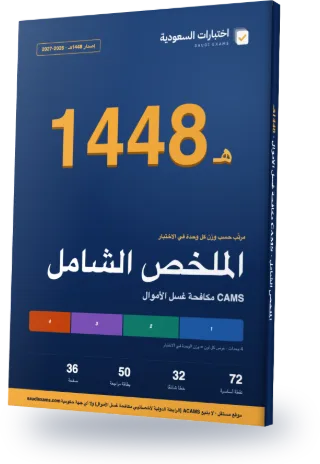
36-page · 72 key points · 32 common mistakes · 50 review cards
The first three chapters alone cover about 79% of the exam. Short on time? Start there.
About the question bank
A 120-question, 3.5-hour international exam with a passing score of 75. Practise 552 explained questions across the four domains, with free questions and no sign-up.
- 552 questions in the bank
- 120 questions in 210 min per mock
- 50 flashcards
Every option explained so you understand why
What you get
- 552questions in the bankPractise with the answer shown right away, or sit a full timed mock
- 4unitsSplit by the exam syllabus
- 50flashcardsTo lock in terms and definitions
- 72quick review pointsEach unit in a few key lines
Study material sample: Risks and Methods of Money Laundering and Terrorism Financing
Summary
This unit covers Domain I of the official ACAMS Candidate Handbook (2020). It carries 26% of the exam, about 31 questions (of 120). It opens with the consequences of AML violations for individuals and institutions and the purpose of sanctions, then the methods of terrorism financing. Next come laundering methods and red flags in banks, insurance and capital markets, then gaming, precious metals and real estate, then bureaux de change, money services businesses, lawyers, accountants and trust and company service providers. It closes with technology and virtual-asset risks, human trafficking, shell companies, ownership opacity and moving money, and trade-based money laundering. Most objectives in this domain are written as scenarios in which you identify the red flags.
What the exam focuses on · Common traps · Try the flashcards
What the exam focuses on
- Penalties under the Saudi AML Law: 2 to 10 years or a fine up to SAR 5 million, rising to 3 to 15 years and up to SAR 7 million with aggravating circumstances, and a fine up to SAR 50 million for a legal person.
- Institutional risks in the Basel framework: reputational, operational, legal and concentration, and how each links to weak due diligence.
- How terrorism financing differs from laundering: the funds may come from a legitimate source, and no link to a specific terrorist act is required.
Show 5 more
- Sector-specific red flags: banks, life insurance, securities, casinos, precious-metal dealers, real estate agents, bureaux de change, and legal and accounting professionals.
- FATF thresholds for designated non-financial businesses and professions: USD/EUR 3,000 for casinos and USD/EUR 15,000 for dealers in precious metals and stones in cash transactions.
- Virtual assets, peer-to-peer exchangers, mixing and crypto kiosks: how criminals use them and what the warning signs are.
- Behavioural and financial signs of human trafficking: front companies, exploitative employment, funnel accounts and alternative payment methods.
- Trade-based money laundering: over- and under-invoicing, multiple invoicing, the Black Market Peso Exchange and document discrepancies.
Common traps
- The penalty for a natural person (prison or a fine up to SAR 5 million) differs from the penalty for a legal person (a fine up to SAR 50 million and not less than double the value of the funds).
- Terrorism financing does not require criminal proceeds: it covers funds of legitimate origin and also financing the travel of individuals for terrorist purposes.
- OFAC sanctions are a US programme. The freeze-without-delay duty in FATF Recommendations 6 and 7 rests on UN Security Council resolutions. Do not treat them as one global system.
Show 5 more
- A casino applies due diligence at USD/EUR 3,000 and a precious-metal dealer at USD/EUR 15,000 in cash. The thresholds differ and cannot be swapped.
- A real estate agent falls under Recommendation 22 when involved in buying and selling property for a client, with no monetary threshold. Thresholds apply only to casinos and precious-metal dealers.
- A shell company is not a shell bank. A shell bank has no physical presence in the country that licensed it and is unaffiliated with a group under effective consolidated supervision. Financial institutions must not keep correspondent relationships with one.
- Over- or under-invoicing misstates the price, while multiple invoicing bills the same goods more than once. Both are TBML methods, but they are different ones.
- One red flag does not prove suspicion: the guidance behind these lists calls for looking at context, the customer profile and further red flags before concluding.
Try the flashcards
Tap a card to see the answer
What is the basic penalty for a natural person for money laundering under the Saudi law?
2 to 10 years in prison, a fine up to SAR 5 million, or both (Art. 26).
What is the penalty with aggravating circumstances under the Saudi law?
3 to 15 years in prison, a fine up to SAR 7 million, or both (Art. 27).
What fine applies to a legal person under the Saudi law?
Up to SAR 50 million and not less than double the value of the funds, with possible prohibition, closure or liquidation (Art. 31).
What four risks does the Basel paper list for a bank?
Reputational, operational, legal and concentration risk.
Must funds come from a criminal source to be terrorism financing?
No. The offence covers funds from a legitimate or illegitimate source and needs no link to a specific terrorist act (Recommendation 5).
What forms of NPO abuse does Recommendation 8 describe?
Posing as legitimate entities, acting as conduits for terrorist financing including escaping asset freezes, and concealing the diversion of funds meant for legitimate purposes.
What is the FATF threshold for casino financial transactions?
USD/EUR 3,000 (Interpretive Note to Recommendations 22 and 23).
What is the FATF threshold for dealers in precious metals and stones?
USD/EUR 15,000 for any cash transaction, including several operations that appear linked.
Why you can trust these questions
- Published questions: 552. Read the explanations and references, and report any error from the question.
- Exam facts last checked against the organiser’s website: 2026-11-16. We check them again every three months and two weeks before each test.
- Found a mistake? Tap "Report an error" under any question in the practice area, or email us at support@saudiexams.com
- Independent website. Not affiliated with ETEC (Qiyas), the Financial Academy, ACAMS, Saudi Aramco or any government body.
Update log
- 2026-11-16 First draft: exam structure per the official ACAMS candidate handbook and the certification page, with a question bank under review.
Full prep for this exam
All of this in one purchase.
- Full mock exam, same as the real one120 questions in 210 minutes. You get a total score and a score for every unit.
- Practice unit by unit552 questions, every option explained with its source. Starts with your weakest units.
- Complete Review Guide 2026–2027 (PDF)Ordered by each unit's weight in the exam. With lifetime access only.
Choose your access
Continue with your Google account and you go straight to the payment page.