CAMS · CAMS
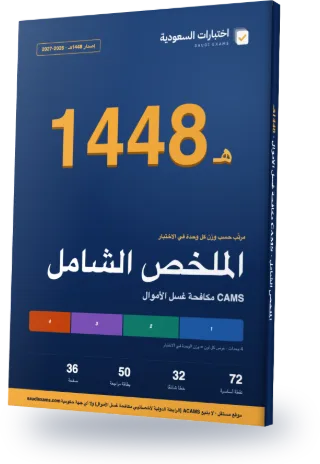
CAMS Anti-Money Laundering Complete Review Guide 2026–2027
Every exam topic in a 36-page Arabic PDF, ordered from the heaviest unit to the lightest. The first three chapters alone cover about 79% of the exam questions.
- 36Pages
- 72Key points
- 32Common mistakes
- 50Flashcards
Guide map
Each chapter is one exam unit, ordered by its weight in the real exam.
| Chapter | Unit | Weight | Exam questions | Key points |
|---|---|---|---|---|
| 1 | AML, CFT and Sanctions Compliance Programs | 28% | 34 | 18 |
| 2 | Risks and Methods of Money Laundering and Terrorism Financing | 26% | 31 | 18 |
| 3 | Compliance Standards for AML and CFT | 25% | 30 | 18 |
| 4 | Conducting and Supporting the Investigation Process | 21% | 25 | 18 |
Chapter 1 in full: AML, CFT and Sanctions Compliance Programs
28% of the exam, about 34 questions. These are its key points, as in the guide.
- (Institution-wide risk assessment) Financial institutions must identify and assess their ML/TF risks across customers, countries or geographic areas, and products, services, transactions and delivery channels, document the assessment, keep it up to date and make it available to competent authorities. Its extent is proportionate to the nature and size of the business (FATF R.1 and its Interpretive Note; Saudi AML Law Art. 5). Risks of a new product, practice or technology must be assessed and mitigated before launch (FATF R.15). Senior management approves the control policies, and measures match the risk: enhanced when higher, simplified when lower (INR 1).
- (Controls and record keeping) An AML program includes internal policies, procedures and controls with compliance management arrangements and adequate screening when hiring staff, an ongoing training programme, an independent audit function to test the system, and a compliance officer appointed at management level. Financial-group programmes apply to all branches and majority-owned subsidiaries (INR 18; Saudi AML Law Art. 14).
- (Controls and record keeping) Record keeping: FATF R.11 requires transaction records for at least five years, sufficient to reconstruct individual transactions, and CDD records, account files, correspondence and analysis results for five years after the relationship ends or the occasional transaction date. Article 12 of the Saudi AML Law requires at least ten years, and the Public Prosecution may require a longer period.
The rest of chapter 1, on this page
- (Training programs) Training is an ongoing part of the program. The Basel paper says its focus should differ for new staff, front-line staff, compliance staff and staff dealing with new customers, with regular refreshers. OFAC's framework expects job-specific content, a statement of each employee's responsibilities, assessments to hold staff accountable, delivery at least annually and tailoring to the institution's risk, plus training or other corrective action once testing or audit finds a weakness.
- (Governance: senior management and the board) The board must be committed to an effective program, allocate explicit responsibility within the institution, and specify in writing the channels for reporting suspicious transactions, communicated to all personnel (Basel paper, para 55). Under OFAC's framework, management commitment covers approving the program, giving the compliance unit authority, autonomy, direct reporting lines and adequate resources, promoting a culture of compliance, and letting staff report misconduct without fear of reprisal. An institution with several lines of business or countries needs a group-wide approach, information sharing with branches under confidentiality safeguards, and home-country requirements applied where host-country rules are weaker (INR 18).
- (Onboarding, CDD/EDD and PEPs) CDD applies when establishing a business relationship, carrying out an occasional transaction above the designated threshold (USD/EUR 15,000) or a wire transfer covered by R.16, when there is suspicion, and when there are doubts about earlier identification data. The steps include identifying and verifying the customer from reliable, independent sources and identifying the beneficial owner with reasonable verification measures. Anonymous accounts and accounts in fictitious names are prohibited (FATF R.10; Saudi AML Law Art. 6).
- (Onboarding, CDD/EDD and PEPs) If the institution cannot comply with the CDD requirements, it must not open the account, start the relationship or perform the transaction, or must end the relationship, and should consider an STR. If it reasonably believes that continuing CDD would tip off the customer, it may stop CDD and file an STR. Verification may be completed after the relationship starts only where this is essential not to interrupt business and the risks are effectively managed, for example non-face-to-face business and securities transactions (R.10 and INR 10).
- (Onboarding, CDD/EDD and PEPs) The beneficial owner of a legal person is identified through cascading steps: the natural persons with a controlling ownership interest (a threshold such as 25% is given as an example), then, if there is doubt or no controlling owner, those exercising control by other means, and if none, the senior managing official. Shareholders of a listed company subject to disclosure requirements that ensure transparent beneficial ownership need not be identified (INR 10).
- (Enhanced due diligence) Where risk is higher, examine the background and purpose of complex, unusual large transactions and unusual patterns with no apparent economic or lawful purpose. Examples of enhanced measures: more information on the customer, more frequent updating of identification data, source of funds or wealth, reasons for transactions, senior management approval, enhanced monitoring, and a first payment from an account in the customer's name at a bank with similar CDD standards. Risk factors include non-resident customers, nominee shareholders or bearer shares, cash-intensive businesses, unusually complex ownership and private banking. Simplified measures are never acceptable when there is suspicion.
- (PEPs) For foreign PEPs (as customer or beneficial owner): risk-management systems to identify them, senior management approval to establish or continue the relationship, reasonable measures to establish source of wealth and source of funds, and enhanced ongoing monitoring. For domestic PEPs and those at international organisations the last three measures apply when the relationship is higher risk, and the requirements extend to family members and close associates. The Basel paper adds that the decision to open an account for a PEP should be taken at senior management level and that important customers should be reviewed regularly because some may become PEPs later. Article 8 of the Saudi AML Law requires appropriate tools to identify those entrusted with a high public mission in the Kingdom or abroad.
- (Automated monitoring tools) Effective monitoring assumes knowing the customer's normal activity, setting limits for each class of accounts and paying special attention to transactions above them, closer monitoring of higher-risk accounts, and management reports covering missing account-opening documents, unusual transactions and aggregation of the customer's total relationship (Basel paper, paras 53–54). OFAC's framework calls for selecting and calibrating technology to fit the risk profile and testing it routinely. Causes of filter faults include screening software not updated for sanctions lists, missing SWIFT BICs of blocked institutions, and ignored alternative spellings.
- (Suspicious behavior and red flags) Indicators include a relationship conducted in unusual circumstances, cash-intensive activity, unusually complex ownership, very high turnover inconsistent with the balance, and transactions that make no economic sense (Basel paper, para 53). Canada's FINTRAC lists among its indicators structuring amounts to avoid identification or reporting thresholds, multiple transactions below the threshold in a short period, a client who knows the reporting thresholds, and a client who uses different locations or employees. The response is to examine the background and purpose, weigh the risk of tipping off, and report when suspicion arises.
- (Wire transfers and funds tracing) On wire transfers, the required accurate originator information and required beneficiary information must stay with the transfer through the whole payment chain, and institutions monitor transfers that lack it (FATF R.16). The ordering institution is not allowed to execute a transfer that does not meet the requirements, the intermediary keeps the accompanying information, and the beneficiary institution has risk-based policies on whether to execute, reject or suspend. Article 10 of the Saudi AML Law bars executing a wire transfer if the information cannot be obtained. OFAC lists stripping or manipulating payment messages among ways of concealing prohibited activity. To trace funds, records must be sufficient to reconstruct individual transactions (R.11) and to analyze data and track transactions (Art. 12).
- (SAR/STR filing, protection and law-enforcement requests) FATF R.20: report promptly, by law, to the FIU when the institution suspects or has reasonable grounds to suspect that funds are proceeds of crime or related to terrorist financing. Article 15 of the Saudi AML Law covers attempted transactions and requires immediate notice and a detailed report to the General Administration of Financial Investigations. In the United States a bank files a SAR (31 CFR 1020.320) on a transaction of $5,000 or more that it knows, suspects or has reason to suspect falls in the listed categories, within 30 calendar days of initial detection. If no suspect is identified it may delay another 30 days, and no delay may exceed 60 days. A copy of the SAR and supporting documents is kept for five years.
- (SAR/STR filing, protection and law-enforcement requests) Protection and confidentiality: FATF R.21 protects the institution, its directors and employees from liability when they report in good faith and prohibits disclosing that a report is being filed (tipping-off). Article 16 of the Saudi AML Law exempts communications among directors and employees and with lawyers or the competent authorities. Under the US bank rule, a bank subpoenaed for a SAR must decline to produce it and notify FinCEN, while disclosure to the authorities and in a joint SAR with another institution is allowed. On law-enforcement requests, Article 18 of the Saudi AML Law requires institutions to promptly submit information the General Administration of Financial Investigations asks for.
- (Sanctions compliance) A sanctions compliance program under OFAC's (US) framework rests on five components: management commitment, risk assessment, internal controls, testing and auditing, and training. The risk assessment covers customers, supply chain, intermediaries, counter-parties, products, services and geographic locations, and includes mergers and acquisitions. Controls must identify, interdict, escalate, report and keep records of prohibited activity, and adjust quickly to changes in the SDN List, the SSI List, sanctions programs and general licenses. On the UN side, funds are frozen without delay, ideally within hours of a designation (FATF R.6 and R.7).
- (Sanctions compliance) OFAC's lists are the reference to keep current: the SDN List, the SSI List, other sanctions lists and general licenses; R.6 and R.7 point to Security Council designations. OFAC's 50 Percent Rule: entities owned 50% or more, directly or indirectly and in the aggregate, by one or more blocked persons are blocked, so two persons each owning 25% block the entity. Control without that ownership does not automatically block it, but one may not deal with a blocked person who signs a contract for a non-blocked entity. Root causes of program failures include no formal program, misunderstanding the reach of the regulations, weak due diligence on ownership, and a de-centralized compliance function.
- (Program changes, audit and regulator findings) The testing or audit function must be independent of the activities it reviews, accountable to senior management, have sufficient authority, skills and resources, and fit the level and sophistication of the program. It can be internal or external, and cover one element or the whole enterprise. Internal audit independently evaluates control effectiveness and should follow up its own findings (Basel paper, paras 56–57). When a weakness is confirmed, compensating controls go in immediately until the root cause is found and remediated, the risk assessment is updated for root causes of violations and systemic deficiencies, and training or other corrective action is given to the staff concerned (OFAC framework).
Common mistakes in this chapter
- Record retention: FATF Recommendation 11 requires at least five years, while Article 12 of the Saudi AML Law requires at least ten. Use the rule the scenario names.
- Simplified CDD is allowed for lower risk after adequate analysis, but never when there is suspicion. Lower risk for identification does not mean lower risk for ongoing monitoring.
- Failing to complete CDD does not mean proceeding with caution: do not open the account, start the relationship or carry out the transaction, or end the relationship, and consider filing a suspicion report.
- Identifying the beneficial owner of a legal person is a cascade, not a menu of options: controlling ownership first, then control by other means, then the senior managing official.
- OFAC's 50 Percent Rule looks at ownership, not control, and adds up the stakes of blocked persons. An entity a blocked person controls without owning 50% is not automatically blocked, but dealing with it calls for caution.
- Under the US rule, confidentiality covers the SAR and anything that would reveal it, not the underlying facts and documents. They may be shared with the authorities and with another institution preparing a joint SAR.
- The ordering institution is not allowed to execute a transfer that lacks the required information. Even below the de minimis threshold (up to USD/EUR 1,000), the originator and beneficiary names and an account number for each, or a unique reference number, are still required.
- OFAC regulations do not require a formal compliance program but OFAC encourages one and weighs an effective program when assessing a penalty. The testing or audit function must be independent of the activities it reviews.
The other chapters are in the full guide
One purchase · lifetime access · review guide included
7-day review plan
The chapters are spread over 6 days by weight so each day carries a similar load. Day 7 is a full exam.
Day 1 · 28% of the exam
Chapter 1: AML, CFT and Sanctions Compliance Programs
Day 2 · 26% of the exam
Chapter 2: Risks and Methods of Money Laundering and Terrorism Financing
Day 3 · 25% of the exam
Chapter 3: Compliance Standards for AML and CFT
Day 4 · 21% of the exam
Chapter 4: Conducting and Supporting the Investigation Process
Day 5
Full mock exam: 120 questions in 210 minutes, then review the common mistakes in the units where you lost marks.
Before you read: see your score today
10 free questions from the main units, no sign-up. Then you know which chapter to start with.
Try 10 free questions and see your levelA look at each chapter
The first three key points of each chapter, as they appear in the guide (in Arabic in the PDF).
Chapter 1: AML, CFT and Sanctions Compliance Programs
- (Institution-wide risk assessment) Financial institutions must identify and assess their ML/TF risks across customers…
- (Controls and record keeping) An AML program includes internal policies, procedures and controls with…
- (Controls and record keeping) Record keeping
Chapter 2: Risks and Methods of Money Laundering and Terrorism Financing
- (Consequences and purpose of sanctions) Under the Saudi AML Law, money laundering is punished…
- (Consequences and purpose of sanctions) The Basel customer due diligence paper lists four interrelated…
- (Consequences and purpose of sanctions) OFAC administers US economic and trade sanctions programmes against…
Chapter 3: Compliance Standards for AML and CFT
- (FATF Recommendations) The 40 Recommendations, with their Interpretive Notes and the Glossary, make up…
- (FATF Recommendations) Recommendation 10 bans anonymous accounts and accounts in obviously fictitious names. CDD…
- (FATF Recommendations) Recommendation 12
Chapter 4: Conducting and Supporting the Investigation Process
- (Reporting SARs) If a financial institution suspects, or has reasonable grounds to suspect, that…
- (Reporting SARs) The interpretive note to Recommendation 20 covers all suspicious transactions, attempts included…
- (Reporting SARs) Under the Saudi AML Law (Article 15), on suspicion or reasonable grounds…
The full guide comes with lifetime access
The full guide (36 pages) is included with lifetime access to this exam, together with every question and full mock exam. Chapter 1 is free for everyone.
Questions about the guide
Is the guide free?
Chapter 1 is free to read on the guide page. The full guide comes with lifetime access to this exam; 7-day access does not include it.
Is it up to date for 2026–2027?
Yes. Unit weights and exam facts follow what the exam body last published, and the last check date is printed in the guide. If the standards change we update the file and buyers download the new version.
Does the guide have questions?
No. The guide covers key points and common mistakes; scoring, weak-area practice and full mock exams are on the site.
Can I read it on my phone?
Yes. A5 pages in a single column, with chapters linked from the contents.
- Pages
- 36
- Edition
- 1448 AH · 2026–2027
- Language
- Arabic
- Last updated
Full prep for this exam
All of this in one purchase.
- Full mock exam, same as the real one120 questions in 210 minutes. You get a total score and a score for every unit.
- Practice unit by unit552 questions, every option explained with its source. Starts with your weakest units.
- Complete Review Guide 2026–2027 (PDF)Ordered by each unit's weight in the exam. With lifetime access only.
Choose your access
Continue with your Google account and you go straight to the payment page.