SCFHS Dietetic Technician Exam
SCFHS Dietetic Technician Exam — Number of questions: 150 questions. Exam time: 3 hours. Pass mark: 55%. Calculator: The SCFHS content guideline does not say whether a calculator is allowed. Exam fee: Paid to SCFHS online when you apply through Mumaris Plus; the amount is shown in your application. Source: Saudi Commission for Health Specialties (SCFHS) (Last verified: 2026-11-17). Question bank: full mock exams of 150 questions in 180 minutes, like the real test with a result for every unit, plus 555 explained questions across 11 units, every option explained, a review of your mistakes, and two ways to practise: see the answer right away, or sit a full timed mock. Free questions: a 10-question diagnostic test covering the main units, no sign-up; at the end we compare your score with the pass mark and show your weakest units. With lifetime access: the Complete Review Guide, a 72-page PDF ordered by unit weight; chapter 1 is free to read on the guide page.
Last verified on the Saudi Commission for Health Specialties (SCFHS) website: 17 November 2026
If you sat the exam today, what would you score?
10 free questions · no sign-up · your score as soon as you finish
Question 1 of 10
A man is 1.75 m tall and weighs 90 kg. About how many kilograms must he lose, at minimum, to reach a BMI of 25?
All 10 free questions with answers and an explanation for every option
Where the questions come from
- Fundamentals of Dietetics15 questions
- Disease Prevention and Health Promotion15 questions
- Nutrition Screening, Assessment and Counseling10 questions
- Medical Nutrition Therapy20 questions
- Food Science and Normal Nutrition22 questions
- Principles of Food Preparation and Training9 questions
- Menu Planning15 questions
- Procurement and Materials Management8 questions
- Food Production, Distribution and Facility Design7 questions
- Safety and Sanitation21 questions
- Community Nutrition8 questions
Exam facts
- Exam language
- English
- Number of questions
- 150 questions Source
- Exam time
- 3 hours Source
- Pass mark
- 55% Source
- Calculator
- The SCFHS content guideline does not say whether a calculator is allowed Source
- Exam fee
- Paid to SCFHS online when you apply through Mumaris Plus; the amount is shown in your application Source
- Registration
- Apply through the Professional Classification service in Mumaris Plus; SCFHS has not published a separate window calendar for the dietetic technician exam Source
- Retakes
- If you do not pass you get further attempts under SCFHS regulations and pay the evaluation fee Source
Last verified: 2026-11-17
Where other sources differ
- The pass mark is 55% for the technician level in the content guideline. Section weights may differ by up to 5% in each category.
- Eleven sections: safety and sanitation 14%, food science and normal nutrition 15%, medical nutrition therapy 13%, fundamentals of dietetics, disease prevention and menu planning 10% each, screening, assessment and counseling 7%, food preparation and training 6%, and procurement, food production and facility design and community nutrition 5% each.
Exam body
Saudi Commission for Health Specialties (SCFHS): Official website: Saudi Commission for Health Specialties (SCFHS)
How to register
- Choose the Professional Classification service in the Mumaris Plus system and submit your application with your certificate and documents.
- Once your application is accepted you are referred to an electronic written exam delivered through Prometric or Pearson VUE.
- Pay the evaluation fee shown in your application.
- Book your slot at a test centre through the booking service SCFHS opens in your application.
- On exam day bring your ID or passport and your booking confirmation.
Study guides (3)
Frequently asked questions
How many questions are there and how long is the exam?
150 multiple-choice questions in 3 hours, according to the SCFHS Dietetic Technician content guideline.
Can I try Dietetic Technician questions for free?
Yes. Free questions: a 10-question diagnostic test covering the main units, no sign-up; at the end we compare your score with the pass mark and show your weakest units. The free practice test page lists the same questions with answers and an explanation for every option. The rest of the questions and the full mock exams come with a pass from SAR 26.
What makes this Dietetic Technician question bank different?
Question bank: full mock exams of 150 questions in 180 minutes, like the real test with a result for every unit, plus 555 explained questions across 11 units, every option explained, a review of your mistakes, and two ways to practise: see the answer right away, or sit a full timed mock. Practice questions and explanations are ready to use on your phone. Try the free questions and read the explanations before you buy.
Is there a PDF review guide for Dietetic Technician?
Yes. "Dietetic Technician Complete Review Guide 2026–2027" is a 72-page Arabic PDF: 11 units ordered from the heaviest in the exam to the lightest, each chapter with key points, common mistakes and review cards, plus a 7-day plan. Chapter 1 is free to read on the guide page; the full guide comes with lifetime access to this exam and is not part of 7-day access. The guide has no questions: scoring, practice and mock exams are on the site.
What is the pass mark?
55% for the technician level according to the guideline. On our site your result shows your percentage in each section so you can see where you lose points.
What language is the exam in?
The guideline does not state the language. The guideline and its reference books are in English, so our questions and explanations are in English. This is our inference, so confirm it in your Mumaris Plus application.
Which sections does the exam cover?
Eleven sections; the largest are food science and normal nutrition (15%), safety and sanitation (14%) and medical nutrition therapy (13%).
How is it different from the SCNLE clinical nutrition exam?
This is the dietetic technician exam: 150 questions, eleven sections and a 55% pass mark. The SCNLE is the clinical nutrition licensure exam, with 200 questions and four sections.
Is this site part of SCFHS?
No. This is an independent exam preparation site with no link to SCFHS, Prometric or any government body. Always rely on what SCFHS announces.
Is this an official site, and how do I pay?
It is an independent site, not part of Qiyas, this exam's regulator or any government body, with practice questions and answer explanations. You pay once, with no automatic renewal, through Waffo Pancake (the merchant of record) by Visa, Mastercard, Apple Pay or Google Pay, and your statement shows "WAFFO". If you were charged twice or the pass did not open, email support@saudiexams.com.
Dietetic Technician Complete Review Guide 2026–2027
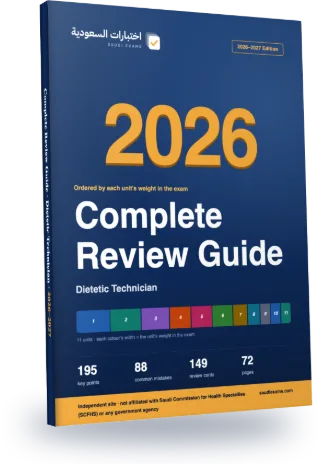
72-page · 195 key points · 88 common mistakes · 149 review cards
The first three chapters alone cover about 42% of the exam. Short on time? Start there.
About the question bank
Know your score before the SCFHS Dietetic Technician exam. We picked 555 questions across nutrition fundamentals, medical nutrition therapy, food science, food service management, food safety and community nutrition, so you see where you lose points before test day.
- 150 questions in 180 min, like the real test
- 555 questions covering the main scoring topics, with explanations
- 55% pass mark, with targeted practice on your weak spots
See the gap to your target score Practise the units costing you the most marks A full mock exam like the real one
Every option explained so you understand why
What you get
- 555questions in the bankPractise with the answer shown right away, or sit a full timed mock
- 11unitsSplit by the exam syllabus
- 149flashcardsTo lock in terms and definitions
- 195quick review pointsEach unit in a few key lines
Study material sample: Fundamentals of Dietetics
Summary
Fundamentals of Dietetics is worth about 15 of the 150 questions. It has two parts. The first covers the dietetics profession, the Nutrition Care Process (assessment, nutrition diagnosis, intervention, monitoring and evaluation) and professional ethics such as confidentiality, scope of practice and working within your competence as a technician. The second covers energy and nutrients, dietary reference intakes and basic calculations: energy values of macronutrients, BMI, percent of energy from a nutrient, and reading reference values. Expect short scenario questions that ask what the technician should do next, plus simple arithmetic that you can do by hand. Learn the vocabulary exactly, because many options differ by only one word.
What the exam focuses on · Common traps · Try the flashcards
What the exam focuses on
- The Nutrition Care Process runs in four steps: nutrition assessment, nutrition diagnosis, nutrition intervention, then monitoring and evaluation. Questions often ask which step an action belongs to.
- A nutrition diagnosis names a problem the dietitian can treat with food and nutrition, written as problem, etiology and signs/symptoms. A medical diagnosis (for example diabetes) is made by the physician.
- A technician works under the supervision of a dietitian and stays within scope of practice. Anything outside your competence is referred, not improvised.
Show 5 more
- Patient confidentiality: share information only with the care team that needs it for care, and never discuss patients in public areas.
- Energy values: fat gives about 9 kcal per gram, carbohydrate and protein about 4 kcal per gram. Use these to convert grams to calories and to find percent of energy.
- BMI = weight in kg divided by height in metres squared. Adult cut-offs: 25 or more is overweight, 30 or more is obesity.
- Acceptable Macronutrient Distribution Ranges for adults: carbohydrate 45-65%, fat 20-35%, protein 10-35% of energy.
- Know what each reference value means: RDA covers the needs of nearly all healthy people, AI is used when evidence is not enough for an RDA, and an upper limit is the highest intake unlikely to cause harm.
Common traps
- Confusing a nutrition diagnosis with a medical diagnosis. 'Type 2 diabetes' is medical; 'excessive carbohydrate intake related to...' is a nutrition diagnosis.
- Putting assessment actions (collecting weight, labs, diet history) in the intervention step. Collecting data is assessment; delivering education or changing the diet is intervention.
- Forgetting the last step: monitoring and evaluation checks whether goals were met and may send you back to assessment.
Show 5 more
- Using height in centimetres in the BMI formula. Convert to metres first, then square it.
- Mixing up grams and calories: 10 g of fat is 90 kcal, not 10 kcal. Multiply by the energy value before taking a percentage.
- Treating an AI as if it were an RDA. An AI is an estimate based on observed intakes of healthy groups, so it is less certain.
- Choosing an answer that breaches confidentiality because it seems helpful, for example telling a relative the patient's results without consent.
- Taking on tasks beyond a technician's role, such as changing a diet order on your own. The right answer is usually to report to the supervising dietitian.
Try the flashcards
Tap a card to see the answer
Four steps of the Nutrition Care Process
Assessment, nutrition diagnosis, intervention, monitoring and evaluation.
Parts of a nutrition diagnosis statement
Problem, etiology (cause), and signs and symptoms (PES).
Who makes a medical diagnosis?
The physician. The dietitian writes nutrition diagnoses.
kcal per gram: fat
About 9 kcal per gram.
kcal per gram: carbohydrate and protein
About 4 kcal per gram each.
BMI formula
Weight in kg divided by height in metres squared.
Adult BMI for overweight and obesity
Overweight 25 or more; obesity 30 or more.
AMDR for adults
Carbohydrate 45-65%, fat 20-35%, protein 10-35% of energy.
Why you can trust these questions
- Published questions: 555. Read the explanations and references, and report any error from the question.
- Exam facts last checked against the organiser’s website: 2026-11-17. We check them again every three months and two weeks before each test.
- Found a mistake? Tap "Report an error" under any question in the practice area, or email us at support@saudiexams.com
- Independent website. Not affiliated with ETEC (Qiyas), the Financial Academy, ACAMS, the ACFE, Saudi Aramco or any government body.
Update log
- 2026-11-17 Added the exam from the Dietetic Technician content guideline (150 questions, 3 hours, 55% pass mark) and the SCFHS classification exams page.
Full prep for this exam
All of this in one purchase.
- Full mock exam, same as the real one150 questions in 180 minutes. You get a total score and a score for every unit.
- Practice unit by unit555 questions, every option explained with its source. Starts with your weakest units.
- Complete Review Guide 2026–2027 (PDF)Ordered by each unit's weight in the exam. With lifetime access only.
Choose your access
Continue with your Google account and you go straight to the payment page.