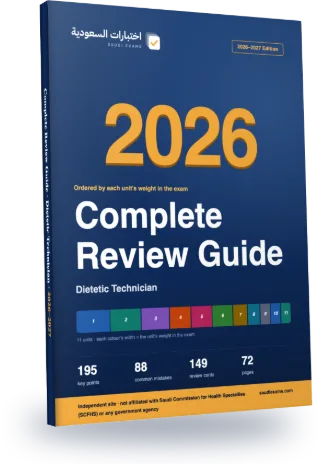
Dietetic Technician Complete Review Guide 2026–2027
Every exam topic in a 72-page Arabic PDF, ordered from the heaviest unit to the lightest. The first three chapters alone cover about 42% of the exam questions.
- 72Pages
- 195Key points
- 88Common mistakes
- 149Flashcards
Guide map
Each chapter is one exam unit, ordered by its weight in the real exam.
| Chapter | Unit | Weight | Exam questions | Key points |
|---|---|---|---|---|
| 1 | Food Science and Normal Nutrition | 15% | 22 | 18 |
| 2 | Safety and Sanitation | 14% | 21 | 18 |
| 3 | Medical Nutrition Therapy | 13% | 20 | 18 |
| 4 | Fundamentals of Dietetics | 10% | 15 | 16 |
| 5 | Disease Prevention and Health Promotion | 10% | 15 | 18 |
| 6 | Menu Planning | 10% | 15 | 17 |
| 7 | Nutrition Screening, Assessment and Counseling | 7% | 10 | 18 |
| 8 | Principles of Food Preparation and Training | 6% | 9 | 18 |
| 9 | Procurement and Materials Management | 5% | 8 | 18 |
| 10 | Food Production, Distribution and Facility Design | 5% | 7 | 18 |
| 11 | Community Nutrition | 5% | 8 | 18 |
Chapter 1 in full: Food Science and Normal Nutrition
15% of the exam, about 22 questions. These are its key points, as in the guide.
- (Carbohydrates, fiber, protein and fat) Carbohydrate and protein provide about 4 kcal per gram and fat about 9 kcal per gram, so 10 g of fat supplies about 90 kcal.
- (Carbohydrates, fiber, protein and fat) Glucose is the brain's preferred fuel; fiber is a carbohydrate that is not digested into absorbable sugars. At least 25 g of fibre a day is advised for adults.
- (Carbohydrates, fiber, protein and fat) Whole grains, pulses, vegetables and fruit are the main fibre sources; replacing refined grains with whole grains raises fibre intake.
The rest of chapter 1, on this page
- (Carbohydrates, fiber, protein and fat) Free sugars should supply under 10% of daily energy; limiting to 5% or less may give extra benefit.
- (Carbohydrates, fiber, protein and fat) Protein intake at 10-15% of energy is generally enough for adults. Essential amino acids cannot be made by the body and must come from food.
- (Carbohydrates, fiber, protein and fat) Unsaturated fats (fish, nuts, avocado, olive and sunflower oils) are preferred to saturated fats (fatty meat, butter, ghee, cream, palm and coconut oil); trans fat should be under 1% of energy.
- (Vitamins, minerals and water) Vitamin A is needed for vision and epithelial health; deficiency causes night blindness. Dark-green leafy vegetables and orange vegetables supply carotenoids.
- (Vitamins, minerals and water) Vitamin D with calcium supports bone mineralization; deficiency causes rickets in children and osteomalacia in adults, a recognised problem in Saudi Arabia.
- (Vitamins, minerals and water) Iron deficiency is the most common nutritional cause of anaemia; folate, B12 and vitamin A deficiencies can also cause it.
- (Vitamins, minerals and water) Iodine is needed for thyroid hormone and brain development; use iodized salt, but keep total salt under 5 g a day.
- (Vitamins, minerals and water) Sodium is needed for plasma volume, acid-base balance and nerve impulses; excess raises blood pressure.
- (Vitamins, minerals and water) A sedentary adult should drink at least 1.5 litres of water per day; needs rise in hot weather and with activity, and infants and the elderly dehydrate more easily.
- (Digestion, absorption and metabolism) Salivary amylase begins starch digestion in the mouth; pepsin and hydrochloric acid act in the stomach; bile, pancreatic lipase, amylase and proteases act in the small intestine.
- (Digestion, absorption and metabolism) Absorption of nutrients happens mostly through the villi of the small intestine; the large intestine absorbs water and electrolytes and houses gut bacteria that ferment some fibre.
- (Digestion, absorption and metabolism) In the fed state glucose is stored as glycogen (liver and muscle) and excess is converted to fat; in fasting the body first uses glycogen, then fat and protein.
- (Nutrition across the life cycle) Infants: start breastfeeding within 1 hour of birth, breastfeed exclusively for 6 months, then add complementary foods and continue breastfeeding up to 2 years or beyond.
- (Nutrition across the life cycle) Complementary feeding: 2-3 meals per day at 6-8 months and 3-4 meals per day at 9-23 months, with 1-2 snacks as needed; increase consistency and variety gradually.
- (Food science: food properties and cooking reactions) Keep cold food at 5 C (41 F) or below and hot food at 57 C (135 F) or above; cooked food should cool from 57 C to 21 C within 2 hours and to 5 C within 6 hours total; reheat to 74 C (165 F).
Common mistakes in this chapter
- Do not confuse soluble and insoluble fiber: cholesterol and glucose benefits belong to soluble fiber, laxative effect to insoluble.
- Vitamin C and the B vitamins are not stored in large amounts, so toxicity is a fat-soluble vitamin problem (A and D especially), not a water-soluble one.
- Fat is not digested in the stomach to any large degree; the main fat digestion happens in the small intestine after bile emulsifies it. Bile is made in the liver and stored in the gallbladder; it does not contain enzymes.
- Carbohydrate digestion has two amylases (salivary and pancreatic), but protein digestion has several enzymes in sequence (pepsin, then trypsin and chymotrypsin, then peptidases); do not assign everything to one enzyme.
- Heme iron (meat, fish, poultry) is absorbed better than non-heme iron (plants); vitamin C helps non-heme absorption, while tea, coffee, bran and calcium reduce it.
- Free sugars include honey, syrups and fruit juice, not only table sugar; WHO limits them to under 10% of energy.
- Cooking guidance on temperature: the danger zone is between cold-hold and hot-hold limits (above 5 C and below 57 C); do not mix up holding temperatures with the 74 C reheating temperature.
- Infants: salt and sugars should not be added to complementary foods, and water or other drinks should not replace breast milk in the first 6 months unless medically needed.
The other chapters are in the full guide
One purchase · lifetime access · review guide included
7-day review plan
The chapters are spread over 6 days by weight so each day carries a similar load. Day 7 is a full exam.
Day 1 · 15% of the exam
Chapter 1: Food Science and Normal Nutrition
Day 2 · 19% of the exam
Chapter 2: Safety and Sanitation
Chapter 11: Community NutritionDay 3 · 18% of the exam
Chapter 3: Medical Nutrition Therapy
Chapter 10: Food Production, Distribution and Facility DesignDay 4 · 17% of the exam
Chapter 4: Fundamentals of Dietetics
Chapter 7: Nutrition Screening, Assessment and CounselingDay 5 · 16% of the exam
Chapter 5: Disease Prevention and Health Promotion
Chapter 8: Principles of Food Preparation and TrainingDay 6 · 15% of the exam
Chapter 6: Menu Planning
Chapter 9: Procurement and Materials ManagementDay 7
Full mock exam: 150 questions in 180 minutes, then review the common mistakes in the units where you lost marks.
How many correct answers do you need?
- Pass mark 55%83 correct out of 150
Before you read: see your score today
10 free questions from the main units, no sign-up. Then you know which chapter to start with.
Try 10 free questions and see your levelA look at each chapter
The first three key points of each chapter, as they appear in the guide (in Arabic in the PDF).
Chapter 1: Food Science and Normal Nutrition
- (Carbohydrates, fiber, protein and fat) Carbohydrate and protein provide about 4 kcal per gram…
- (Carbohydrates, fiber, protein and fat) Glucose is the brain's preferred fuel; fiber is a…
- (Carbohydrates, fiber, protein and fat) Whole grains, pulses, vegetables and fruit are the main…
Chapter 2: Safety and Sanitation
- (Foodborne illness and personal hygiene) Foodborne illness is caused by pathogens (bacteria, viruses, parasites)…
- (Foodborne illness and personal hygiene) The Food Code lists norovirus, hepatitis A virus, Shigella…
- (Foodborne illness and personal hygiene) Norovirus is highly contagious and passes by the faecal-oral…
Chapter 3: Medical Nutrition Therapy
- (Diabetes and nutrition) Carbohydrates raise blood glucose; carb counting is most useful for people…
- (Diabetes and nutrition) Plate method
- (Diabetes and nutrition) Limit foods high in sodium and drinks with added sugar; water…
Chapter 4: Fundamentals of Dietetics
- (The dietetics profession, the Nutrition Care Process and ethics) The Nutrition Care Process is…
- (The dietetics profession, the Nutrition Care Process and ethics) Nutrition assessment gathers food and…
- (The dietetics profession, the Nutrition Care Process and ethics) A nutrition diagnosis statement has…
Chapter 5: Disease Prevention and Health Promotion
- (Dietary guidelines and healthy eating patterns) A healthy diet is built on minimally processed…
- (Dietary guidelines and healthy eating patterns) Dietary guidelines advise following a healthy pattern at…
- (Dietary guidelines and healthy eating patterns) Free sugars
Chapter 6: Menu Planning
- (Menu types and the factors that shape a menu) Static menu
- (Menu types and the factors that shape a menu) Cycle menu
- (Menu types and the factors that shape a menu) Selective menu offers choices in…
Chapter 7: Nutrition Screening, Assessment and Counseling
- (Nutrition screening and anthropometrics) Screening is a rapid, simple process using validated tools to…
- (Nutrition screening and anthropometrics) Common screening content: recent unintentional weight loss, reduced food intake…
- (Nutrition screening and anthropometrics) BMI is weight in kg divided by height in m²;…
Chapter 8: Principles of Food Preparation and Training
- (Cooking methods, standardized recipes and portioning) Dry-heat cooking: roasting and baking use hot air…
- (Cooking methods, standardized recipes and portioning) Moist-heat cooking: boiling, simmering, poaching and steaming cook…
- (Cooking methods, standardized recipes and portioning) Combination cooking (braising, stewing) first browns food, then…
Chapter 9: Procurement and Materials Management
- (Purchasing methods, specifications and vendor selection) A purchasing system starts from need: forecast the…
- (Purchasing methods, specifications and vendor selection) A requisition is an internal request for goods;…
- (Purchasing methods, specifications and vendor selection) Informal (competitive) buying gets quotes from several vendors…
Chapter 10: Food Production, Distribution and Facility Design
- (Production planning, distribution and service systems) Production planning links the menu, the forecast of…
- (Production planning, distribution and service systems) A standardized recipe records ingredients, amounts, steps, yield…
- (Production planning, distribution and service systems) Recipes can be adjusted to a new yield…
Chapter 11: Community Nutrition
- (Community needs assessment and nutrition program planning) A community needs assessment collects data on…
- (Community needs assessment and nutrition program planning) Data sources include existing records and surveys…
- (Community needs assessment and nutrition program planning) Priorities are chosen by size and severity…
The full guide comes with lifetime access
The full guide (72 pages) is included with lifetime access to this exam, together with every question and full mock exam. Chapter 1 is free for everyone.
Questions about the guide
Is the guide free?
Chapter 1 is free to read on the guide page. The full guide comes with lifetime access to this exam; 7-day access does not include it.
Is it up to date for 2026–2027?
Yes. Unit weights and exam facts follow what the exam body last published, and the last check date is printed in the guide. If the standards change we update the file and buyers download the new version.
Does the guide have questions?
No. The guide covers key points and common mistakes; scoring, weak-area practice and full mock exams are on the site.
Can I read it on my phone?
Yes. A5 pages in a single column, with chapters linked from the contents.
- Pages
- 72
- Edition
- 1448 AH · 2026–2027
- Language
- Arabic
- Last updated
Full prep for this exam
All of this in one purchase.
- Full mock exam, same as the real one150 questions in 180 minutes. You get a total score and a score for every unit.
- Practice unit by unit555 questions, every option explained with its source. Starts with your weakest units.
- Complete Review Guide 2026–2027 (PDF)Ordered by each unit's weight in the exam. With lifetime access only.
Choose your access
Continue with your Google account and you go straight to the payment page.