FE
Saudi Council of Engineers FE Exam: Mechanical Engineering Part
Saudi Council of Engineers FE Exam: Mechanical Engineering Part — Number of questions: 50 questions. Exam time: 180 minutes. Pass mark: You must pass both the general part and your discipline part. Calculator: Approved models allowed; formula and data sheets are handed out in the hall. Exam fee: SAR 400 for the general part and SAR 400 for the discipline part. Source: Saudi Council of Engineers (SCE) with the National Center for Assessment (Qiyas) (Last verified: 2026-11-17). Question bank: full mock exams of 50 questions in 180 minutes, like the real test with a result for every unit, plus 530 explained questions across 8 units, every option explained, a review of your mistakes, and two ways to practise: see the answer right away, or sit a full timed mock. Free questions: a 10-question diagnostic test covering the main units, no sign-up; at the end you get your score and your weakest units. With lifetime access: the Complete Review Guide, a 53-page PDF ordered by unit weight; chapter 1 is free to read on the guide page.
Last verified on the Saudi Council of Engineers (SCE) with the National Center for Assessment (Qiyas) website: 17 November 2026
If you sat the exam today, what would you score?
10 free questions · no sign-up · your score as soon as you finish
Question 1 of 10
F(s) = \dfrac{8s+3}{s^2+2s+5} is the Laplace transform of f(t), with f(t) = 0 for t < 0. The initial slope \dot f(0^+) equals:
All 10 free questions with answers and an explanation for every option
Where the questions come from
- Mechanical Design and Analysis8 questions
- Engineering Mechanics7 questions
- System Dynamics and Control5 questions
- Material Processing and Manufacturing5 questions
- Measurements and Instrumentation4 questions
- Thermodynamics and Thermal Systems8 questions
- Fluid Mechanics and Fluid Machinery8 questions
- Heat Transfer5 questions
Exam facts
- Exam code
- FE
- Exam language
- English
- Number of questions
- 50 questions Source
- Exam time
- 180 minutes Source
- Pass mark
- You must pass both the general part and your discipline part Source
- Calculator
- Approved models allowed; formula and data sheets are handed out in the hall Source
- Exam fee
- SAR 400 for the general part and SAR 400 for the discipline part Source
- Registration
- The SCE announces the dates each year (in 2025: 28 April and 1 September), and Qiyas registration opens about two months before Source Last verified: 2026-11-01
- Results
- Results are announced on Qiyas, then the electronic pass certificate is emailed to those who pass Source Last verified: 2026-11-01
- Retakes
- Register for a later sitting and pay the fee again for the part you did not pass Source Last verified: 2026-11-01
Last verified: 2026-11-17
Where other sources differ
- This is the SCE exam run with Qiyas. It differs from the US FE exam by NCEES, which the SCE also accepts: the NCEES exam has 110 questions and costs SAR 1,500 to the SCE plus USD 250 to NCEES.
- Thermodynamics, fluid mechanics and mechanical design together make up 24 of the 50 questions in the mechanical part, and most are calculation problems where you need your calculator.
- Since the Professional Accreditation Guide for Engineering Categories was approved in November 2024, passing the Fundamentals of Engineering exam is required for the Associate Engineer grade, and the PE practice exam plus 5 years of experience for the Professional grade.
Exam body
Saudi Council of Engineers (SCE) with the National Center for Assessment (Qiyas): Official website: Saudi Council of Engineers (SCE) with the National Center for Assessment (Qiyas)
How to register
- Register with the Saudi Council of Engineers and hold an active membership; it is required to sit the exam.
- Wait for the SCE to announce the exam date and open registration, then register through your professional accreditation profile at the SCE or through the Qiyas portal.
- Register for both parts: the general part (90 questions) and the mechanical engineering part (50 questions).
- Pay the fee for each part (SAR 400) and attend on exam day with your admission card at the centre you chose.
- After Qiyas announces the results, your pass certificate is emailed to you and you use it to apply for the SCE Associate Engineer grade.
Study guides (3)
Frequently asked questions
What is the Saudi Council of Engineers exam and who needs it?
The Fundamentals of Engineering (FE) exam is offered by the Saudi Council of Engineers with the National Center for Assessment (Qiyas). It measures the core engineering knowledge of anyone seeking the Associate Engineer grade. Final-year students, fresh graduates and working engineers can take it, provided they hold an active SCE membership. It has two parts: a general part shared by all engineers and a discipline part.
Can I try SCE FE Mechanical questions for free?
Yes. Free questions: a 10-question diagnostic test covering the main units, no sign-up; at the end you get your score and your weakest units. The free practice test page lists the same questions with answers and an explanation for every option. The rest of the questions and the full mock exams come with a pass from SAR 26.
What makes this SCE FE Mechanical question bank different?
Question bank: full mock exams of 50 questions in 180 minutes, like the real test with a result for every unit, plus 530 explained questions across 8 units, every option explained, a review of your mistakes, and two ways to practise: see the answer right away, or sit a full timed mock. Practice questions and explanations are ready to use on your phone. Try the free questions and read the explanations before you buy.
Is there a PDF review guide for SCE FE Mechanical?
Yes. "SCE FE Mechanical Complete Review Guide 2026–2027" is a 53-page Arabic PDF: 8 units ordered from the heaviest in the exam to the lightest, each chapter with key points, common mistakes and review cards, plus a 7-day plan. Chapter 1 is free to read on the guide page; the full guide comes with lifetime access to this exam and is not part of 7-day access. The guide has no questions: scoring, practice and mock exams are on the site.
How many questions are in the mechanical part and how long is it?
50 multiple-choice questions with four options in 3 hours, with no penalty for wrong answers, according to the study guide. It is the second session after the general part (90 questions in 3 hours), and you must pass both parts.
What topics does the mechanical part cover?
8 topics, according to the table of specifications in the study guide: mechanical design and analysis 8 questions, thermodynamics and thermal systems 8, fluid mechanics and fluid machinery 8, engineering mechanics 7, system dynamics and control 5, material processing and manufacturing 5, heat transfer 5 and measurements and instrumentation 4.
Is the exam in Arabic or English?
The exam is in English, according to the FAQ on the SCE website. That is why the questions here show in English first, with the Arabic translation and Arabic explanations one tap away.
Can I use a calculator?
Yes, calculators approved by the exam authority are allowed, and the formula and data sheets you need are handed out in the hall; books and notes are not allowed, according to the exam rules in the study guide.
What is the difference between the SCE-Qiyas exam and the NCEES exam?
No. We wrote the questions ourselves against the indicators in the mechanical engineering standards in the study guide, reviewed each one, and every question names the topic and indicator it tests. The SCE does not provide sample question banks, and we use the guide's sample questions only to match the level, without copying them.
Are the questions on this site taken from the official exam?
No. We wrote the questions ourselves against the indicators in the electrical engineering standards in the study guide, reviewed each one, and every question names the topic and indicator it tests. The SCE does not provide sample question banks, and we use the guide's sample questions only to match the level, without copying them.
Is this an official site, and how do I pay?
It is an independent site, not part of Qiyas, this exam's regulator or any government body, with practice questions and answer explanations. You pay once, with no automatic renewal, through Waffo Pancake (the merchant of record) by Visa, Mastercard, Apple Pay or Google Pay, and your statement shows "WAFFO". If you were charged twice or the pass did not open, email support@saudiexams.com.
SCE FE Mechanical Complete Review Guide 2026–2027
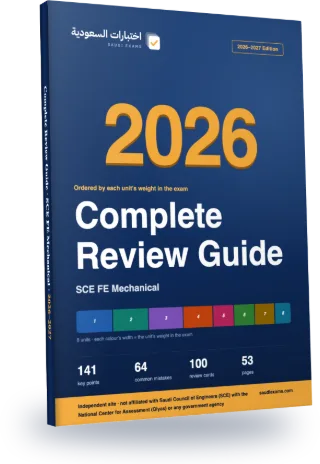
53-page · 141 key points · 64 common mistakes · 100 review cards
The first three chapters alone cover about 48% of the exam. Short on time? Start there.
About the question bank
You only get the Associate Engineer grade if you pass your discipline part as well as the general part: 50 English questions in mechanical engineering in 3 hours. We've handpicked 530 questions across the topics on the latest syllabus, to help you find your level and push your score before test day!
- 530 questions in the bank
- 50 questions in 180 min per mock
- 100 flashcards
Every option explained so you understand why
What you get
- 530questions in the bankPractise with the answer shown right away, or sit a full timed mock
- 8unitsSplit by the exam syllabus
- 100flashcardsTo lock in terms and definitions
- 141quick review pointsEach unit in a few key lines
Study material sample: Mechanical Design and Analysis
Summary
This unit has 8 of the 50 questions (16%), one of the largest on the exam. It covers ten indicators: mechanical and thermal stress and strain; failure, fatigue, fracture and buckling; 3D solid modeling and 2D drawing; finite element ideas and rapid prototyping; axial, torsion and bending behavior; reliability and decision matrices; conceptual design; shafts, springs, bearings and brakes; bolted and welded joints; and factors of safety. Most questions are calculations that need one formula and correct units. Start by memorizing the stress, torsion and bending formulas, then the failure criteria and the fatigue diagram, then solve at least one problem per indicator. Modeling and conceptual design questions are theory, so learn the terms and definitions.
What the exam focuses on · Common traps · Try the flashcards
What the exam focuses on
- Fully constrained thermal stress: \sigma=E\alpha\Delta T. Steel with E=200 GPa, \alpha=12\times10^{-6}, \Delta T=50 gives 120 MPa (ME-T1-01).
- Von Mises for ductile materials: \sigma'=\sqrt{\tfrac12[(\sigma_1-\sigma_2)^2+(\sigma_2-\sigma_3)^2+(\sigma_3-\sigma_1)^2]}, safety factor n=S_y/\sigma' (ME-T1-02).
- Euler critical load: P_{cr}=\pi^2EI/(KL)^2, which depends on the end conditions (ME-T1-02).
Show 5 more
- Torsion of a solid round shaft: \tau=16T/(\pi d^3), angle of twist \phi=TL/(GJ) (ME-T1-05).
- Bending stress \sigma=Mc/I; for a rectangle I=bh^3/12 (ME-T1-05).
- System reliability: series R=R_1R_2, parallel R=1-(1-R_1)(1-R_2) (ME-T1-06).
- Helical spring rate k=Gd^4/(8D^3N_a) (ME-T1-08).
- Fillet weld: throat t=0.707h, shear stress \tau=F/(0.707\,h\,L) (ME-T1-09).
Common traps
- Mixing mm and m: I in mm^4 converts to m^4 by multiplying by 10^{-12} (ME-T1-05).
- Thermal stress appears only when expansion is blocked. A free member grows by \delta=\alpha L\Delta T with no stress (ME-T1-01).
- Euler's formula does not apply to short columns. Check the slenderness ratio KL/r first (ME-T1-02).
Show 5 more
- Fatigue safety factor comes from a fatigue criterion (Goodman or Soderberg), not from S_y alone (ME-T1-02).
- Forgetting that mean stress matters in fatigue, and that S_e is reduced by surface, size and loading factors (ME-T1-02).
- Reliability: parallel raises it, series lowers it. Do not multiply the R values in a parallel system (ME-T1-06).
- Bolt loading: the external load does not simply add to preload. The bolt and clamped members share it by stiffness (ME-T1-09).
- Compute the factor of safety from the governing stress with a criterion suited to the material, not from one directional stress (ME-T1-10).
Try the flashcards
Tap a card to see the answer
Constrained thermal stress
\sigma=E\alpha\Delta T. Steel, \Delta T=50: 120 MPa.
Von Mises yield condition
\sigma'\ge S_y.
Euler critical load
P_{cr}=\pi^2EI/(KL)^2.
Column K values
Pinned 1, fixed-fixed 0.5, fixed-free 2.
Goodman fatigue line
1/n=\sigma_a/S_e+\sigma_m/S_{ut}.
Torsion stress, solid shaft
\tau=16T/(\pi d^3).
Bending stress
\sigma=My/I; rectangle I=bh^3/12.
Series and parallel reliability
Series: \prod R_i. Parallel: 1-\prod(1-R_i).
Why you can trust these questions
- Published questions: 530. Read the explanations and references, and report any error from the question.
- Exam facts last checked against the organiser’s website: 2026-11-17. We check them again every three months and two weeks before each test.
- Found a mistake? Tap "Report an error" under any question in the practice area, or email us at support@saudiexams.com
- Independent website. Not affiliated with ETEC (Qiyas), the Financial Academy, ACAMS, the ACFE, Saudi Aramco or any government body.
Update log
- 2026-11-17 Published the mechanical part facts from the Saudi Council of Engineers pages and the study guide published with Qiyas.
Full prep for this exam
All of this in one purchase.
- Full mock exam, same as the real one50 questions in 180 minutes. You get a total score and a score for every unit.
- Practice unit by unit530 questions, every option explained with its source. Starts with your weakest units.
- Complete Review Guide 2026–2027 (PDF)Ordered by each unit's weight in the exam. With lifetime access only.
Choose your access
Continue with your Google account and you go straight to the payment page.