FE
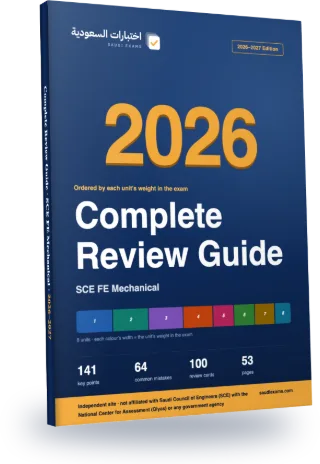
SCE FE Mechanical Complete Review Guide 2026–2027
Every exam topic in a 53-page Arabic PDF, ordered from the heaviest unit to the lightest. The first three chapters alone cover about 48% of the exam questions.
- 53Pages
- 141Key points
- 64Common mistakes
- 100Flashcards
Guide map
Each chapter is one exam unit, ordered by its weight in the real exam.
| Chapter | Unit | Weight | Exam questions | Key points |
|---|---|---|---|---|
| 1 | Mechanical Design and Analysis | 16% | 8 | 16 |
| 2 | Thermodynamics and Thermal Systems | 16% | 8 | 18 |
| 3 | Fluid Mechanics and Fluid Machinery | 16% | 8 | 18 |
| 4 | Engineering Mechanics | 14% | 7 | 18 |
| 5 | System Dynamics and Control | 10% | 5 | 18 |
| 6 | Material Processing and Manufacturing | 10% | 5 | 17 |
| 7 | Heat Transfer | 10% | 5 | 18 |
| 8 | Measurements and Instrumentation | 8% | 4 | 18 |
Chapter 1 in full: Mechanical Design and Analysis
16% of the exam, about 8 questions. These are its key points, as in the guide.
- Normal stress \(\sigma=F/A\), strain \(\varepsilon=\delta/L\), Hooke's law \(\sigma=E\varepsilon\) (ME-T1-01).
- Free thermal expansion \(\delta_T=\alpha L\Delta T\). If fully blocked, \(\sigma=E\alpha\Delta T\) (ME-T1-01).
- Poisson's ratio \(\nu=-\varepsilon_{lat}/\varepsilon_{axial}\) and \(G=E/[2(1+\nu)]\) (ME-T1-01).
The rest of chapter 1, on this page
- Maximum shear (Tresca): yield at \(\tau_{max}=S_y/2\); von Mises is slightly less conservative. Example: \(\sigma_1=100,\sigma_2=0,\sigma_3=-50\) MPa gives \(\sigma'=132.3\) MPa and \(n=300/132.3=2.27\) for \(S_y=300\) (ME-T1-02).
- Buckling: a pinned-pinned column, \(d=20\) mm, \(L=1\) m, \(E=200\) GPa gives \(P_{cr}=15.5\) kN. Effective length factor \(K\): 1 pinned, 0.5 fixed-fixed, 2 fixed-free (ME-T1-02).
- Fatigue: the endurance limit \(S_e\) is reduced by surface, size and loading factors. Goodman: \(1/n=\sigma_a/S_e+\sigma_m/S_{ut}\); with \(\sigma_a=100,\sigma_m=150,S_e=200,S_{ut}=600\), \(n=1.33\). Brittle fracture is governed by fracture toughness \(K_{Ic}\) (ME-T1-02).
- Solid modeling: features (extrude, revolve, fillet, hole) build in sequence in a feature tree. 2D drawings use orthographic projection (first or third angle), sections and dimensions (ME-T1-03).
- Finite elements: split the body into elements and nodes and solve \([K]\{u\}=\{F\}\). Refine the mesh where stress concentrates. Rapid prototyping builds the part layer by layer (FDM, SLA, SLS) (ME-T1-04).
- Axial bar: \(\delta=FL/(AE)\). Torsion: \(\tau=Tr/J\), \(J=\pi d^4/32\) for a solid circle. Example \(T=500\) N·m, \(d=40\) mm gives \(\tau=39.8\) MPa (ME-T1-05).
- Bending: \(\sigma=My/I\). Example: a \(50\times100\) mm section with \(M=1000\) N·m gives \(\sigma=12\) MPa. Combined loads: add normal stresses, then use Mohr's circle (ME-T1-05).
- Reliability: series \(R=\prod R_i\), so components of 0.95 and 0.90 give 0.855; parallel \(R=1-\prod(1-R_i)\) gives 0.995. A decision matrix gives each criterion a weight and score and sums the weighted scores (ME-T1-06).
- Design steps: define the problem and needs, set measurable specifications, generate concepts, evaluate and select, then detailed analysis and prototype. A need is turned into a specification with a number (ME-T1-07).
- Rotating shafts are sized for torsion and bending together, then fatigue. Keep running speed away from the critical speed to avoid resonance. Spring: \(\tau=K_w\,8FD/(\pi d^3)\), with \(K_w\) the Wahl factor. Example: \(G=79.3\) GPa, \(d=2\) mm, \(D=20\) mm, \(N_a=10\) gives \(k=1.98\) kN/m (ME-T1-08).
- Bearings: rolling-bearing life \(L_{10}=(C/P)^{a}\) in millions of revolutions, \(a=3\) for ball and \(10/3\) for roller bearings. Brakes and clutches: friction torque \(T=\mu F r\) in the simple case (ME-T1-08).
- Bolt: preload is about 75% of proof load for a reusable joint. External load \(P\) splits into \(C P\) in the bolt and \((1-C)P\) in the members, where \(C=k_b/(k_b+k_m)\). Weld: fillet throat \(0.707h\); \(h=6\) mm and \(L=100\) mm give a shear area of 424 mm\(^2\) and 47.1 MPa at \(F=20\) kN (ME-T1-09).
- Factor of safety \(n=\) strength / actual stress, and allowable stress \(\sigma_{allow}=S_y/n\). Use a larger \(n\) with more uncertainty in loads or material and with more severe failure consequences. Standards (ASME, ISO, AISC) set minimums (ME-T1-10).
Common mistakes in this chapter
- Mixing mm and m: \(I\) in mm\(^4\) converts to m\(^4\) by multiplying by \(10^{-12}\) (ME-T1-05).
- Thermal stress appears only when expansion is blocked. A free member grows by \(\delta=\alpha L\Delta T\) with no stress (ME-T1-01).
- Euler's formula does not apply to short columns. Check the slenderness ratio \(KL/r\) first (ME-T1-02).
- Fatigue safety factor comes from a fatigue criterion (Goodman or Soderberg), not from \(S_y\) alone (ME-T1-02).
- Forgetting that mean stress matters in fatigue, and that \(S_e\) is reduced by surface, size and loading factors (ME-T1-02).
- Reliability: parallel raises it, series lowers it. Do not multiply the \(R\) values in a parallel system (ME-T1-06).
- Bolt loading: the external load does not simply add to preload. The bolt and clamped members share it by stiffness (ME-T1-09).
- Compute the factor of safety from the governing stress with a criterion suited to the material, not from one directional stress (ME-T1-10).
The other chapters are in the full guide
One purchase · lifetime access · review guide included
7-day review plan
The chapters are spread over 6 days by weight so each day carries a similar load. Day 7 is a full exam.
Day 1 · 16% of the exam
Chapter 1: Mechanical Design and Analysis
Day 2 · 16% of the exam
Chapter 2: Thermodynamics and Thermal Systems
Day 3 · 16% of the exam
Chapter 3: Fluid Mechanics and Fluid Machinery
Day 4 · 14% of the exam
Chapter 4: Engineering Mechanics
Day 5 · 20% of the exam
Chapter 5: System Dynamics and Control
Chapter 7: Heat TransferDay 6 · 18% of the exam
Chapter 6: Material Processing and Manufacturing
Chapter 8: Measurements and InstrumentationDay 7
Full mock exam: 50 questions in 180 minutes, then review the common mistakes in the units where you lost marks.
Before you read: see your score today
10 free questions from the main units, no sign-up. Then you know which chapter to start with.
Try 10 free questions and see your levelA look at each chapter
The first three key points of each chapter, as they appear in the guide (in Arabic in the PDF).
Chapter 1: Mechanical Design and Analysis
- Normal stress \(\sigma=F/A\), strain \(\varepsilon=\delta/L\), Hooke's law \(\sigma=E\varepsilon\) (ME-T1-01).
- Free thermal expansion \(\delta_T=\alpha L\Delta T\). If fully blocked, \(\sigma=E\alpha\Delta T\) (ME-T1-01).
- Poisson's ratio \(\nu=-\varepsilon_{lat}/\varepsilon_{axial}\) and \(G=E/[2(1+\nu)]\) (ME-T1-01).
Chapter 2: Thermodynamics and Thermal Systems
- Isobaric
- Isothermal ideal gas
- Reversible adiabatic ideal gas
Chapter 3: Fluid Mechanics and Fluid Machinery
- Pressure in a static liquid is \( p=p_0+\rho g h \). Example
- Continuity for incompressible fluid
- Bernoulli
Chapter 4: Engineering Mechanics
- Rectilinear motion
- Circular motion
- Newton's second law
Chapter 5: System Dynamics and Control
- Laplace pairs
- Derivative
- Transfer function \(G(s)=Y(s)/U(s)\) with zero initial conditions; poles are the roots of the denominator…
Chapter 6: Material Processing and Manufacturing
- Common crystal structures
- Engineering stress \(\sigma = F/A_0\). A 10 mm diameter bar under 20 kN: \(\sigma…
- Metals are ductile and tough, ceramics hard and brittle, polymers light, flexible and sensitive…
Chapter 7: Heat Transfer
- Fourier's law
- Plane wall
- Hollow cylinder
Chapter 8: Measurements and Instrumentation
- Error = reading minus true value. Systematic error (bias) can be calibrated out. Random…
- Accuracy is closeness to the true value. Precision is spread of repeated readings. Resolution…
- For \( y=f(x_1,x_2,\dots) \)
The full guide comes with lifetime access
The full guide (53 pages) is included with lifetime access to this exam, together with every question and full mock exam. Chapter 1 is free for everyone.
Questions about the guide
Is the guide free?
Chapter 1 is free to read on the guide page. The full guide comes with lifetime access to this exam; 7-day access does not include it.
Is it up to date for 2026–2027?
Yes. Unit weights and exam facts follow what the exam body last published, and the last check date is printed in the guide. If the standards change we update the file and buyers download the new version.
Does the guide have questions?
No. The guide covers key points and common mistakes; scoring, weak-area practice and full mock exams are on the site.
Can I read it on my phone?
Yes. A5 pages in a single column, with chapters linked from the contents.
- Pages
- 53
- Edition
- 1448 AH · 2026–2027
- Language
- Arabic
- Last updated
All Engineering Exams review guides
Back to Saudi Council of Engineers FE Exam: Mechanical Engineering Part
Full prep for this exam
All of this in one purchase.
- Full mock exam, same as the real one50 questions in 180 minutes. You get a total score and a score for every unit.
- Practice unit by unit530 questions, every option explained with its source. Starts with your weakest units.
- Complete Review Guide 2026–2027 (PDF)Ordered by each unit's weight in the exam. With lifetime access only.
Choose your access
Continue with your Google account and you go straight to the payment page.