FE
SCE FE Mechanical Part Syllabus: 8 Topics and 50 Questions
The 8 topics of the SCE FE mechanical part with questions per topic, what each tests and how to prepare, led by design, thermodynamics and fluids.
- Questions and time
- 50 questions · 180 minutes
- Pass mark
- You must pass both the general part and your discipline part
- Exam fee
- SAR 400 for the general part and SAR 400 for the discipline part
Start with 10 free questions to find what needs more work. No sign-up, with answer explanations.
Try 10 free questions and see your levelPut what you just read into practice
Start with 10 free questions to find what needs more work. No sign-up, with answer explanations.
Try 10 free questions and see your levelLast checked: 17 November 2026. Check the Mechanical Engineering Standards, the Mechanical Engineering Exam Study Guide and the SCE frequently asked questions before you start.
The mechanical part is the second session of the Fundamentals of Engineering (FE) exam: 50 questions in 8 topics, all in English. Mechanical design, thermodynamics and fluid mechanics alone are 24 questions, 48% of the part, and most are calculation problems. The topics and question counts come from the table of specifications in the study guide; the indicators come from the standards document. Both are the 2014 edition.
Exam format at a glance
| Item | Details |
|---|---|
| Questions | 50 in the mechanical part; the general part is a separate session with 90 |
| Time | 3 hours (180 minutes), about 3.6 minutes per question |
| Question type | Multiple choice with four options, and no penalty for wrong answers according to the study guide |
| Language | English |
| Calculator | Approved models are allowed. Formula sheets and data tables are handed out in the hall; books and notes are not allowed |
| Result | You must pass both the general part and the mechanical part |
You register for both parts together, at SAR 400 per part. The SCE also accepts the US NCEES FE exam, which is a different exam with 110 questions; this site follows the SCE-Qiyas exam.
The 8 topics, what is asked and how to prepare
| Topic | Questions | Weight | What is tested | How to prepare |
|---|---|---|---|---|
| Mechanical Design and Analysis | 8 | 16% | Stress and strain (mechanical and thermal), failure theories, fatigue and fracture, deformable-body behaviour under axial, torsion, bending and combined loads, design of shafts, springs, gears, bearings, brakes and clutches, bolted and welded joints, and factors of safety. | Ten indicators for 8 questions. Practise shaft sizing, von Mises and Goodman checks, bolt preload and weld stress until each takes about three minutes. |
| Engineering Mechanics | 7 | 14% | Kinematics and kinetics of particles and planar rigid bodies, work-energy, impulse-momentum and impact, static and dynamic force analysis, degrees of freedom of mechanisms, velocity and acceleration of linkages, gear trains, cams and balancing. | Learn instantaneous centres and relative-velocity equations, then moment-of-inertia based problems. Count degrees of freedom with Gruebler's equation and trace gear-train ratios. |
| System Dynamics and Control | 5 | 10% | Laplace transforms, transfer functions and block diagrams, natural frequency and resonance, modelling of mechanical, electrical, hydraulic, pneumatic and thermal systems, vibration under dynamic loads, PI, PD and PID controllers, second-order response, Routh stability and frequency response. | Know the second-order response formulas and the Routh table by heart, then model a spring-mass-damper from its equation. Know what each PID term does to the response. |
| Material Processing and Manufacturing | 5 | 10% | Properties of metals, polymers, ceramics and alloys, equilibrium phase diagrams and the lever rule, basic manufacturing processes, heat treatment of steels, process selection, cutting forces and power, material selection, tolerances, and testing equipment. | Practise the lever rule on a phase diagram and the Taylor tool-life equation. For process selection, learn which process fits which batch size, material and accuracy. |
| Measurements and Instrumentation | 4 | 8% | Accuracy, resolution and instrument specifications, uncertainty analysis, sampling and aliasing, ADC resolution, signal conditioning with bridges and amplifiers, filters, and choosing a technique from a confidence interval. | Only 4 questions, so cover the repeating calculations: root-sum-square uncertainty, t-based confidence intervals, Nyquist rate and bridge output. |
| Thermodynamics and Thermal Systems | 8 | 16% | Processes, heat and work, closed and open systems, steam, refrigerant and air properties, h-s diagrams, first-law analysis of nozzles, turbines, compressors and heat exchangers, cycles, combustion, and second-law feasibility, entropy and COP. | Calculation-heavy. Always convert to kelvin, check the sign of work and heat, and write the steady-flow energy equation first. Practise isentropic turbine work and cycle efficiency. |
| Fluid Mechanics and Fluid Machinery | 8 | 16% | Fluid statics, Bernoulli and continuity, Reynolds number and flow type, forces on submerged bodies, momentum balance, Moody chart and pipe losses, pump power, slip factor, specific speed, similarity laws and pump and system curves. | Practise head-loss problems with the Darcy equation, then find the operating point from a pump curve and a system curve. Learn the three similarity laws for speed changes. |
| Heat Transfer | 5 | 10% | Conduction, convection and radiation laws, composite walls and thermal resistance, lumped transient response, forced and free convection correlations, and heat exchangers by LMTD and effectiveness-NTU. | Draw the thermal-resistance network first. Know when the lumped model applies (Bi below 0.1), and practise LMTD for counter flow and the effectiveness-NTU relations. |
Where to start
Mechanical design (8), thermodynamics (8) and fluid mechanics (8) carry 24 of the 50 questions, so start there and give them most of your time. Engineering mechanics (7) comes next. Control (5), manufacturing (5) and heat transfer (5) have shorter question types, and measurements (4) weighs least; cover the repeating problem types in them and move on.
How the free questions help
Solve the 10 free questions before you plan, so you see your score in each topic. A weak score in a large topic deserves extra days before any small topic. Because the exam is in English, learn the terms in English from the start, and use your approved calculator on every calculation problem.
Finished reading? Try a set of questions
Start with 10 free questions to find your weakest units. Keep practising with the full question bank and mock exams from SAR 26.
Put the plan to work here
SAR 34 $9
One purchase · lifetime access · review guide included
- 530 questions, every option explained with its source
- Full mock exams: 50 questions in 180 minutes, like the real one
- Practice that starts with your weakest units, plus a review of your mistakes
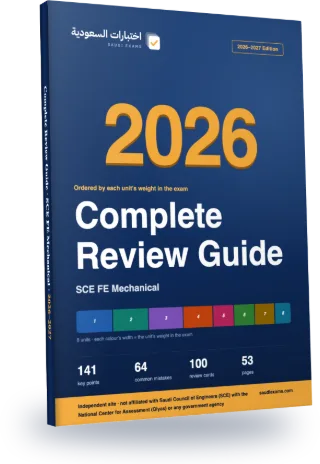 Complete Review Guide 2026–2027 included (PDF)Ordered by the weight of each unit in the examBuy now · SAR 34or 7 days for SAR 26
See everything included
Full mock exams like the real one and 530 explained questions that find your weak spots and train them
- Unlimited full mock exams to practise your pace and check your performance across the whole exam
- Practise 10 weak-area questions, starting where you lose the most marks
- 530 questions explaining why every option is right or wrong
- Arabic and English with one pass
- Unit notes and flashcards, then questions to check your understanding
If you fail either part you pay its fee again (SAR 400) and wait for the next sitting, and you cannot get the Associate Engineer grade until you pass both parts. Source Last verified: 2026-11-17