Dietetic Technician Syllabus: 11 Sections and Weights
The eleven Dietetic Technician exam sections with official weights, what each covers, how our 150-question mock exam splits them, and the official reference books.
- Questions and time
- 150 questions · 3 hours
- Pass mark
- 55%
- correct answers to pass (55%)
- 83 of 150
- Exam fee
- Paid to SCFHS online when you apply through Mumaris Plus; the amount is shown in your application
Start with 10 free questions to find what needs more work. No sign-up, with answer explanations.
Try 10 free questions and see your levelPut what you just read into practice
Start with 10 free questions to find what needs more work. No sign-up, with answer explanations.
Try 10 free questions and see your levelLast checked: 17 November 2026. Weights and content can change at any time, so check the classification exams page on the SCFHS website and the Dietetic Technician content guideline (PDF) before you start studying. This is an independent guide. It is not affiliated with the Saudi Commission for Health Specialties (SCFHS), Prometric, Pearson VUE or any government body.
The SCFHS Dietetic Technician exam is a single exam with eleven sections. Food science and normal nutrition (15%), safety and sanitation (14%) and medical nutrition therapy (13%) are the largest. Use this page to decide where to start.
Exam format at a glance
| Item | Details |
|---|---|
| Questions | 150 multiple-choice questions |
| Time | 3 hours |
| Pass mark | 55% (technician level) |
| Distribution | The real distribution can differ from the published weights by up to 5% (plus or minus) in each section |
| Exam language | Not stated by SCFHS. The guideline and its books are in English, so we treat the exam as English (our inference); confirm in your application. |
The eleven sections and their weights
SCFHS publishes one percentage per section. The last column is the split we use in our full mock exam (150 questions): the official percentage times 150, rounded to a whole number, so the total is 150.
| Section | Official weight | Questions in our mock exam |
|---|---|---|
| 1. Fundamentals of Dietetics | 10% | 15 |
| 2. Disease Prevention and Health Promotion | 10% | 15 |
| 3. Nutrition Screening, Assessment and Counseling | 7% | 10 |
| 4. Medical Nutrition Therapy | 13% | 20 |
| 5. Food Science and Normal Nutrition | 15% | 22 |
| 6. Principles of Food Preparation and Training | 6% | 9 |
| 7. Menu Planning | 10% | 15 |
| 8. Procurement and Materials Management | 5% | 8 |
| 9. Food Production, Distribution and Facility Design | 5% | 7 |
| 10. Safety and Sanitation | 14% | 21 |
| 11. Community Nutrition | 5% | 8 |
| Total | 100% | 150 |
The guideline names the eleven sections and has no detailed topic list. The topic lists below are our own breakdown, built from the section names and the books SCFHS lists, and are not an official outline.
Section 1: Fundamentals of Dietetics (10%, 15 questions)
The profession, the Nutrition Care Process (assessment, diagnosis, intervention, monitoring), ethics and confidentiality, and energy, nutrients and dietary reference values with the basic calculations.
- The dietetics profession, the Nutrition Care Process and ethics
- Energy, nutrients, dietary reference intakes and basic calculations
Section 2: Disease Prevention and Health Promotion (10%, 15 questions)
Dietary guidelines and healthy eating patterns, preventing obesity, diabetes, heart disease and hypertension, health promotion, behavior change and physical activity.
- Dietary guidelines and healthy eating patterns
- Preventing obesity, diabetes, heart disease and hypertension
- Health promotion, behavior change and physical activity
Section 3: Nutrition Screening, Assessment and Counseling (7%, 10 questions)
Screening versus assessment, anthropometrics, the biochemical, clinical and dietary methods of assessment, and counseling and communication skills.
- Nutrition screening and anthropometrics
- Nutritional assessment: biochemical, clinical and dietary methods
- Nutrition counseling and communication skills
Section 4: Medical Nutrition Therapy (13%, 20 questions)
Diabetes, heart disease and hypertension, kidney, liver and gastrointestinal disease, tube and intravenous feeding, dysphagia, food allergy and malnutrition.
- Diabetes and nutrition
- Cardiovascular disease, hypertension and lipids
- Kidney, liver and gastrointestinal disease
- Enteral and parenteral nutrition, dysphagia, food allergy and malnutrition
Section 5: Food Science and Normal Nutrition (15%, 22 questions)
Carbohydrate, protein and fat, vitamins, minerals and water, digestion and metabolism, nutrition across the life cycle, and food science.
- Carbohydrates, fiber, protein and fat
- Vitamins, minerals and water
- Digestion, absorption and metabolism
- Nutrition across the life cycle
- Food science: food properties and cooking reactions
Section 6: Principles of Food Preparation and Training (6%, 9 questions)
Cooking methods, standardized recipes and portioning, and training food service employees.
- Cooking methods, standardized recipes and portioning
- Employee training and evaluating training
Section 7: Menu Planning (10%, 15 questions)
Menu types and planning factors, menus for nutrition standards and populations, therapeutic and texture-modified menus, and menu evaluation.
- Menu types and the factors that shape a menu
- Therapeutic menus, texture modification and menu evaluation
Section 8: Procurement and Materials Management (5%, 8 questions)
Purchasing methods, specifications and vendors, receiving, storage and inventory control.
- Purchasing methods, specifications and vendor selection
- Receiving, storage and inventory control
Section 9: Food Production, Distribution and Facility Design (5%, 7 questions)
Production planning, distribution and service systems, kitchen layout, equipment and work flow.
- Production planning, distribution and service systems
- Kitchen design, equipment and work flow
Section 10: Safety and Sanitation (14%, 21 questions)
Foodborne illness, personal hygiene, time and temperature control, cross-contamination, cleaning and sanitizing, pest control, HACCP and allergens.
- Foodborne illness and personal hygiene
- Time and temperature control and cross-contamination
- Cleaning, sanitizing, pest control and equipment
- HACCP and food allergen control
Section 11: Community Nutrition (5%, 8 questions)
Community needs assessment, nutrition program planning, public nutrition problems such as malnutrition and anaemia, and infant feeding.
- Community needs assessment and nutrition program planning
- Public nutrition: malnutrition, anaemia, infant feeding and food security
Official reference list
SCFHS lists these books as a study aid only. It states that the list does not imply endorsement, and that exam questions are not necessarily taken from them. Each is meant as the latest edition.
- Rolfes, Pinna and Whitney, Understanding Normal and Clinical Nutrition
- Mahan, Raymond and Escott-Stump, Krause's Food and the Nutrition Care Process
- American Diabetes Association and American Dietetic Association, Choose Your Foods: Exchange Lists for Diabetes
- Escott-Stump, Nutrition and Diagnosis-Related Care
- Gregoire, Foodservice Organizations: A Managerial and Systems Approach
- Vaclavik and Christian, Essentials of Food Science
- Amy Brown, Understanding Food: Principles and Preparation
- Katsilambros et al., Clinical Nutrition in Practice
How it differs from the SCNLE
This is the dietetic technician exam: 150 questions, eleven sections and a 55% pass mark. The Saudi Clinical Nutrition Licensure Examination (SCNLE) is the licensure exam for clinical nutrition specialists, with 200 questions and four sections. Do not study from the SCNLE material for this exam.
How our practice follows this syllabus
Our questions are in English. The section split in our full mock exam is the one in the table above, and every practice set ends with your result in each section so you know where to start. For the explanations we use public documents such as the FDA Food Code, the Dietary Guidelines for Americans, the Dietary Guidelines for Saudis from the Saudi Ministry of Health and World Health Organization fact sheets.
Finished reading? Try a set of questions
Start with 10 free questions to find your weakest units. Keep practising with the full question bank and mock exams from SAR 26.
Put the plan to work here
SAR 34 $9
One purchase · lifetime access · review guide included
- 555 questions, every option explained with its source
- Full mock exams: 150 questions in 180 minutes, like the real one
- Practice that starts with your weakest units, plus a review of your mistakes
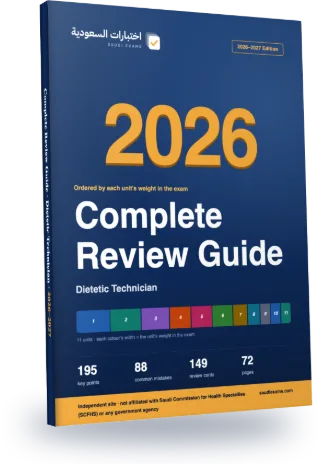 Complete Review Guide 2026–2027 included (PDF)Ordered by the weight of each unit in the examBuy now · SAR 34or 7 days for SAR 26
See everything included
Full mock exams like the real one and 555 explained questions that find your weak spots and train them
- Unlimited full mock exams to practise your pace and check your performance across the whole exam
- Practise 10 weak-area questions, starting where you lose the most marks
- 555 questions explaining why every option is right or wrong
- Arabic and English with one pass
- Unit notes and flashcards, then questions to check your understanding
This exam is part of professional classification as a dietetic technician, and you cannot get a practice licence without classification. If you do not pass you get further attempts under SCFHS rules and pay the evaluation fee. Source Last verified: 2026-11-17