Midwifery Technician Syllabus: 10 Sections and Their Weights
The ten Midwifery Technician exam sections with official weights, what each covers, our 150-question mock split, and the reference books.
- Questions and time
- 150 questions · 3 hours
- Pass mark
- 55%
- correct answers to pass (55%)
- 83 of 150
- Exam fee
- Paid to SCFHS online when you apply through Mumaris Plus; the amount is shown in your application
Start with 10 free questions to find what needs more work. No sign-up, with answer explanations.
Try 10 free questions and see your levelPut what you just read into practice
Start with 10 free questions to find what needs more work. No sign-up, with answer explanations.
Try 10 free questions and see your levelLast checked: 17 November 2026. Weights and content can change at any time, so check the classification exams page on the SCFHS website and the Midwifery Technician content guideline (PDF) before you start studying. This is an independent website, not affiliated with the Saudi Commission for Health Specialties, Prometric or Pearson VUE.
The SCFHS Midwifery Technician exam is a single exam with ten sections. Intrapartum Care alone carries 40%, and with Postpartum Care (15%) and Antepartum Care (10%) it makes up 65% of the exam. Use this page to decide where to start.
Exam format at a glance
| Item | Details |
|---|---|
| Questions | 150 multiple-choice questions |
| Time | 3 hours |
| Pass mark | 55% (Technician) |
| Distribution | The real distribution can differ from the published weights by up to 5% (plus or minus) in each section |
| Exam language | The guideline does not state it. We treat the exam as English because the reference books it lists are English; this is our inference, so confirm it in your application. |
The ten sections and their weights
SCFHS publishes one percentage per section. The last column is the split we use in our full mock exams (150 questions): the official percentage times 150, rounded to a whole number, with the seven 5% sections rounded so that the total is 150.
| Section | Official weight | Questions in our mock exam |
|---|---|---|
| 1. Antenatal Care | 5% | 8 |
| 2. Intrapartum Care | 40% | 60 |
| 3. Antepartum Care | 10% | 15 |
| 4. Postpartum Care | 15% | 22 |
| 5. Newborn Care | 5% | 7 |
| 6. Gynecological Care | 5% | 8 |
| 7. Pharmacology in Midwifery | 5% | 8 |
| 8. Counseling and Education | 5% | 7 |
| 9. Patient Safety | 5% | 8 |
| 10. Professionalism and Ethics | 5% | 7 |
| Total | 100% | 150 |
Intrapartum Care is 60 of 150 questions on its own. Postpartum is 22 and Antepartum is 15. The other seven sections are 7 or 8 questions each. Our practice questions follow the same split, and your result is shown section by section.
A note on detail: the SCFHS guideline gives only the ten section names and their weights. It has no topic list under each section. We read Antenatal Care as routine care in a normal pregnancy (check-ups and education), and Antepartum Care as complications during pregnancy. The topic lists below are our own breakdown, built from the section names and from the subjects of the reference books SCFHS names, and are not an official outline.
Section 1: Antenatal Care (5%, 8 questions)
- Booking visit and routine check-ups: history, examination, schedule of visits.
- Screening and tests offered in a normal pregnancy.
- Normal changes of pregnancy and common minor complaints.
- Nutrition, supplements and health education during pregnancy.
- Birth preparation and danger signs to report.
How to prepare: a small section with predictable questions. Learn what is done at each visit and which findings mean the woman should be referred.
Section 2: Intrapartum Care (40%, 60 questions)
- Labour and its stages: onset, assessment on admission, progress, partograph.
- Fetal monitoring: intermittent auscultation and CTG interpretation. CTG Interpretation and Fetal Heart Monitoring are both on the SCFHS reference list.
- Comfort and support in labour and pain relief options.
- Normal birth: second stage, care of the perineum, third stage and delivery of the placenta.
- Induction and augmentation of labour.
- Abnormal labour and emergencies: prolonged or obstructed labour, malpresentation, shoulder dystocia, cord prolapse, postpartum haemorrhage, and when to call for help or transfer.
How to prepare: this is the section to master. Give it two weeks. For emergencies, learn the steps in order and say them aloud, because questions ask what you do first. Practise reading CTG patterns by recognising the shape first and then linking it to what it means for the baby.
Section 3: Antepartum Care (10%, 15 questions)
- Hypertensive disorders of pregnancy and pre-eclampsia.
- Diabetes and other medical conditions in pregnancy.
- Bleeding in pregnancy and early pregnancy loss.
- Preterm labour and rupture of membranes.
- Infections, anaemia and multiple pregnancy.
- Fetal growth and wellbeing concerns.
How to prepare: for each complication, write the same four lines: how it presents, what you assess, what you do first, and when you refer. Questions usually give a short case and ask for the next action.
Section 4: Postpartum Care (15%, 22 questions)
- Normal recovery: uterine involution, lochia, perineal care and rest.
- Postpartum complications: haemorrhage, infection, thromboembolism, hypertension and perineal problems.
- Breastfeeding support and common feeding problems.
- Emotional wellbeing and postpartum mood disorders.
- Family planning and discharge advice.
How to prepare: learn the normal findings by day so that you can spot a deviation. Treat postpartum haemorrhage as a drill, in the same step-by-step way as in Section 2.
Section 5: Newborn Care (5%, 7 questions)
- Immediate care at birth: drying, warmth, skin-to-skin contact, cord care and Apgar score.
- Newborn resuscitation.
- Routine examination and normal findings.
- Feeding, jaundice and infection in the newborn.
- Low birth weight and preterm babies, including kangaroo mother care.
How to prepare: learn the resuscitation sequence in order, and the danger signs that mean a baby needs urgent review.
Section 6: Gynecological Care (5%, 8 questions)
- Menstrual disorders and the menopause.
- Contraception: methods, who each suits and who it does not.
- Genital tract infections and sexually transmitted infections.
- Cervical screening and common gynaecological conditions.
How to prepare: make a contraception table (method, how it works, main contraindications, main side effects) and rebuild it from memory.
Section 7: Pharmacology in Midwifery (5%, 8 questions)
- Drugs used in labour and birth: oxytocics, uterotonics and drugs for pain.
- Drugs for hypertension and pre-eclampsia, including magnesium sulfate.
- Drugs in the newborn period and during breastfeeding.
- Contraceptive and gynecological drugs.
- Dosing, routes, side effects and safe administration.
How to prepare: for each drug write the use, the dose and route, the main side effects and the key check before giving it. Study drugs alongside the clinical topics above, because the questions are usually set inside a clinical case. Practise dose calculations by hand.
Section 8: Counseling and Education (5%, 7 questions)
- Counseling skills: listening, open questions, giving information in a way the woman understands.
- Informed choice and consent.
- Health education for pregnancy, birth, breastfeeding, newborn care and family planning.
- Counseling in difficult situations, such as pregnancy loss or a baby who is unwell.
How to prepare: in these questions the best answer is usually the one that respects the woman's choice and gives clear, balanced information. Read the stem for what she has said she wants.
Section 9: Patient Safety (5%, 8 questions)
- Infection prevention and hand hygiene.
- Safe medication practice.
- Patient identification, handover and communication.
- Checklists, incident reporting and learning from errors.
How to prepare: learn the standard safety steps and use them as a checklist when you read a case. Essentials of Patient Safety is on the SCFHS reference list.
Section 10: Professionalism and Ethics (5%, 7 questions)
- Professional conduct and the limits of your role.
- Confidentiality and privacy.
- Consent and respect for the woman's wishes.
- Accountability, documentation and working with the team, including when to refer or escalate.
How to prepare: read the SCFHS Professionalism and Ethics Handbook from the reference list if you can get it, and practise short scenario questions. The safe answer usually protects the woman, stays within your role and escalates when you are unsure.
Official reference list
SCFHS lists these books as a study aid only. It states that exam questions are not necessarily taken from them.
- Green, Maternal Newborn Nursing Care Plans (3rd ed.)
- Brucker and King, Pharmacology for Women's Health (2nd ed.)
- Schuiling and Likis, Women's Gynecologic Health (2nd ed.)
- Chandraharan, CTG Interpretation: From Patterns to Physiology (2017)
- Fetal Heart Monitoring
- Master the NCLEX-PN: Maternal/Newborn Nursing
- Mayes' Midwifery
- Lippincott, NCLEX-RN Maternal-Neonatal Nursing Made Incredibly Easy
- SCFHS, Professionalism and Ethics Handbook for Residents
- SCFHS, Essentials of Patient Safety
How it differs from the Midwifery Specialist exam
This is the technician exam, with its own content guideline: ten sections and a 55% pass mark. The Midwifery Specialist exam is a different exam, with its own page on the SCFHS list, its own content guideline and its own sections and pass mark. Do not study from the specialist guide for this exam.
How our practice follows this syllabus
Our questions are in English. The section split in our full mock exam is the one in the table above, and every practice set ends with your result in each section so you know where to start.
Finished reading? Try a set of questions
Start with 10 free questions to find your weakest units. Keep practising with the full question bank and mock exams from SAR 26.
Put the plan to work here
SAR 34 $9
One purchase · lifetime access · review guide included
- 547 questions, every option explained with its source
- Full mock exams: 150 questions in 180 minutes, like the real one
- Practice that starts with your weakest units, plus a review of your mistakes
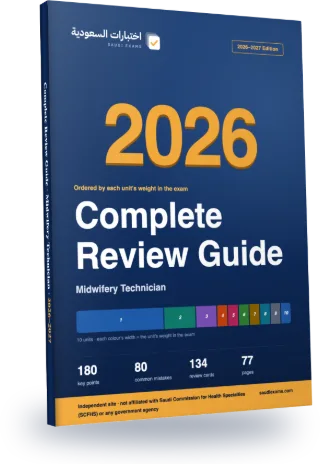 Complete Review Guide 2026–2027 included (PDF)Ordered by the weight of each unit in the examBuy now · SAR 34or 7 days for SAR 26
See everything included
Full mock exams like the real one and 547 explained questions that find your weak spots and train them
- Unlimited full mock exams to practise your pace and check your performance across the whole exam
- Practise 10 weak-area questions, starting where you lose the most marks
- 547 questions explaining why every option is right or wrong
- Arabic and English with one pass
- Unit notes and flashcards, then questions to check your understanding
This exam is part of professional classification as a midwifery technician, and you cannot get a practice licence without classification. If you do not pass you get further attempts under SCFHS rules and pay the evaluation fee. Source Last verified: 2026-11-17