Respiratory Therapy Technician Study Plan: 6 Weeks, or 2
A study plan for the SCFHS Respiratory Therapy Technician exam by the weight of its 11 sections: assessment, equipment and therapy first, then airway and ventilation, and a full mock two days before.
- Questions and time
- 150 questions · 180 minutes
- Pass mark
- 55%
- correct answers to pass (55%)
- 83 of 150
- Exam fee
- Check the current fee when you apply for eligibility and book through the approved channels.
Start with 10 free questions to find what needs more work. No sign-up, with answer explanations.
Try 10 free questions and see your levelPut what you just read into practice
Respiratory Therapy Technician (SCFHS)
Start with 10 free questions to find what needs more work. No sign-up, with answer explanations.
Try 10 free questions and see your levelLast checked: 17 November 2026. Check the SCFHS website and the Respiratory Therapy Technician content guideline (PDF) before you start, because weights and rules can change. This is an independent guide with no link to SCFHS, Prometric or any government body.
The exam has 150 questions across 11 sections. Assessment and Evaluation, Equipment Manipulation and Therapeutic Procedures together are 44% of it, and Airway Patency and Care and Mechanical Ventilation are 12% each. This plan starts with assessment because it is the largest section and blood gas reading and ventilator settings build on it, gives each big block its own days, and keeps the last week for gaps and a full mock. The detail of each section is in the exam content guide, and the application steps are in the registration guide.
Numbers to build your plan on
| Item | What it means for your study |
|---|---|
| 150 multiple-choice questions | Per the SCFHS content guideline. The guideline does not state the number of options; our questions use four. |
| 3 hours | 180 minutes for 150 questions is 72 seconds a question. Practise sitting the full time in one go. |
| Pass mark 55% | Your result on this site shows your percentage in each section, so you can compare sections and track progress. |
| Shares can move by up to 5 percentage points | Do not skip a small section. The five smallest (Bronchial Hygiene, Infection Control, Pulmonary Rehabilitation and Home Care, Patient Safety, Patient Education) add up to 36 questions, 24% of the exam. |
| Language | The guideline does not state it. We assume English (our inference), so revise terms in English from the start. Our questions and explanations are in English. |
| Calculator | Not mentioned in the guideline, so practise any calculation by hand with simple numbers. |
Split your time by section
The percentages are the official weights. The question counts are the split in our 150-question full mock exam (the percentage times 150, rounded to a total of 150):
| Section | Official weight | Questions | Your time in the plan |
|---|---|---|---|
| Assessment and Evaluation | 15% | 23 | Week 1 |
| Equipment Manipulation, Troubleshooting and Quality Control | 15% | 22 | Week 2 |
| Therapeutic Procedures | 14% | 21 | Week 2–3 |
| Airway Patency and Care | 12% | 18 | Week 3 |
| Mechanical Ventilation | 12% | 18 | Week 4 |
| Patient Data | 8% | 12 | Week 4 |
| Bronchial Hygiene Techniques | 6% | 9 | Week 4 |
| Infection Control | 5% | 8 | Week 5 |
| Pulmonary Rehabilitation and Home Care | 5% | 7 | Week 5 |
| Patient Safety | 5% | 8 | Week 5 |
| Patient Education | 3% | 4 | Week 5 |
Assessment and Evaluation takes all of Week 1 along with your first check. Equipment takes the start of Week 2 and Therapeutic Procedures follows, finishing in Week 3 alongside Airway Patency and Care. Mechanical Ventilation opens Week 4, followed by Bronchial Hygiene and Patient Data. The four remaining small sections (Infection Control, Pulmonary Rehabilitation and Home Care, Patient Safety, Patient Education), 27 questions in total, share Week 5.
6-week plan
The plan assumes one to two hours a day. Count six weeks back from your booking date, once your scheduling permit shows the booking window. The same rhythm repeats each week: five days of reading and practice, one day to redo the week's mistakes, and one light day.
Week 1: Assessment and Evaluation
- Day 1: Take the free practice test (10 free questions, no sign-up). Note your percentage in each section and your three weakest sections.
- Day 2: Physical assessment and auscultation. Day 3: Arterial blood gas sampling and interpretation. Day 4: Pulse oximetry and capnography.
- Day 5: Pulmonary function testing. Day 6: Chest radiograph basics. Blood gas interpretation is among the most-tested skills, so practise it with many examples.
Week 2: Equipment and Therapeutic Procedures
- Day 1: Oxygen delivery devices and gas supply. Day 2: Humidification and aerosol generators. Day 3: Ventilator and circuit checks, alarms.
- Day 4: Blood gas analyzer and equipment quality control.
- Day 5: Oxygen therapy.
- Day 6: Aerosolized medications and bronchodilators.
Week 3: Therapeutic Procedures and Airway Patency and Care
- Day 1: Lung expansion therapy and CPAP/BiPAP. Day 2: Asthma, COPD and emergency respiratory care.
- Day 3: Airway positioning and adjuncts. Day 4: Endotracheal intubation and extubation.
- Day 5: Tracheostomy care. Day 6: Suctioning and cuff management.
Week 4: Mechanical Ventilation, Bronchial Hygiene and Patient Data
- Day 1: Indications, modes and settings. Day 2: Ventilator graphics, mechanics and alarms. Day 3: ARDS and lung-protective ventilation.
- Day 4: Weaning and extubation.
- Day 5: Bronchial Hygiene: Postural drainage, percussion and vibration, then Cough techniques, PEP and airway clearance devices.
- Day 6: Patient Data: Chart review and patient history; Vital signs and physical findings; Reading orders, labs and imaging data.
Week 5: The small sections and a first sweep
- Day 1: Infection Control: Standard and transmission-based precautions; Equipment disinfection and sterilization; Ventilator-associated pneumonia prevention.
- Day 2: Pulmonary Rehabilitation and Home Care: Pulmonary rehabilitation, then Home oxygen and home ventilation.
- Day 3: Patient Safety: Oxygen, fire and gas cylinder safety; Basic and advanced life support; Hand hygiene, error prevention and ethics.
- Day 4: Patient Education: Inhaler technique and disease self-management, then Smoking cessation and communication.
- Day 5: Open the practice area, pick your two weakest sections and answer 10 questions from each topic.
Week 6: Close the gaps and sit the full mock
- Days 1–3: Redo every question in your mistake book, then practise your weakest topics 10 questions at a time.
- Day 4: A light day. Read your notes on assessment, equipment and mechanical ventilation.
- Day 5 (two days before the exam): Sit a full mock exam (next section).
- Day 6: Review only the mock's mistakes, and do not open a new topic.
The full mock, two days before the real exam
- 150 questions in 180 minutes, in one sitting. The content guideline does not mention a break, so do not plan one.
- No phone and no notes. Calculate by hand.
- If a question stops you, flag it and move on. At 72 seconds a question, a slow one takes time from the next.
- When you finish, open each section's result. The section with the lowest percentage is what you revise on your last study day.
2-week plan if time is short
Build it on the sections with the most questions:
| Day | Task |
|---|---|
| 1 | Free practice test (10 questions) and find your weakest sections |
| 2 | Assessment and Evaluation |
| 3 | Equipment Manipulation, Troubleshooting and Quality Control |
| 4 | Therapeutic Procedures |
| 5 | Airway Patency and Care |
| 6 | Mechanical Ventilation |
| 7 | Patient Data and Bronchial Hygiene Techniques |
| 8 | Infection Control and Pulmonary Rehabilitation and Home Care |
| 9 | Patient Safety and Patient Education |
| 10–12 | Mistake book and weakest topics (10 questions per topic) |
| 13 | Full mock: 150 questions in 180 minutes |
| 14 | Review only the mock's mistakes, then sleep early |
How to handle your mistakes
- Read the explanation of every option, not just the correct answer. Today's wrong option can be tomorrow's right one.
- Write the cause of each mistake in one phrase: a missing fact, two terms mixed up, an arithmetic slip, or a rushed read. One cause usually repeats.
- Redo the missed questions after two days and again after a week. When you answer one correctly twice in a row, remove it from your book.
What this site adds to your plan
- Free practice test: 10 free questions from the exam's sections, with the answer, an explanation and your percentage in each section, no sign-up.
- Practice area: practise section by section, with a mistake book and training on your weakest topics. The remaining questions need paid access.
- Full mock exam of 150 questions in 180 minutes, matching the question count and total time in the guideline. It also needs paid access.
This is an independent exam preparation website with no link to SCFHS, Prometric or any government body.
Finished reading? Try a set of questions
Start with 10 free questions to find your weakest units. Keep practising with the full question bank and mock exams from SAR 26.
Put the plan to work here
SAR 34 $9
One purchase · lifetime access · review guide included
- 577 questions, every option explained with its source
- Full mock exams: 150 questions in 180 minutes, like the real one
- Practice that starts with your weakest units, plus a review of your mistakes
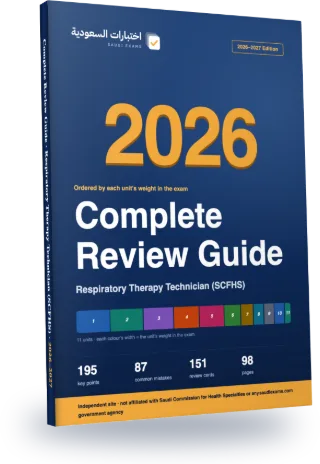 Complete Review Guide 2026–2027 included (PDF)Ordered by the weight of each unit in the examBuy now · SAR 34or 7 days for SAR 26
See everything included
Full mock exams like the real one and 577 explained questions that find your weak spots and train them
- Unlimited full mock exams to practise your pace and check your performance across the whole exam
- Practise 10 weak-area questions, starting where you lose the most marks
- 577 questions explaining why every option is right or wrong
- Arabic and English with one pass
- Unit notes and flashcards, then questions to check your understanding