ECG Technician Syllabus: 10 Sections and Their Weights
The ten ECG Technician exam sections with official weights, what each covers, how our 150-question mock exam splits them, and the official reference books.
- Questions and time
- 150 questions · 3 hours
- Pass mark
- 55%
- correct answers to pass (55%)
- 83 of 150
- Exam fee
- Paid to SCFHS online when you apply through Mumaris Plus; the amount is shown in your application
Start with 10 free questions to find what needs more work. No sign-up, with answer explanations.
Try 10 free questions and see your levelPut what you just read into practice
Start with 10 free questions to find what needs more work. No sign-up, with answer explanations.
Try 10 free questions and see your levelLast checked: 17 November 2026. Weights and content can change at any time, so check the SCFHS classification exams page and the Electrocardiograph content guideline (PDF) before you start studying. This is an independent website with no link to SCFHS, Prometric, Pearson VUE or any government body.
The SCFHS Electrocardiograph Technician exam is one exam with ten sections. The largest are Basic Life Support (20%) and the Technical aspect of 12 LEAD ECG (15%), together 35% of the exam. Use this page to decide where to start.
The exam at a glance
| Item | Details |
|---|---|
| Questions | 150 multiple-choice questions |
| Time | 3 hours |
| Pass mark | 55% for the technician category, for tests from 29 June 2022 onward |
| Question split | The real split can differ by up to 5% (plus or minus) in each section from the published weights |
| Exam language | English |
The ten sections and their weights
SCFHS publishes a weight for each section. The last column is the split we use in our full 150-question mock exams: the official percentage times 150, rounded, so the total is 150.
| Section | Official weight | Questions in our mock exam |
|---|---|---|
| 1. Cardiac Anatomy | 5% | 8 |
| 2. Cardiac Electro-physiology | 10% | 15 |
| 3. Pharmacotherapy | 5% | 7 |
| 4. Ischemic Heart Disease | 10% | 15 |
| 5. Valvular Heart Disease | 5% | 8 |
| 6. Tachy-arrhythmias | 10% | 15 |
| 7. Brady-arrhythmias | 10% | 15 |
| 8. Technical aspect of 12 LEAD ECG | 15% | 22 |
| 9. Pacemakers and Defibrillators | 10% | 15 |
| 10. Basic Life Support | 20% | 30 |
| Total | 100% | 150 |
Basic Life Support alone is 30 questions and the Technical aspect of 12 LEAD ECG is 22, together 52 of 150. The rhythm and ischemia sections (Tachy-arrhythmias, Brady-arrhythmias, Ischemic Heart Disease) are 15 questions each, and the smallest sections (Anatomy, Valvular Disease, Pharmacotherapy) are 7 or 8. Our practice questions follow the same split and show your result for each section.
A note on detail: the SCFHS guideline lists the ten sections and their weights, with no detailed topic list. The topic lists below are our own breakdown, based on the section names and on the chapters of the reference books SCFHS lists. They are not an official breakdown.
Section 1: Cardiac Anatomy (5%, 8 questions)
Topics covered: Chambers, valves and septum; coronary arteries and perfusion; pericardium, heart wall and great vessels; position of the heart relative to the chest and ECG leads.
How to study: Start by drawing the heart with its chambers and valves and tracing blood flow, then link each coronary artery to the area it supplies, because that link returns in infarct questions. Tie the position of the heart to the chest lead positions.
Section 2: Cardiac Electro-physiology (10%, 15 questions)
Topics covered: Action potential in the pacemaker and myocardial cells; the conduction system (SA node, AV node, bundle of His, Purkinje fibres); ECG waves, intervals and normal values; electrical axis and the effect of electrolytes.
How to study: Learn each wave and interval with its normal duration, and write the path of the impulse from the SA node to the Purkinje fibres from memory. Review how potassium and calcium change the tracing. This section is the base for every rhythm section.
Section 3: Pharmacotherapy (5%, 7 questions)
Topics covered: Antiarrhythmic drugs, their classes and ECG effects; digoxin, beta blockers and calcium channel blockers; anti-anginal, antiplatelet, anticoagulant and emergency drugs.
How to study: Build a table for each drug group with indication, ECG effect and main warning. Questions here usually ask how a drug relates to what appears on the strip.
Section 4: Ischemic Heart Disease (10%, 15 questions)
Topics covered: Stable angina, unstable angina and acute coronary syndrome; STEMI and NSTEMI and how the ECG evolves; localizing the infarct from the leads; mimics (pericarditis, Prinzmetal angina, early repolarization).
How to study: Link each lead group to a wall of the heart and its responsible artery, and follow the ECG evolution from tall T waves to ST elevation to Q waves. Practise telling infarction from its mimics.
Section 5: Valvular Heart Disease (5%, 8 questions)
Topics covered: Mitral and aortic stenosis; mitral and aortic regurgitation; mitral valve prolapse; murmurs; ECG effects of valve disease; endocarditis.
How to study: For each lesion write the timing of the murmur, where it is heard, and the enlargement or rhythm disturbance it causes on the ECG. The section is small, so focus on the repeating patterns.
Section 6: Tachy-arrhythmias (10%, 15 questions)
Topics covered: Sinus tachycardia; premature atrial and ventricular beats; atrial fibrillation and flutter; supraventricular tachycardias (AVNRT, WPW) and multifocal atrial tachycardia; ventricular tachycardia, torsades and ventricular fibrillation.
How to study: Learn each rhythm through five checks: regularity, rate, P wave shape, PR interval and QRS width. Then practise reading strips without looking at the name. Keep apart the rhythms that need immediate team action and those you report to the physician.
Section 7: Brady-arrhythmias (10%, 15 questions)
Topics covered: Sinus bradycardia, sinus pause and sick sinus syndrome; first-, second- and third-degree AV block; junctional and escape rhythms; bundle branch blocks; asystole and pulseless electrical activity (PEA).
How to study: Tell the AV blocks apart by how the PR interval behaves and by dropped beats. Link the arrest rhythms to the resuscitation algorithm, because this section overlaps with Basic Life Support.
Section 8: Technical aspect of 12 LEAD ECG (15%, 22 questions)
Topics covered: Patient preparation, machine set-up, calibration and paper speed; electrode placement and the limb and chest leads; artifact, technical errors and lead reversal; rate calculation, measurements and reading the strip; stress testing, Holter, cardiac monitoring and equipment safety.
How to study: This is the technician's own work and the second-largest section. Memorize the chest electrode positions V1 to V6 and the limb electrodes, and learn what each artifact looks like (baseline wander, muscle tremor, mains interference), what causes it and how to fix it. Practise rate calculation with the 300 method, the small-square method and the six-second method.
Section 9: Pacemakers and Defibrillators (10%, 15 questions)
Topics covered: Pacemaker types and the NBG code; the paced ECG (capture, sensing and malfunction); external defibrillators, AED and synchronized cardioversion; ICD and care of patients with implanted devices.
How to study: Memorize the letters of the NBG code and what each mode means (AAI, VVI, DDD), and learn how successful capture, failure to capture and failure to sense look on the strip. Separate unsynchronized shock from synchronized cardioversion and when each is used.
Section 10: Basic Life Support (20%, 30 questions)
Topics covered: Chain of survival and recognizing cardiac arrest; adult chest compressions and rescue breathing; child and infant BLS; AED use and team dynamics; airway obstruction and special situations.
How to study: This is the largest section, and it matches the AHA BLS manual in the reference list. Memorize the numbers that repeat: compression depth and rate, and the compression-to-breath ratio for adult, child and infant, the order of rescue steps, and AED use step by step.
Official reference list
SCFHS lists these books as study references. It states that the list does not endorse particular books and that exam questions are not necessarily taken from them.
- ECGs by Example (3rd edition)
- Dale Dubin, Rapid Interpretation of EKG's (6th edition)
- Conover, Understanding Electrocardiography (8th edition)
- ECG Made Easy (9th edition)
- BLS for Healthcare Providers, American Heart Association (AHA) manual
How our practice follows this guide
Our questions are in English, as in the real exam. The section split and weights in our full mock exam are the ones in the table above, and every practice set ends with your result for each section so you know where to start. Try the free practice test (10 free questions, no sign-up), then follow the study plan and read the application steps in the registration guide.
This is an independent exam preparation website with no link to SCFHS, Prometric, Pearson VUE or any government body.
Finished reading? Try a set of questions
Start with 10 free questions to find your weakest units. Keep practising with the full question bank and mock exams from SAR 26.
Put the plan to work here
SAR 34 $9
One purchase · lifetime access · review guide included
- 562 questions, every option explained with its source
- Full mock exams: 150 questions in 180 minutes, like the real one
- Practice that starts with your weakest units, plus a review of your mistakes
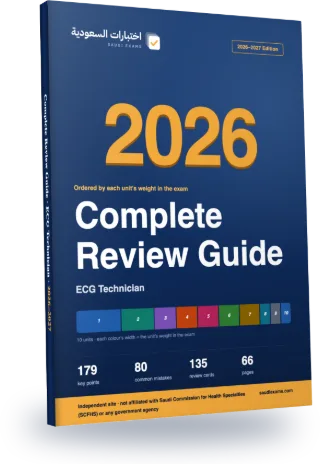 Complete Review Guide 2026–2027 included (PDF)Ordered by the weight of each unit in the examBuy now · SAR 34or 7 days for SAR 26
See everything included
Full mock exams like the real one and 562 explained questions that find your weak spots and train them
- Unlimited full mock exams to practise your pace and check your performance across the whole exam
- Practise 10 weak-area questions, starting where you lose the most marks
- 562 questions explaining why every option is right or wrong
- Arabic and English with one pass
- Unit notes and flashcards, then questions to check your understanding
This exam is part of professional classification as an ECG technician, and you cannot get a practice licence without classification. If you do not pass you get further attempts under SCFHS rules and pay the evaluation fee. Source Last verified: 2026-11-17