ECG Technician Exam Study Plan: 6 Weeks, or 2
A study plan for the SCFHS ECG Technician exam by the weight of its ten sections: start with Basic Life Support and the technical section, and sit a full mock two days before.
- Questions and time
- 150 questions · 3 hours
- Pass mark
- 55%
- correct answers to pass (55%)
- 83 of 150
- Exam fee
- Paid to SCFHS online when you apply through Mumaris Plus; the amount is shown in your application
Start with 10 free questions to find what needs more work. No sign-up, with answer explanations.
Try 10 free questions and see your levelPut what you just read into practice
Start with 10 free questions to find what needs more work. No sign-up, with answer explanations.
Try 10 free questions and see your levelLast verified: 17 November 2026. Check the SCFHS classification exams page and the Electrocardiograph content guideline (PDF) before you start, because weights and rules can change. This is an independent guide with no link to SCFHS, Prometric, Pearson VUE or any government body.
The exam has 150 questions across ten sections. The largest are Basic Life Support (20%) and the Technical aspect of 12 LEAD ECG (15%), so the plan starts with them. Anatomy, electro-physiology and drugs come next, then the fast and slow rhythms, then ischemia, valves and devices. The sixth week closes gaps and sits a full mock. The detail of each section is in the exam content guide, and the application steps are in the registration guide.
Numbers to build your plan on
| Item | What it means for your study |
|---|---|
| 150 multiple-choice questions | Per the SCFHS content guideline. The guideline does not state the number of options; our questions use four. |
| 3 hours | 180 minutes for 150 questions is 72 seconds a question. Practise sitting the full time in one go. |
| Pass mark 55% | Your result on this site shows your percentage in each section, so you can compare sections and track progress. |
| Weights can move by up to 5% per section | Do not skip a small section. Even the smallest is worth about 7 or 8 questions. |
| Language | Not published. We treat the exam as English (our inference), so revise terms in English from the start. Our questions and explanations are in English. |
| Calculator | Not mentioned in the guideline, so practise rate calculation by hand. |
Split your time by section
The percentages are the official weights. The question counts are the split in our 150-question full mock exam (the percentage times 150, rounded):
| Section | Official weight | Questions | Your time in the 6-week plan |
|---|---|---|---|
| Cardiac Anatomy | 5% | 8 | Week 3 |
| Cardiac Electro-physiology | 10% | 15 | Week 3 |
| Pharmacotherapy | 5% | 7 | Week 3 |
| Ischemic Heart Disease | 10% | 15 | Week 5 |
| Valvular Heart Disease | 5% | 8 | Week 5 |
| Tachy-arrhythmias | 10% | 15 | Week 4 |
| Brady-arrhythmias | 10% | 15 | Week 4 |
| Technical aspect of 12 LEAD ECG | 15% | 22 | Week 2 |
| Pacemakers and Defibrillators | 10% | 15 | Week 5 |
| Basic Life Support | 20% | 30 | Week 1 |
Basic Life Support (30 questions) takes the first week after the assessment and the technical section (22 questions) takes the second, so those two cover 52 of 150 questions before you reach the rhythms. The three rhythm and ischemia sections (45 questions) share about two weeks, and the three small sections (23 questions) take a few days.
The 6-week plan
The plan assumes one to two hours a day. Count back six weeks from your booking date once SCFHS opens booking in your application. Each week has the same rhythm: five days of reading and practice, one day to redo the week's mistakes, and one light day.
Week 1: Assessment and Basic Life Support
- Day 1: take the free practice test (10 free questions, no sign-up). Record your percentage in each section and your three weakest sections.
- Day 2: chain of survival and recognizing cardiac arrest. Day 3: adult chest compressions and rescue breathing; memorize compression depth, rate and the compression-to-breath ratio.
- Day 4: child and infant BLS, and what differs from the adult. Day 5: AED use and team dynamics.
- Day 6: airway obstruction and special situations, then 10 questions from the Basic Life Support section.
Week 2: Technical aspect of 12 LEAD ECG
- Day 1: patient preparation, machine set-up, calibration and paper speed. Day 2: chest electrode positions V1 to V6 and the limb electrodes; write them from memory.
- Day 3: limb and chest leads and what each one views. Day 4: artifact, technical errors and lead reversal; for each artifact name the cause and the fix.
- Day 5: rate calculation (300 method, small squares, six-second method) and reading the strip. Day 6: stress testing, Holter, monitoring and equipment safety.
Week 3: Anatomy, Electro-physiology and Pharmacotherapy
- Day 1: chambers, valves and coronary arteries. Day 2: pericardium, great vessels and the position of the heart relative to the leads.
- Day 3: action potential and the conduction system. Day 4: waves, intervals and normal values, electrical axis and the effect of electrolytes.
- Day 5: drugs: antiarrhythmics, digoxin, beta blockers and calcium channel blockers. Day 6: anti-anginal, anticoagulant and emergency drugs.
Week 4: Tachy- and Brady-arrhythmias
- Day 1: sinus tachycardia and premature beats. Day 2: atrial fibrillation and flutter.
- Day 3: supraventricular tachycardias, WPW and multifocal atrial tachycardia. Day 4: ventricular tachycardia, torsades and ventricular fibrillation.
- Day 5: sinus bradycardia, sick sinus syndrome and the AV blocks. Day 6: junctional and escape rhythms, bundle branch blocks, asystole and PEA, then read 10 strips without looking at the names.
Week 5: Ischemia, Valves and Devices
- Day 1: angina and acute coronary syndrome. Day 2: myocardial infarction and how the ECG evolves. Day 3: localizing the infarct from the leads, and the mimics.
- Day 4: valvular disease and murmurs. Day 5: pacemakers, the NBG code and the paced strip.
- Day 6: defibrillators, AED, synchronized cardioversion and the ICD.
Week 6: Close gaps and sit the full mock
- Days 1-3: redo every question in your error log, then practise your weakest topics 10 questions at a time. Add a short review of Basic Life Support and the technical section, the two largest shares.
- Day 4: a light day. Read your notes on the larger sections.
- Day 5 (two days before the exam): sit a full mock exam (next section).
- Day 6: review only the mock exam mistakes and do not open a new topic.
The full mock exam two days before the real one
- 150 questions in 180 minutes, in one sitting. The content guideline does not mention a break, so do not plan one.
- No phone and no notes. Calculate the rate on strips by hand.
- If a question stops you, flag it and move on. At 72 seconds a question, a slow one takes time from the next.
- When you finish, open the result for each section. The section with the lowest percentage is what you review on your last study day.
A 2-week plan if time is short
Build it on the two largest sections (Basic Life Support and the technical section, 35% of the exam), then the rhythm sections:
| Day | Task |
|---|---|
| 1 | Free practice test (10 questions) and finding your weakest sections |
| 2-4 | Basic Life Support (20%) |
| 5-7 | Technical aspect of 12 LEAD ECG (15%) |
| 8 | Cardiac Electro-physiology, with a quick pass over Anatomy and Pharmacotherapy |
| 9-10 | Tachy-arrhythmias and Brady-arrhythmias |
| 11 | Ischemic Heart Disease and Valvular Heart Disease |
| 12 | Pacemakers and Defibrillators, then the error log (10 questions per weak topic) |
| 13 | Full mock exam: 150 questions in 180 minutes |
| 14 | Review only the mock exam mistakes, then sleep early |
How to handle your mistakes
- Read the explanation of every option, not only the correct answer. Today's wrong option can be tomorrow's right one.
- Write the reason for each mistake in one phrase: a missing fact, mixing up two rhythms, a rate calculation error, or reading the strip too fast. One reason usually repeats.
- Redo the missed questions after two days and again after a week. When you answer a question correctly twice in a row, remove it from your log.
What this website adds to your plan
- The free practice test: 10 free questions from the exam sections, with the answer, its explanation and your percentage in each section, no sign-up.
- The practice area: practise section by section, with an error log and practice on your weakest topics. The remaining questions need paid access.
- The full mock exam of 150 questions in 180 minutes, matching the question count and total time in the guideline. It also needs paid access.
This is an independent exam preparation website with no link to SCFHS, Prometric, Pearson VUE or any government body.
Finished reading? Try a set of questions
Start with 10 free questions to find your weakest units. Keep practising with the full question bank and mock exams from SAR 26.
Put the plan to work here
SAR 34 $9
One purchase · lifetime access · review guide included
- 562 questions, every option explained with its source
- Full mock exams: 150 questions in 180 minutes, like the real one
- Practice that starts with your weakest units, plus a review of your mistakes
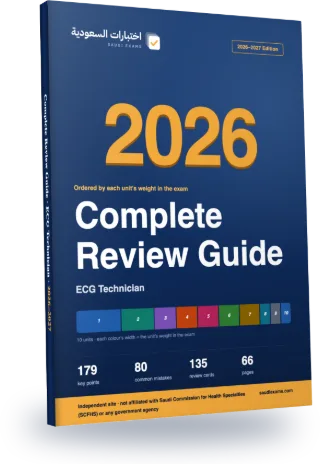 Complete Review Guide 2026–2027 included (PDF)Ordered by the weight of each unit in the examBuy now · SAR 34or 7 days for SAR 26
See everything included
Full mock exams like the real one and 562 explained questions that find your weak spots and train them
- Unlimited full mock exams to practise your pace and check your performance across the whole exam
- Practise 10 weak-area questions, starting where you lose the most marks
- 562 questions explaining why every option is right or wrong
- Arabic and English with one pass
- Unit notes and flashcards, then questions to check your understanding
This exam is part of professional classification as an ECG technician, and you cannot get a practice licence without classification. If you do not pass you get further attempts under SCFHS rules and pay the evaluation fee. Source Last verified: 2026-11-17