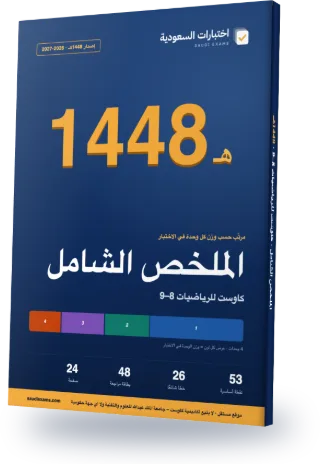
KMC Grades 8–9 Complete Review Guide 2026–2027
A 26-page PDF ordered by unit weight. The first three chapters cover 84% of the published syllabus weight.
- 26Pages
- 53Key points
- 26Common mistakes
- 48Flashcards
Guide map
Each chapter is one exam unit, ordered by its weight in the real exam.
| Chapter | Unit | Weight | Exam questions | Key points |
|---|---|---|---|---|
| 1 | Algebra and Arithmetic | 42% | 10 | 16 |
| 2 | Number Theory | 21% | 5 | 12 |
| 3 | Combinatorics and Logic | 21% | 5 | 12 |
| 4 | Geometry | 16% | 4 | 13 |
Chapter 1 in full: Algebra and Arithmetic
42% of the exam, about 10 questions. These are its key points, as in the guide.
- (Ratios, percentages, fractions and word problems) A rise then a fall by the same percentage multiplies the two factors: \( 1.2\times 0.8=0.96 \), a net fall of \( 4\% \).
- (Ratios, percentages, fractions and word problems) A ratio \( a:b \) with known sum \( S \): the parts are \( \frac{a}{a+b}S \) and \( \frac{b}{a+b}S \); for example \( 3:5 \) with sum 40 gives 15 and 25.
- (Ratios, percentages, fractions and word problems) The average speed over two equal distances at speeds \( v_1 \) and \( v_2 \) is \( \frac{2v_1v_2}{v_1+v_2} \); with 40 and 60 it is \( 48 \).
The rest of chapter 1, on this page
- (Ratios, percentages, fractions and word problems) In work problems add the rates: someone finishing a job in 6 days and someone finishing it in 3 days together do \( \frac16+\frac13=\frac12 \) of it per day, so they need 2 days.
- (Equations, systems and inequalities) Adding and subtracting two equations: from \( 2x+3y=12 \) and \( 3x+2y=13 \), adding gives \( x+y=5 \) and subtracting gives \( x-y=1 \), so \( x=3 \) and \( y=2 \).
- (Equations, systems and inequalities) Fractional equations: multiply by the common denominator. \( \frac x2+\frac x3=10 \) becomes \( 3x+2x=60 \), so \( x=12 \).
- (Equations, systems and inequalities) An inequality is solved like an equation, flipping the sign when multiplying or dividing by a negative: \( -2x+3>9 \) gives \( -2x>6 \), so \( x<-3 \).
- (Equations, systems and inequalities) Absolute value gives two cases: \( |x-3|=5 \) means \( x-3=5 \) or \( x-3=-5 \), so \( x=8 \) or \( x=-2 \). The integers satisfying \( 3<2x-1<11 \) are 3, 4 and 5 (three of them), because \( 2<x<6 \).
- (Algebraic expressions, powers, roots and clever simplification) Difference of squares: \( a^2-b^2=(a-b)(a+b) \); for example \( 101^2-99^2=2\times 200=400 \) and \( 99\times 101=100^2-1=9999 \).
- (Algebraic expressions, powers, roots and clever simplification) The identity \( (a+b)^2=a^2+2ab+b^2 \): if \( a+b=7 \) and \( ab=10 \) then \( a^2+b^2=49-20=29 \).
- (Algebraic expressions, powers, roots and clever simplification) Exponent rules: \( a^m\cdot a^n=a^{m+n} \) and \( (a^m)^n=a^{mn} \); to simplify \( 4^5\cdot 8^2 \) write it as \( 2^{10}\cdot 2^6=2^{16}=65536 \).
- (Algebraic expressions, powers, roots and clever simplification) Roots: pull out the perfect square, \( \sqrt{50}=5\sqrt2 \), then add like roots: \( \sqrt{18}+\sqrt8=3\sqrt2+2\sqrt2=5\sqrt2 \).
- (Sequences, functions and averages) Arithmetic sequence \( a_n=a_1+(n-1)d \): in \( 5,8,11,\dots \) the 20th term is \( 5+19\cdot 3=62 \).
- (Sequences, functions and averages) The sum of an arithmetic sequence is \( S=\frac{n(a_1+a_n)}{2} \); so \( 1+2+\cdots+100=5050 \), and the sum of the 20 terms above is \( \frac{20\cdot 67}{2}=670 \).
- (Sequences, functions and averages) Mean = sum ÷ count, so sum = mean × count: five numbers with mean 12 add to 60, and for six numbers to have mean 13 the new number must be \( 78-60=18 \).
- (Sequences, functions and averages) A function is a rule giving one output per input: if \( f(x)=2x+3 \) then \( f(5)=13 \) and \( f(f(1))=f(5)=13 \); if \( f(x)=3x-1 \) and \( f(a)=11 \) then \( a=4 \).
Common mistakes in this chapter
- Adding percentages instead of multiplying: a \( 20\% \) rise followed by a \( 20\% \) fall does not return the original number; the result is \( 1.2\times 0.8=0.96 \).
- Mixing up ratio parts and the total: in \( 3:5 \) the total is 8 parts, so do not divide the whole by 3 or by 5.
- Forgetting to flip the inequality when multiplying or dividing by a negative number: \( -2x>6 \) gives \( x<-3 \).
- Treating \( (a+b)^2 \) as \( a^2+b^2 \); the correct expansion is \( a^2+2ab+b^2 \), and likewise \( \sqrt{a^2+b^2}\neq a+b \).
- Averaging two speeds directly: for equal distances at 40 and 60 the average speed is \( \frac{2\cdot 40\cdot 60}{100}=48 \), not 50.
- Being off by one in the number of terms: in \( 5,8,\dots \) the \( n \)th term is \( 5+(n-1)\cdot 3 \), not \( 5+3n \).
- When counting integers that satisfy an inequality, forgetting that open ends are excluded: \( 2<x<6 \) has 3 integers, not 5.
The other chapters are in the full guide
One purchase · lifetime access · review guide included
7-day review plan
The chapters are spread over 6 days by weight so each day carries a similar load. Day 7 is a full exam.
Day 1 · 42% of the exam
Chapter 1: Algebra and Arithmetic
Day 2 · 21% of the exam
Chapter 2: Number Theory
Day 3 · 21% of the exam
Chapter 3: Combinatorics and Logic
Day 4 · 16% of the exam
Chapter 4: Geometry
Day 5
Full mock exam: 24 questions in 120 minutes, then review the common mistakes in the units where you lost marks.
Before you read: see your score today
10 free questions from the main units, no sign-up. Then you know which chapter to start with.
Try 10 free questions and see your levelA look at each chapter
The first three key points of each chapter, as they appear in the guide (in Arabic in the PDF).
Chapter 1: Algebra and Arithmetic
- (Ratios, percentages, fractions and word problems) A rise then a fall by the same…
- (Ratios, percentages, fractions and word problems) A ratio \( a:b \) with known sum…
- (Ratios, percentages, fractions and word problems) The average speed over two equal distances at…
Chapter 2: Number Theory
- (Divisibility, primes and factorization) Divisibility rules
- (Divisibility, primes and factorization) Prime factorization gives the number of divisors: \( 360=2^3\cdot 3^2\cdot…
- (Divisibility, primes and factorization) To test whether \( n \) is prime, try primes…
Chapter 3: Combinatorics and Logic
- (Counting, arrangements and selections) The multiplication principle: 3 shirts and 4 pairs of trousers…
- (Counting, arrangements and selections) Arranging \( n \) different objects in a row gives…
- (Counting, arrangements and selections) Choosing \( k \) from \( n \) with no…
Chapter 4: Geometry
- (Angles, triangles and polygons) The angles of a triangle sum to 180°, and an…
- (Angles, triangles and polygons) The interior angles of an \( n \)-gon sum to…
- (Angles, triangles and polygons) Parallel lines give equal alternate angles and co-interior angles summing…
The full guide comes with lifetime access
The full guide (26 pages) is included with lifetime access to this exam, together with every question and full mock exam. Chapter 1 is free for everyone.
Questions about the guide
Is the guide free?
Chapter 1 is free to read on the guide page. The full guide comes with lifetime access to this exam; 7-day access does not include it.
Is it up to date for 2026–2027?
Yes. Unit weights and exam facts follow what the exam body last published, and the last check date is printed in the guide. If the standards change we update the file and buyers download the new version.
Does the guide have questions?
No. The guide covers key points and common mistakes; scoring, weak-area practice and full mock exams are on the site.
Can I read it on my phone?
Yes. A5 pages in a single column, with chapters linked from the contents.
- Pages
- 26
- Edition
- 1448 AH · 2026–2027
- Language
- English
- Last updated
All School Student Exams review guides
Back to KAUST Mathematics Competition (KMC) – Phase One – Grades 8–9
Full prep for this exam
All of this in one purchase.
- Full mock exam, same as the real one24 questions in 120 minutes. You get a total score and a score for every unit.
- Practice unit by unit164 questions, every option explained with its source. Starts with your weakest units.
- Complete Review Guide 2026–2027 (PDF)Ordered by each unit's weight in the exam. With lifetime access only.
Choose your access
Continue with your Google account and you go straight to the payment page.