GRCP
OCEG GRC Professional (GRCP) Certification
OCEG GRC Professional (GRCP) Certification — Number of questions: 100 questions. Exam time: 120 minutes. Pass mark: 70%. Exam fee: Included in OCEG’s All Access Pass, which covers preparation, the exam, retakes and renewal. The non-renewing pass is US$875. language: English only. OCEG’s self-study course is in English, with subtitles in several languages including Arabic. Source: OCEG (nonprofit GRC organization) (Last verified: 2026-11-18). Question bank: full mock exams of 100 questions in 120 minutes, like the real test with a result for every unit, plus 624 explained questions across 5 units, every option explained, a review of your mistakes, and two ways to practise: see the answer right away, or sit a full timed mock. Free questions: a 10-question diagnostic test covering the main units, no sign-up; at the end we compare your score with the pass mark and show your weakest units. With lifetime access: the Complete Review Guide, a 35-page PDF ordered by unit weight; chapter 1 is free to read on the guide page.
Last verified on the OCEG (nonprofit GRC organization) website: 18 November 2026
If you sat the exam today, what would you score?
10 free questions · no sign-up · your score as soon as you finish
Question 1 of 10
Middle managers in a regional sales unit hint that winning a public contract matters more than approval steps. Which response best aligns with a strong compliance culture?
All 10 free questions with answers and an explanation for every option
Where the questions come from
- GRC Key Concepts30 questions
- Learn: Context and Culture15 questions
- Align: Direction, Objectives and Strategy20 questions
- Perform: Actions and Controls25 questions
- Review: Monitoring, Assurance and Improvement10 questions
Exam facts
- Exam code
- GRCP
- Exam language
- English
- Number of questions
- 100 questions Source
- Exam time
- 120 minutes Source
- Pass mark
- 70% Source
- Exam fee
- Included in OCEG’s All Access Pass, which covers preparation, the exam, retakes and renewal. The non-renewing pass is US$875. Source
- language
- English only. OCEG’s self-study course is in English, with subtitles in several languages including Arabic. Source
- Registration
- Buy OCEG’s All Access Pass, then start the online exam at any time with no booking, after a short form and agreeing to the code of conduct. Source
- Retakes
- Up to six attempts a year, at no extra fee. Source
- Validity
- The certificate runs to your next Pro membership renewal, then renews yearly. From the second year you need 8 CPE credits a year, with a 90-day grace period. Source
Last verified: 2026-11-18
Exam body
OCEG (nonprofit GRC organization): Official website: OCEG (nonprofit GRC organization)
How to register
- Buy the All Access Pass on the OCEG site; it covers preparation materials, the exam and retakes.
- Study the GRC Capability Model (the Red Book) and the GRC Fundamentals self-study course, both included in the pass.
- Start the online exam at any time: 100 scored questions in 120 minutes, and you pass with 70 correct.
- If you do not pass, you can retake up to six times a year at no extra fee.
Study guides (3)
Frequently asked questions
What does the GRCP cover, and how is it split?
100 scored questions, split by the official weights: GRC Key Concepts (30); Learn (15); Align (20); Perform (25); Review (10). The counts are worked out from the weights, not official per-area numbers. Source: OCEG GRCP page.
Can I try GRCP questions for free?
Yes. Free questions: a 10-question diagnostic test covering the main units, no sign-up; at the end we compare your score with the pass mark and show your weakest units. The free practice test page lists the same questions with answers and an explanation for every option. The rest of the questions and the full mock exams come with a pass from SAR 26.
What makes this GRCP question bank different?
Question bank: full mock exams of 100 questions in 120 minutes, like the real test with a result for every unit, plus 624 explained questions across 5 units, every option explained, a review of your mistakes, and two ways to practise: see the answer right away, or sit a full timed mock. Practice questions and explanations are ready to use on your phone. Try the free questions and read the explanations before you buy.
Is there a PDF review guide for GRCP?
Yes. "GRCP Complete Review Guide 2026–2027" is a 35-page Arabic PDF: 5 units ordered from the heaviest in the exam to the lightest, each chapter with key points, common mistakes and review cards, plus a 7-day plan. Chapter 1 is free to read on the guide page; the full guide comes with lifetime access to this exam and is not part of 7-day access. The guide has no questions: scoring, practice and mock exams are on the site.
What language is the GRCP exam in?
English only. OCEG’s self-study course is in English with subtitles in several languages, including Arabic. Our questions are in English, with an Arabic translation to help you check your understanding.
How long is the exam, and what is the pass mark?
120 minutes for 100 scored questions plus up to 15 unscored ones, all multiple choice. You pass by answering 70 of the 100 scored questions correctly. Source: OCEG GRCP page.
Is the GRCP exam open book?
Yes. OCEG allows web search, your notes and OCEG materials during the exam, but no AI tools. OCEG says it may revoke the certificate if it detects AI use.
How much does the GRCP cost?
The exam is part of OCEG’s All Access Pass, which includes preparation, the exam, retakes and maintenance. The non-renewing pass is USD 875. Check the OCEG site for the current price.
How many times can I retake the GRCP?
Up to six times a year, with no extra fee. Source: OCEG GRCP page.
How do I keep the GRCP certificate?
It runs to your next Pro membership renewal and then renews each year. From the second year you need at least 8 continuing education credits a year, with a 90-day grace period.
Are your questions taken from OCEG or the Red Book?
No. We are not affiliated with OCEG. Every question is a practice question built on the official weights and public frameworks such as COSO, the IIA Three Lines Model and NIST CSF 2.0.
Is this an official site, and how do I pay?
It is an independent site, not part of Qiyas, this exam's regulator or any government body, with practice questions and answer explanations. You pay once, with no automatic renewal, through Waffo Pancake (the merchant of record) by Visa, Mastercard, Apple Pay or Google Pay, and your statement shows "WAFFO". If you were charged twice or the pass did not open, email support@saudiexams.com.
GRCP Complete Review Guide 2026–2027
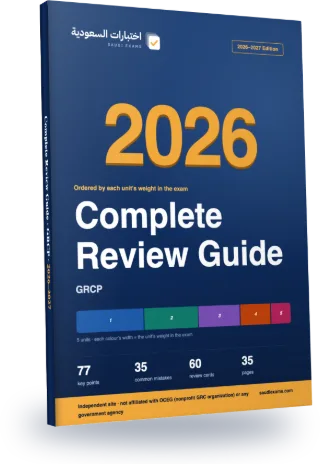
35-page · 77 key points · 35 common mistakes · 60 review cards
The first three chapters alone cover about 75% of the exam. Short on time? Start there.
About the question bank
624 GRCP practice questions split by OCEG’s published exam weights. The largest area is GRC Key Concepts at 30%. Every question comes with an answer explanation.
- 100 questions in 120 min, like the real test
- 624 questions covering the main scoring topics, with explanations
- 70% pass mark, with targeted practice on your weak spots
See the gap to your target score Practise the units costing you the most marks A full mock exam like the real one
Every option explained so you understand why
What you get
- 624questions in the bankPractise with the answer shown right away, or sit a full timed mock
- 5unitsSplit by the exam syllabus
- 60flashcardsTo lock in terms and definitions
- 77quick review pointsEach unit in a few key lines
Study material sample: GRC Key Concepts
Summary
This unit covers the core ideas that connect governance, risk, compliance, performance, and internal control. It represents about 30% of the GRCP exam, or roughly 30 of 100 scored questions. The sub-topics are: achieving objectives through governance, strategy, and performance; addressing uncertainty through risk concepts; acting with integrity through compliance, ethics, and culture; clarifying roles, responsibilities, and accountability; selecting and designing actions and controls; and measuring GRC capability through effectiveness, maturity, and indicators. You should understand how the board and management set direction, how risk is managed in relation to objectives and risk appetite, how internal control supports reliable operations and reporting, how the three lines work together, and how organizations monitor, learn, and improve over time.
What the exam focuses on · Common traps · Try the flashcards
What the exam focuses on
- Governance is about direction, oversight, and accountability. The board oversees objectives, strategy, risk, integrity, and performance, while management runs operations and implements decisions.
- Risk is the effect of uncertainty on objectives. Risk management does not try to remove all risk; it helps the organization make informed choices and stay within risk appetite and risk tolerance.
- Compliance and ethics need more than written rules. An effective compliance program is risk-based, supported by leadership, resourced, communicated, monitored, investigated, and improved when issues appear.
Show 4 more
- Culture matters because people carry out controls, raise concerns, and make decisions. Incentives, discipline, management behavior, and non-retaliation shape whether the real culture supports integrity.
- Roles should be clear across the three lines. The first line manages risks and controls in operations, the second line provides expertise and oversight, and the third line gives independent assurance.
- Control design should match the risk and the process. Good design considers objectives, root cause, who performs the control, evidence, timing, segregation of duties, and whether the control is preventive, detective, or corrective.
- Measurement should separate activity from results. Count what is done, but also test whether controls work, whether risks stay within limits, whether issues are remediated, and whether capability is improving over time.
Common traps
- Wrong belief: Governance is only a board matter. Correct view: Governance involves the board, management, information flows, oversight, and accountability across the organization.
- Wrong belief: Good risk management means taking as little risk as possible. Correct view: Good risk management supports objectives by taking, avoiding, reducing, sharing, or accepting risk in a deliberate way.
- Wrong belief: Compliance is the job of the legal or compliance team only. Correct view: Management and staff in the business own day-to-day compliance, while compliance specialists support, advise, and oversee.
Show 4 more
- Wrong belief: Internal audit owns risk management and controls. Correct view: Management owns risks and controls; internal audit provides independent assurance on governance, risk management, and control.
- Wrong belief: More controls always mean better control. Correct view: Controls should be proportionate, targeted, and workable. Too many poorly designed controls can hide responsibility and create workarounds.
- Wrong belief: If training was completed and policies exist, the compliance program is effective. Correct view: Effectiveness depends on whether the program works in practice, finds issues, responds, and improves behavior.
- Wrong belief: A mature process is automatically effective. Correct view: Maturity and effectiveness are related but different. A process can look formal and still fail to achieve objectives or control risk.
Try the flashcards
Tap a card to see the answer
What is the basic aim of governance in an organization?
To direct, oversee, and hold the organization accountable for achieving objectives with integrity and performance.
How is risk best understood in GRC?
As the effect of uncertainty on objectives.
What is the difference between risk appetite and risk tolerance?
Risk appetite is the overall amount and type of risk the organization is willing to pursue or retain. Risk tolerance is the more specific acceptable variation or limit.
What is the difference between inherent risk and residual risk?
Inherent risk exists before controls or responses. Residual risk remains after controls or responses.
Who owns risks and controls in normal operations?
Management in the business, mainly the first line, owns and manages them.
What does the second line do?
It provides expertise, support, challenge, and oversight for risk management and compliance.
Why must internal audit remain independent?
So it can provide objective, independent assurance on governance, risk management, and internal control.
What are preventive, detective, and corrective controls?
Preventive controls stop problems before they happen. Detective controls find problems. Corrective controls fix problems and restore the process.
Why you can trust these questions
- Published questions: 624. Read the explanations and references, and report any error from the question.
- Exam facts last checked against the organiser’s website: 2026-11-18. We check them again every three months and two weeks before each test.
- Found a mistake? Tap "Report an error" under any question in the practice area, or email us at support@saudiexams.com
- Independent website. Not affiliated with ETEC (Qiyas), the Financial Academy, ACAMS, the ACFE, DAMA, CompTIA, Saudi Aramco or any government body.
Update log
- 2026-11-19 Bank review: one ambiguous question was rewritten, explanations that gave away the answer were fixed, and weak wrong options were strengthened across several units.
- 2026-11-18 Published the exam specs and content weights from OCEG’s GRCP page with a practice question bank.
Full prep for this exam
All of this in one purchase.
- Full mock exam, same as the real one100 questions in 120 minutes. You get a total score and a score for every unit.
- Practice unit by unit624 questions, every option explained with its source. Starts with your weakest units.
- Complete Review Guide 2026–2027 (PDF)Ordered by each unit's weight in the exam. With lifetime access only.
Choose your access
Continue with your Google account and you go straight to the payment page.