Saudi Board Part One Examination – Diagnostic Radiology
Saudi Board Part One Examination – Diagnostic Radiology — Number of questions: 150 questions. Exam time: Confirm with the exam body. Pass mark: 65%. Exam fee: Registration is automatic and free for eligible trainees. Source: Saudi Commission for Health Specialties (SCFHS) (Last verified: 2026-11-17). Question bank: A site supplementary practice session of 150 questions in 90 minutes with a result for every unit, plus 555 explained questions across 11 units, every option explained, a review of your mistakes, and two ways to practise: see the answer right away, or sit a full timed mock. Free questions: a 10-question diagnostic test covering the main units, no sign-up; at the end we compare your score with the pass mark and show your weakest units. With lifetime access: the Complete Review Guide, a 81-page PDF ordered by unit weight; chapter 1 is free to read on the guide page.
Last verified on the Saudi Commission for Health Specialties (SCFHS) website: 17 November 2026
If you sat the exam today, what would you score?
10 free questions · no sign-up · your score as soon as you finish
Question 1 of 10
In a patient with cirrhosis, multiphase CT shows a 7 mm nodule with arterial phase hyperenhancement and portal venous washout. Which guideline would allow a definite diagnosis of HCC from these findings alone?
All 10 free questions with answers and an explanation for every option
Where the questions come from
- Musculoskeletal14 questions
- Neuroradiology17 questions
- Head and Neck8 questions
- Cardiothoracic17 questions
- Gastrointestinal19 questions
- Genitourinary9 questions
- Vascular and Interventional7 questions
- Pediatrics12 questions
- Nuclear Medicine13 questions
- Breast Imaging7 questions
- Physics27 questions
Exam facts
- Exam language
- English
- Number of questions
- 150 questions Source
- Exam time
- Confirm with the exam body
- Pass mark
- 65% Source
- Exam fee
- Registration is automatic and free for eligible trainees Source
Last verified: 2026-11-17
Where other sources differ
- The current blueprint covers 2024–2027 (v.1); each section may vary by ±5%. Research, ethics, professionalism and patient safety are incorporated within the various domains.
Exam body
Saudi Commission for Health Specialties (SCFHS): Official website: Saudi Commission for Health Specialties (SCFHS)
How to register
- The system registers you automatically once you have completed nine months of training in a Saudi Board programme with valid registration.
- You are notified of the date and city on Mumaris+, and can request a change of city.
- The exam is held once a year, and you have a maximum of four attempts.
Study guides (3)
Frequently asked questions
How many questions are in Part One and what is the pass mark?
150 single-best-answer questions, plus up to 10% unscored pretest items. The pass mark is 65%; it can be lowered one mark at a time to a floor of 60% if fewer than 70% pass, according to the published blueprint.
Can I try Saudi Board Diagnostic Radiology Part 1 questions for free?
Yes. Free questions: a 10-question diagnostic test covering the main units, no sign-up; at the end we compare your score with the pass mark and show your weakest units. The free practice test page lists the same questions with answers and an explanation for every option. The rest of the questions and the full mock exams come with a pass from SAR 26.
What makes this Saudi Board Diagnostic Radiology Part 1 question bank different?
Question bank: A site supplementary practice session of 150 questions in 90 minutes with a result for every unit, plus 555 explained questions across 11 units, every option explained, a review of your mistakes, and two ways to practise: see the answer right away, or sit a full timed mock. Practice questions and explanations are ready to use on your phone. Try the free questions and read the explanations before you buy.
Is there a PDF review guide for Saudi Board Diagnostic Radiology Part 1?
Yes. "Saudi Board Diagnostic Radiology Part 1 Complete Review Guide 2026–2027" is a 81-page Arabic PDF: 11 units ordered from the heaviest in the exam to the lightest, each chapter with key points, common mistakes and review cards, plus a 7-day plan. Chapter 1 is free to read on the guide page; the full guide comes with lifetime access to this exam and is not part of 7-day access. The guide has no questions: scoring, practice and mock exams are on the site.
What does Saudi Board Radiology Part 1 cover, and how is it split by section?
150 questions, split by the published weights as follows: Musculoskeletal (14); Neuroradiology (17); Head and Neck (8); Cardiothoracic (17); Gastrointestinal (19); Genitourinary (9); Vascular and Interventional (7); Pediatrics (12); Nuclear Medicine (13); Breast Imaging (7); Physics (27). Source: SCFHS published blueprint. Counts are rounded from the percentages and each section may vary by up to 5%.
Which language is Saudi Board Radiology Part 1 in?
SCFHS does not state the exam language, but all of its listed references are English textbooks, so our questions are in English. Explanations are in Arabic and English, and you can switch language on any question with one tap.
How do I register for Saudi Board Radiology Part 1?
The system registers you automatically once you have completed nine months of training in a Saudi Board programme with valid registration. You are notified of the date and city on Mumaris+, and can request a change of city.
How many times can I sit the Part One exam?
A maximum of four attempts, after which the trainee is removed from the programme.
Is this an official site, and how do I pay?
It is an independent site, not part of Qiyas, this exam's regulator or any government body, with practice questions and answer explanations. You pay once, with no automatic renewal, through Waffo Pancake (the merchant of record) by Visa, Mastercard, Apple Pay or Google Pay, and your statement shows "WAFFO". If you were charged twice or the pass did not open, email support@saudiexams.com.
Saudi Board Diagnostic Radiology Part 1 Complete Review Guide 2026–2027
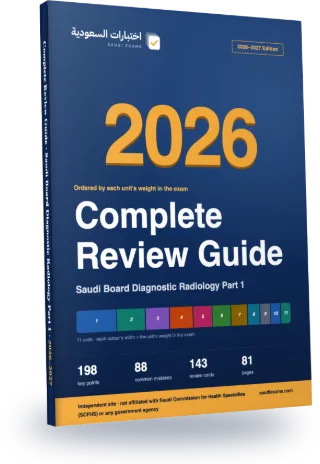
81-page · 198 key points · 88 common mistakes · 143 review cards
The first three chapters alone cover about 42% of the exam. Short on time? Start there.
About the question bank
555 Saudi Board Diagnostic Radiology Part 1 questions across 11 domains. The largest is Physics, 18% of the exam. Every question comes with an answer explanation.
- 150 questions in 90 minutes per site supplementary practice session
- 555 questions covering the main scoring topics, with explanations
- 65% pass mark, with targeted practice on your weak spots
See the gap to your target score Practise the units costing you the most marks Supplementary practice
Every option explained so you understand why
What you get
- 555questions in the bankPractise with the answer shown right away, or sit a full timed mock
- 11unitsSplit by the exam syllabus
- 143flashcardsTo lock in terms and definitions
- 198quick review pointsEach unit in a few key lines
Study material sample: Musculoskeletal
Summary
Musculoskeletal radiology carries about 9% of the blueprint, roughly 14 of the 150 scored questions. The unit covers five areas: fractures, trauma and fracture healing; bone tumours and tumour-like lesions, including soft tissue masses; arthropathies and crystal disease; infection, metabolic bone disease and marrow disorders; and MRI of joints, spine and soft tissue, including the postoperative hip. Questions are mostly short clinical vignettes with a radiograph or MRI description, asking for the most likely diagnosis, the next imaging step or the sign that separates two look-alike conditions. Expect pattern recognition of aggressive versus benign bone lesions, the typical signal pattern of spinal marrow change, and practical protocol choices such as how to limit metal artefact.
What the exam focuses on · Common traps · Try the flashcards
What the exam focuses on
- Elbow in children: fat pad sign and anterior humeral line as clues to an occult supracondylar fracture.
- Scaphoid fracture: occult on first films, repeat imaging after about 10 days, and avascular necrosis or non-union of the proximal pole.
- Reading a bone lesion: zone of transition, periosteal reaction, matrix, age and site, then the classic diagnosis for each pattern.
Show 5 more
- Soft tissue mass work-up: ultrasound triage, MRI as the characterisation tool, and referral to a tumour centre before biopsy.
- Arthropathy patterns: rheumatoid, gout, pyrophosphate, psoriatic and ankylosing spondylitis, told apart by distribution, bone density, erosion type and joint space.
- Timing of osteomyelitis on imaging, and the radiographic hallmarks of osteomalacia, hyperparathyroidism and Paget disease.
- Spine MRI: Modic marrow types, disc protrusion versus extrusion, and grading of cervical canal stenosis.
- MRI after hip arthroplasty: reducing metal artefact, pseudotumour of metal debris, and signs of prosthetic joint infection.
Common traps
- A visible posterior fat pad at the elbow is always abnormal, so it must not be dismissed when no fracture line is seen.
- A normal wrist series does not exclude a scaphoid fracture; with persistent suspicion the examination is repeated after about 10 days.
- Plain radiographs miss early lytic lesions: 40 to 50% of the trabecular bone must be destroyed before a lucency appears.
Show 5 more
- A Codman angle is not specific for malignancy, because osteomyelitis can produce the same interrupted periosteal reaction.
- Gout, unlike rheumatoid arthritis, does not cause osteoporosis and keeps the joint space until late; its erosions have an overhanging lip.
- Radiographs are normal for the first one to two weeks of acute osteomyelitis; the first sign is soft tissue swelling with loss of intermuscular fat planes.
- In older patients lumbar DXA can be falsely high because of marginal osteophytes and aortic calcification, so the hip or forearm is used instead.
- At 3 T metal artefact around an arthroplasty is worse than at 1.5 T, and frequency-selective fat suppression fails where STIR does not.
Try the flashcards
Tap a card to see the answer
Posterior fat pad visible on a lateral elbow film
Always abnormal: effusion or haemarthrosis; in a child suspect a supracondylar fracture.
Light-bulb humeral head in internal rotation
Posterior shoulder dislocation; seizures are the commonest cause and over half are initially missed.
Commonest Salter-Harris injury
Type II (about 75%): physeal separation plus a fracture into part of the metaphysis.
Proportion of trabecular bone lost before a lytic lesion shows on radiographs
40 to 50%.
Fallen-fragment sign
Simple bone cyst, typically the proximal humeral metaphysis in a child, often with a pathological fracture.
Cartilage cap thicker than 2 cm on an osteochondroma
Raises concern for peripheral chondrosarcoma; risk is higher in the multiple form.
Erosions with an overhanging lip and preserved joint space, no osteoporosis
Chronic tophaceous gout.
Thin linear calcification in hyaline cartilage and fibrocartilage
Chondrocalcinosis of CPPD deposition; acute episodes are pseudogout.
Why you can trust these questions
- Published questions: 555. Read the explanations and references, and report any error from the question.
- Exam facts last checked against the organiser’s website: 2026-11-17. We check them again every three months and two weeks before each test.
- Found a mistake? Tap "Report an error" under any question in the practice area, or email us at support@saudiexams.com
- Independent website. Not affiliated with ETEC (Qiyas), the Financial Academy, ACAMS, the ACFE, DAMA, CompTIA, Saudi Aramco or any government body.
Full prep for this exam
All of this in one purchase.
- Timed supplemental practice sessions150 questions in 90 minutes. You get a total score and a score for every unit.
- Practice unit by unit555 questions, every option explained with its source. Starts with your weakest units.
- Complete Review Guide 2026–2027 (PDF)Ordered by each unit's weight in the exam. With lifetime access only.
Choose your access
Continue with your Google account and you go straight to the payment page.