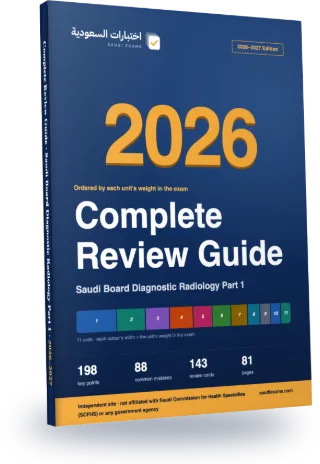
Saudi Board Diagnostic Radiology Part 1 Complete Review Guide 2026–2027
Every exam topic in a 81-page Arabic PDF, ordered from the heaviest unit to the lightest. The first three chapters alone cover about 42% of the exam questions.
- 81Pages
- 198Key points
- 88Common mistakes
- 143Flashcards
Guide map
Each chapter is one exam unit, ordered by its weight in the real exam.
| Chapter | Unit | Weight | Exam questions | Key points |
|---|---|---|---|---|
| 1 | Physics | 18% | 27 | 18 |
| 2 | Gastrointestinal | 13% | 19 | 18 |
| 3 | Neuroradiology | 11% | 17 | 18 |
| 4 | Cardiothoracic | 11% | 17 | 18 |
| 5 | Musculoskeletal | 9% | 14 | 18 |
| 6 | Nuclear Medicine | 9% | 13 | 18 |
| 7 | Pediatrics | 8% | 12 | 18 |
| 8 | Genitourinary | 6% | 9 | 18 |
| 9 | Head and Neck | 5% | 8 | 18 |
| 10 | Vascular and Interventional | 5% | 7 | 18 |
| 11 | Breast Imaging | 5% | 7 | 18 |
Chapter 1 in full: Physics
18% of the exam, about 27 questions. These are its key points, as in the guide.
- (X-ray production and interactions with matter) The maximum photon energy in the bremsstrahlung spectrum equals the full electron energy set by the tube voltage (kVp).
- (X-ray production and interactions with matter) The tungsten K-shell binding energy is 69.5 keV; above it the photoelectric cross-section jumps by about a factor of five.
- (X-ray production and interactions with matter) In the diagnostic range the photoelectric cross-section per atom is roughly proportional to Z⁴ and falls with the cube of photon energy, so iodine (Z=53) absorbs far more than calcium (Z=20).
The rest of chapter 1, on this page
- (X-ray production and interactions with matter) Heel effect: rays emerging toward the anode side are absorbed more, so air kerma is lower on the anode side than the cathode side; mammography uses it to decrease dose from chest wall to nipple.
- (Radiography and fluoroscopy: image quality and dose) The antiscatter grid ratio is r=h/d (strip height to interspace width); a higher ratio rejects more scatter but lowers primary transmission.
- (Radiography and fluoroscopy: image quality and dose) The interventional reference point (IRP) lies 15 cm back toward the focal spot from the isocentre, does not change with C-arm angle, and its cumulative air kerma correlates best with skin dose.
- (Computed tomography physics) CT number: HU = 1000 × (µ − µwater)/µwater; water is 0, air is −1000, and 12 bits cover −1024 to +3071 HU.
- (Computed tomography physics) Helical CT pitch factor is table translation per 360° rotation divided by the nominal beam width.
- (Ultrasound physics) Assumed sound speed in soft tissue is 1540 m/s; the Doppler shift is fD = 2 v f0 cosθ / c, which falls as the Doppler angle increases.
- (Ultrasound physics) The thermal index (TI) is acoustic power over the power needed to raise tissue temperature by 1°C, and is higher in pulsed Doppler because the same focus is repeatedly insonated.
- (MRI physics) The Larmor frequency is γB0; for protons γ ≈ 42.58 MHz/T, giving about 63.9 MHz at 1.5 T and about 127.7 MHz at 3 T.
- (MRI physics) Chemical shift: water and fat differ by about 3.4 ppm and the displacement grows with field strength; it is reduced by setting bandwidth per pixel near the fat-water frequency difference (at the cost of noise) or by fat suppression.
- (Radiation biology and radiation protection) Occupational limits: effective dose 20 mSv per year averaged over 5 years with no more than 50 mSv in any single year; lens of the eye 20 mSv per year; public 1 mSv per year.
- (Radiation biology and radiation protection) A fetal dose below 100 mGy does not justify termination of pregnancy on radiation-risk grounds; between 100 and 500 mGy the decision depends on individual circumstances.
- (Radiation biology and radiation protection) Deterministic skin effects after a single dose: transient erythema above 2 Gy, main erythema above about 7 Gy, and moist desquamation and ulceration at 15–20 Gy.
- (Contrast media) With stable eGFR ≥45 mL/min/1.73m² IV iodinated contrast is not an independent nephrotoxic risk; at 30–44 it is not nephrotoxic or rarely so; if a threshold is used, 30 is the one.
- (Contrast media) Metformin does not raise the risk of contrast-induced kidney injury, but patients who develop acute kidney injury on metformin may be susceptible to lactic acidosis.
- (Contrast media) There is no routine need to stop breastfeeding for 24 hours after iodinated or gadolinium contrast; the decision is left to the mother.
Common mistakes in this chapter
- Changing tube current (mA) or filtration does not change the maximum photon energy; kVp alone sets it.
- Only about 0.8% of the electrical energy at 100 kV becomes X rays; practically all the rest becomes heat.
- No particular MTF value corresponds strictly to the limiting spatial resolution, so do not rely on a fixed cut-off value.
- Pitch is table travel per 360-degree rotation relative to the nominal beam width, not relative to one detector row.
- RF burns are the most common MRI accident, usually from conductive material such as ECG leads, not from the static field.
- The occupational limit is 20 mSv per year averaged over 5 years with no more than 50 mSv in any single year, not 50 mSv every year.
- There is no dose limit for a patient in a justified medical exposure, only justification and optimisation; fetal doses below 100 mGy do not justify termination of pregnancy.
- Metformin does not increase the risk of contrast-induced kidney injury, and breastfeeding need not be stopped routinely after iodinated or gadolinium contrast.
The other chapters are in the full guide
One purchase · lifetime access · review guide included
7-day review plan
The chapters are spread over 6 days by weight so each day carries a similar load. Day 7 is a full exam.
Day 1 · 18% of the exam
Chapter 1: Physics
Day 2 · 18% of the exam
Chapter 2: Gastrointestinal
Chapter 11: Breast ImagingDay 3 · 16% of the exam
Chapter 3: Neuroradiology
Chapter 9: Head and NeckDay 4 · 16% of the exam
Chapter 4: Cardiothoracic
Chapter 10: Vascular and InterventionalDay 5 · 17% of the exam
Chapter 5: Musculoskeletal
Chapter 7: PediatricsDay 6 · 15% of the exam
Chapter 6: Nuclear Medicine
Chapter 8: Genitourinary
How many correct answers do you need?
- Pass mark 65%98 correct out of 150
Before you read: see your score today
10 free questions from the main units, no sign-up. Then you know which chapter to start with.
Try 10 free questions and see your levelA look at each chapter
The first three key points of each chapter, as they appear in the guide (in Arabic in the PDF).
Chapter 1: Physics
- (X-ray production and interactions with matter) The maximum photon energy in the bremsstrahlung spectrum…
- (X-ray production and interactions with matter) The tungsten K-shell binding energy is 69.5 keV;…
- (X-ray production and interactions with matter) In the diagnostic range the photoelectric cross-section per…
Chapter 2: Gastrointestinal
- (Liver and biliary tract) In cirrhosis, APHE with washout in a nodule larger than…
- (Liver and biliary tract) APASL is the only guideline permitting a definite HCC diagnosis…
- (Liver and biliary tract) With a hepatobiliary agent such as gadoxetic acid, AASLD, EASL…
Chapter 3: Neuroradiology
- (Cerebrovascular disease and intracranial haemorrhage) DWI shows ischaemic lesions within minutes of stroke onset…
- (Cerebrovascular disease and intracranial haemorrhage) FLAIR signal rises within 1-4 hours of onset, so…
- (Cerebrovascular disease and intracranial haemorrhage) ADC starts to fall from the first hour, reaches…
Chapter 4: Cardiothoracic
- (Chest radiograph anatomy and signs) Silhouette sign
- (Chest radiograph anatomy and signs) Right middle lobe collapse gives an ill-defined density that…
- (Chest radiograph anatomy and signs) Right upper lobe collapse appears as increased density in…
Chapter 5: Musculoskeletal
- (Fractures, trauma and fracture healing) On lateral elbow films a line along the anterior…
- (Fractures, trauma and fracture healing) Posterior shoulder dislocation shows the humerus fixed in internal…
- (Fractures, trauma and fracture healing) Salter-Harris type II, with growth plate separation and a…
Chapter 6: Nuclear Medicine
- (Radiopharmaceuticals and gamma camera imaging) Transient equilibrium occurs when the daughter half-life is shorter…
- (Radiopharmaceuticals and gamma camera imaging) A 99Mo/99mTc generator of 1000 MBq on Monday, eluted…
- (Radiopharmaceuticals and gamma camera imaging) Thallous chloride 201Tl can contain 202Tl (half-life 12.2 d…
Chapter 7: Pediatrics
- (Neonatal and paediatric chest) Respiratory distress syndrome is surfactant deficiency, with surfactant-producing cells developing…
- (Neonatal and paediatric chest) Retained fetal lung fluid follows delivery before labour or by…
- (Neonatal and paediatric chest) Meconium aspiration syndrome presents within hours in term or post-term…
Chapter 8: Genitourinary
- (Kidney, ureter and adrenal gland) Macroscopic fat in a well-defined solid renal mass without…
- (Kidney, ureter and adrenal gland) In tuberous sclerosis complex, angiomyolipomas occur in 55–75% of…
- (Kidney, ureter and adrenal gland) Without macroscopic fat, a well-defined solid renal mass is…
Chapter 9: Head and Neck
- (Sinonasal cavity and orbit) General rule
- (Sinonasal cavity and orbit) CT is best for bone (1 mm slices, bone and…
- (Sinonasal cavity and orbit) Osteoma is the commonest benign sinonasal tumour (frontal sinus most…
Chapter 10: Vascular and Interventional
- (Vascular imaging and angiographic anatomy) Type I endoleak is a leak at the attachment…
- (Vascular imaging and angiographic anatomy) Type II endoleak is retrograde flow through patent aortic…
- (Vascular imaging and angiographic anatomy) A type II endoleak with a stable sac is…
Chapter 11: Breast Imaging
- (Mammography technique and screening) A mammography system must provide a compression force of at…
- (Mammography technique and screening) The average glandular dose for a single craniocaudal view of…
- (Mammography technique and screening) In a population screening trial of 7500 women aged 40…
The full guide comes with lifetime access
The full guide (81 pages) is included with lifetime access to this exam, together with every question and full mock exam. Chapter 1 is free for everyone.
Questions about the guide
Is the guide free?
Chapter 1 is free to read on the guide page. The full guide comes with lifetime access to this exam; 7-day access does not include it.
Is it up to date for 2026–2027?
Yes. Unit weights and exam facts follow what the exam body last published, and the last check date is printed in the guide. If the standards change we update the file and buyers download the new version.
Does the guide have questions?
No. The guide covers key points and common mistakes; scoring, weak-area practice and full mock exams are on the site.
Can I read it on my phone?
Yes. A5 pages in a single column, with chapters linked from the contents.
- Pages
- 81
- Edition
- 1448 AH · 2026–2027
- Language
- Arabic
- Last updated
All Health Exams review guides
Back to Saudi Board Part One Examination – Diagnostic Radiology
Full prep for this exam
All of this in one purchase.
- Timed supplemental practice sessions150 questions in 90 minutes. You get a total score and a score for every unit.
- Practice unit by unit555 questions, every option explained with its source. Starts with your weakest units.
- Complete Review Guide 2026–2027 (PDF)Ordered by each unit's weight in the exam. With lifetime access only.
Choose your access
Continue with your Google account and you go straight to the payment page.