SCFHS Laboratory Specialist – Hematology Exam
SCFHS Laboratory Specialist – Hematology Exam — Number of questions: 150 questions. Exam time: 3 hours. Pass mark: 60%. Calculator: The SCFHS content guideline does not say whether a calculator is allowed. Exam fee: Paid to SCFHS online when you apply through Mumaris Plus; the amount is shown in your application. Source: Saudi Commission for Health Specialties (SCFHS) (Last verified: 2026-11-17). Question bank: full mock exams of 150 questions in 180 minutes, like the real test with a result for every unit, plus 706 explained questions across 5 units, every option explained, a review of your mistakes, and two ways to practise: see the answer right away, or sit a full timed mock. Free questions: a 10-question diagnostic test covering the main units, no sign-up; at the end we compare your score with the pass mark and show your weakest units. With lifetime access: the Complete Review Guide, a 45-page PDF ordered by unit weight; chapter 1 is free to read on the guide page.
Last verified on the Saudi Commission for Health Specialties (SCFHS) website: 17 November 2026
If you sat the exam today, what would you score?
10 free questions · no sign-up · your score as soon as you finish
Question 1 of 10
A haematology laboratory sets its allowable total error for haemoglobin at 10%. On a two-level control, its analyser shows an average bias of 2% and a coefficient of variation of 2.5%. What is the sigma metric and how is this performance graded?
All 10 free questions with answers and an explanation for every option
Where the questions come from
- Hematology96 questions
- Blood Bank27 questions
- Immunology and Serology9 questions
- Laboratory Operations9 questions
- Patient Safety and Professionalism9 questions
Exam facts
- Exam language
- English
- Number of questions
- 150 questions Source
- Exam time
- 3 hours Source
- Pass mark
- 60% Source
- Calculator
- The SCFHS content guideline does not say whether a calculator is allowed Source
- Exam fee
- Paid to SCFHS online when you apply through Mumaris Plus; the amount is shown in your application Source
- Registration
- Apply through the Professional Classification service in Mumaris Plus; SCFHS has not published a separate window calendar for the hematology specialist exam Source
- Retakes
- If you do not pass you get further attempts under SCFHS regulations and pay the evaluation fee Source
Last verified: 2026-11-17
Where other sources differ
- The pass mark is 60% in the content guideline. Section weights may differ by up to 5% in each category, and SCFHS may change content and percentages at any time.
- Five sections: hematology (60–70%), blood bank (15–20%), then immunology and serology, laboratory operations, and patient safety and professionalism (5–10% each). SCFHS does not state the exam language outright; the content guideline and its references are in English.
Exam body
Saudi Commission for Health Specialties (SCFHS): Official website: Saudi Commission for Health Specialties (SCFHS)
How to register
- Choose the Professional Classification service in the Mumaris Plus system and submit your application with your certificate and documents.
- Once your application is accepted you are referred to an electronic written exam delivered through Prometric.
- Pay the evaluation fee shown in your application.
- Book your slot at a test centre through the booking service SCFHS opens in your application.
- On exam day bring your ID or passport and your booking confirmation.
Study guides (3)
Frequently asked questions
How many questions are there and how long is the exam?
150 multiple-choice questions in 3 hours, according to the SCFHS Laboratory – Hematology content guideline.
Can I try Lab Hematology Specialist questions for free?
Yes. Free questions: a 10-question diagnostic test covering the main units, no sign-up; at the end we compare your score with the pass mark and show your weakest units. The free practice test page lists the same questions with answers and an explanation for every option. The rest of the questions and the full mock exams come with a pass from SAR 26.
What makes this Lab Hematology Specialist question bank different?
Question bank: full mock exams of 150 questions in 180 minutes, like the real test with a result for every unit, plus 706 explained questions across 5 units, every option explained, a review of your mistakes, and two ways to practise: see the answer right away, or sit a full timed mock. Practice questions and explanations are ready to use on your phone. Try the free questions and read the explanations before you buy.
Is there a PDF review guide for Lab Hematology Specialist?
Yes. "Lab Hematology Specialist Complete Review Guide 2026–2027" is a 45-page Arabic PDF: 5 units ordered from the heaviest in the exam to the lightest, each chapter with key points, common mistakes and review cards, plus a 7-day plan. Chapter 1 is free to read on the guide page; the full guide comes with lifetime access to this exam and is not part of 7-day access. The guide has no questions: scoring, practice and mock exams are on the site.
What is the pass mark?
60% according to the guideline. On our site your result shows your percentage in each section so you can see where you lose points.
What language is the exam in?
SCFHS does not state the exam language, but the guideline and its reference books are in English, so our questions and every option explanation are in English. Check your exam language in Mumaris Plus.
Which sections does the exam cover?
Five sections: hematology (60–70%), blood bank (15–20%), then immunology and serology, laboratory operations, and patient safety and professionalism (5–10% each).
How is it different from the SLLE and the lab technician exam?
This is the hematology and blood bank specialty exam: 150 questions, five sections, hematology at 60–70% and a 60% pass mark. The SLLE is the general specialist licensure exam (200 questions, nine sections) and the technician exam has six sections and a 55% pass mark.
Is this site part of SCFHS?
No. This is an independent exam preparation site with no link to SCFHS, Prometric or any government body. Always rely on what SCFHS announces.
Is this an official site, and how do I pay?
It is an independent site, not part of Qiyas, this exam's regulator or any government body, with practice questions and answer explanations. You pay once, with no automatic renewal, through Waffo Pancake (the merchant of record) by Visa, Mastercard, Apple Pay or Google Pay, and your statement shows "WAFFO". If you were charged twice or the pass did not open, email support@saudiexams.com.
Lab Hematology Specialist Complete Review Guide 2026–2027
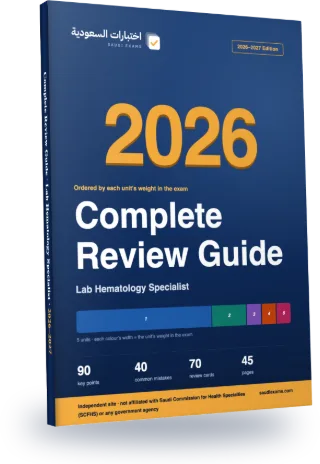
45-page · 90 key points · 40 common mistakes · 70 review cards
The first three chapters alone cover about 90% of the exam. Short on time? Start there.
About the question bank
Know your score before the SCFHS Laboratory Specialist – Hematology exam. We picked 706 questions on hematology, hemostasis, blood bank, immunology and laboratory safety, so you see where you lose points before test day.
- 150 questions in 180 min, like the real test
- 706 questions covering the main scoring topics, with explanations
- 60% pass mark, with targeted practice on your weak spots
See the gap to your target score Practise the units costing you the most marks A full mock exam like the real one
Every option explained so you understand why
What you get
- 706questions in the bankPractise with the answer shown right away, or sit a full timed mock
- 5unitsSplit by the exam syllabus
- 70flashcardsTo lock in terms and definitions
- 90quick review pointsEach unit in a few key lines
Study material sample: Hematology
Summary
Hematology is the largest section of the exam, about 96 of the 150 questions. It has eleven areas. Red cell topics come first: hematopoiesis, the CBC, red cell indices and analyzers, then blood film morphology and inclusions, then the anemias (iron deficiency, megaloblastic, chronic disease, aplastic) and the hemolytic anemias and hemoglobinopathies (G6PD, sickle cell, thalassemia, PNH). White cell topics follow: benign leukocyte disorders, acute leukemias and MDS, MPN, CML, CLL, lymphoma and myeloma, and the methods used to classify them (flow cytometry, cytogenetics, molecular tests, bone marrow). The last three areas are hemostasis: platelets and primary hemostasis, coagulation testing, factor deficiencies and von Willebrand disease, and thrombosis, thrombophilia, DIC and anticoagulant monitoring. Expect interpretation questions with numbers, morphology clues, and the next test to order.
What the exam focuses on · Common traps · Try the flashcards
What the exam focuses on
- Check a CBC for errors with the three rules of three and know which interferents (lipemia, agglutinins, platelet clumps) distort which parameter.
- Match red cell inclusions to their cause: Howell-Jolly, basophilic stippling, Pappenheimer bodies, Heinz bodies.
- Separate iron deficiency from anemia of chronic disease using ferritin, TSAT, reticulocytes and hepcidin biology.
Show 5 more
- Know the lab pattern and tests for each hemolytic anemia: warm AIHA, cold agglutinin disease, G6PD, hereditary spherocytosis, PNH.
- Recognize the defining genetic lesion of each leukemia and MPN: PML::RARA, BCR::ABL1, JAK2.
- Use the correct cell-count thresholds: neutropenia grades, blast percentage for AML, dysplasia percentage for MDS, PV hemoglobin cut-offs.
- Pick the right test for the question: flow cytometry markers, karyotype versus FISH, aspirate versus biopsy.
- Work through a prolonged aPTT or PT (mixing study, factor assay, lupus anticoagulant) and know the von Willebrand disease types.
Common traps
- The three rules of three work for normocytic, normochromic cells and fail for microcytic or macrocytic samples, so a failed rule in thalassemia does not always mean a bad sample.
- Ferritin is an acute phase protein: a normal or high ferritin does not exclude iron deficiency when inflammation is present, so TSAT below 20% or ferritin below 100 ng/mL is used there.
- Basophilic stippling (RNA remnants) and Howell-Jolly bodies (DNA remnants) are different inclusions with different causes.
Show 5 more
- A negative heterophile test does not exclude infectious mononucleosis, especially in young children; the EBV-specific antibody profile is the better tool for staging the infection.
- Warm AIHA is IgG with a DAT positive for IgG (with or without C3), while cold agglutinin disease is IgM with a DAT positive for C3 only.
- In AML with BCR::ABL1 the blast threshold is 20%, which separates it from CML in accelerated phase, so do not apply the lower threshold used for other recurrent genetic lesions.
- A normal karyotype from fewer than 20 metaphases does not exclude a clone, because 20 cells only rule out about a 14% abnormal clone.
- A mildly prolonged aPTT that seems to correct on a 1:1 mix can still hide a weak inhibitor, residual anticoagulant or low-level lupus anticoagulant.
Try the flashcards
Tap a card to see the answer
What does rouleaux with a blue background suggest?
Paraproteinemia or plasma cell dyscrasia; also seen in macroglobulinemia.
Which two interferents most often raise MCHC falsely?
Lipemia (falsely high Hb) and red cell agglutinins; check the smear.
What should be done when an analyzer reports platelet clumps?
Do not report a number; recheck with EDTA and another anticoagulant such as citrate, CTAD or magnesium sulfate, and review the smear.
ASH 2026 ferritin cut-off for iron deficiency in adults?
30 ng/mL or less (instead of 15 or less).
Which pair of tests flags B12 deficiency at the metabolic level?
Raised methylmalonic acid and homocysteine; holo-transcobalamin is the active-B12 marker.
Test for hereditary spherocytosis by flow cytometry?
Eosin-5'-maleimide (EMA) binding, which labels band 3 on red cells; MCHC and osmotic fragility are less ideal.
Cold agglutinin disease: antibody, DAT and specificity?
IgM, DAT positive for C3 only, usually anti-I with titre above 1:500.
Which surface markers are missing on PNH cells and why?
CD55 and CD59, because the GPI anchor is defective.
Why you can trust these questions
- Published questions: 706. Read the explanations and references, and report any error from the question.
- Exam facts last checked against the organiser’s website: 2026-11-17. We check them again every three months and two weeks before each test.
- Found a mistake? Tap "Report an error" under any question in the practice area, or email us at support@saudiexams.com
- Independent website. Not affiliated with ETEC (Qiyas), the Financial Academy, ACAMS, the ACFE, DAMA, CompTIA, Saudi Aramco or any government body.
Update log
- 2026-11-17 Added the exam from the Laboratory – Hematology content guideline: 150 questions, 3 hours, 60% pass mark.
Full prep for this exam
All of this in one purchase.
- Full mock exam, same as the real one150 questions in 180 minutes. You get a total score and a score for every unit.
- Practice unit by unit706 questions, every option explained with its source. Starts with your weakest units.
- Complete Review Guide 2026–2027 (PDF)Ordered by each unit's weight in the exam. With lifetime access only.
Choose your access
Continue with your Google account and you go straight to the payment page.