Lab Hematology Specialist Exam Study Plan: 6 Weeks
A 6-week and a 2-week study plan for the lab hematology specialist exam, weighted to Hematology and Blood Bank, with a full 150-question mock two days before.
- Questions and time
- 150 questions · 3 hours
- Pass mark
- 60%
- correct answers to pass (60%)
- 90 of 150
- Exam fee
- Paid to SCFHS online when you apply through Mumaris Plus; the amount is shown in your application
Start with 10 free questions to find what needs more work. No sign-up, with answer explanations.
Try 10 free questions and see your levelPut what you just read into practice
Start with 10 free questions to find what needs more work. No sign-up, with answer explanations.
Try 10 free questions and see your levelLast verified: 17 November 2026. Check the SCFHS classification exams page and the Laboratory – Hematology content guideline (PDF) before you start, because weights and rules can change. This is an independent guide with no link to SCFHS, Prometric or any government body.
The exam has 150 questions across five sections, and Hematology with Blood Bank carry about 80% of them. This plan gives Hematology the first three and a half weeks, Blood Bank most of week four, puts the three small sections together in week five, and uses week six to close gaps and sit a full mock. The detail of each section is in the exam content guide, and the application steps are in the registration guide.
Numbers to build your plan on
| Item | What it means for your study |
|---|---|
| 150 multiple-choice questions | Per the SCFHS content guideline. The guideline does not state the number of options; our questions use four. |
| 3 hours | 180 minutes for 150 questions is 72 seconds a question. Practise sitting the full time in one go. |
| Pass mark 60% | That is 90 of 150 questions. Your result on this site shows your percentage in each section, so you can compare sections and track progress. |
| Weights can move by up to 5% per section | Do not skip a small section. Even the smallest is worth about 9 questions in our mock exam. |
| Language | The guideline does not state it. We treat the exam as English (our inference), so revise terms in English from the start. Our questions and explanations are in English. |
| Calculator | Not mentioned in the guideline, so practise calculations (red cell indices, corrected counts, control limits) by hand with simple numbers. |
Split your time by section
The percentages are the official ranges. The question counts are the split in our 150-question full mock exam:
| Section | Official weight | Questions | Your time in the plan |
|---|---|---|---|
| Hematology | 60–70% | 96 | Weeks 1–3 and part of week 4 |
| Blood Bank | 15–20% | 27 | Week 4 |
| Immunology and Serology | 5–10% | 9 | Week 5 (1 day) |
| Laboratory Operations | 5–10% | 9 | Week 5 (1 day) |
| Patient Safety and Professionalism | 5–10% | 9 | Week 5 (1 day) |
The 6-week plan
The plan assumes one to two hours a day. Count back six weeks from your booking date once SCFHS opens booking in your application. Each week has the same rhythm: five days of reading and practice, one day to redo the week's mistakes, and one light day.
Week 1: Baseline, CBC and red cell disorders
- Day 1: take the free practice test (10 free questions, no sign-up). Note your percentage in each section and your three weakest.
- Day 2: hematopoiesis, the CBC, red cell indices, histograms and flags.
- Day 3: blood film examination, red cell morphology and inclusions.
- Days 4–5: iron deficiency, megaloblastic, chronic disease and aplastic anemias. Build one pattern card per anemia (MCV, reticulocytes, iron and other tests).
Week 2: Hemolysis, hemoglobinopathies and white cells
- Days 1–2: hemolytic anemias (G6PD, membrane disorders, immune and microangiopathic hemolysis), sickle cell disease, thalassemia and PNH.
- Day 3: benign leukocyte disorders and white cell morphology.
- Days 4–5: acute leukemias and myelodysplastic syndromes, with the key marker and confirming test for each.
Week 3: Myeloid and lymphoid neoplasms, laboratory methods and hemostasis
- Day 1: myeloproliferative neoplasms and CML.
- Day 2: CLL, lymphoma and myeloma.
- Day 3: flow cytometry, cytogenetics, molecular testing and bone marrow examination.
- Days 4–5: primary hemostasis and platelet disorders, then coagulation screening tests.
Week 4: Hemostasis (continued) and Blood Bank
- Day 1: factor deficiencies, von Willebrand disease, thrombosis, thrombophilia, DIC and anticoagulant monitoring.
- Day 2: ABO, Rh and other blood group systems, including typing discrepancies.
- Day 3: antibody screen and identification, crossmatch and the direct antiglobulin test.
- Day 4: blood components (preparation, storage, indications) and transfusion reactions.
- Day 5: hemolytic disease of the fetus and newborn, donor selection and infectious disease screening. Then open the practice area and do 10 questions from your weakest Hematology topic.
Week 5: The three small sections
- Day 1: Immunology and Serology: immunoglobulins, complement, hypersensitivity, autoimmunity and immunoassay methods.
- Day 2: Immunology and Serology (continued): immunodeficiency, HLA and transplant immunology.
- Day 3: Laboratory Operations: quality control, statistics and proficiency testing. Do the calculations on paper.
- Day 4: Laboratory Operations (continued): preanalytical variables, specimen rejection, method validation, critical values and quality systems.
- Day 5: Patient Safety and Professionalism: patient identification, transfusion safety, biosafety, ethics and health practice law.
Week 6: Close the gaps and sit the full mock
- Days 1–3: redo every question in your error notebook, then practise your weakest topics 10 questions at a time.
- Day 4: a light day. Skim your anemia pattern cards and your transfusion reaction checklist.
- Day 5 (two days before the exam): sit one full mock exam (next section).
- Day 6: review only the mistakes from the mock. Do not open a new topic.
The full mock exam, two days before the real one
- 150 questions in 180 minutes, in one sitting. The content guideline does not mention a break, so do not plan one.
- No phone and no notes. Calculate by hand.
- If a question stalls you, flag it and move on; at 72 seconds each, one slow question costs the next one.
- Afterwards, open the result for each section. The section with the lowest percentage is what you review on your last study day.
The 2-week plan if you are short of time
Build it on Hematology and Blood Bank, which are about 80% of the exam, and keep a short pass over each small section:
| Day | Task |
|---|---|
| 1 | Free practice test (10 questions) and pick out your weakest sections |
| 2 | CBC, red cell indices, analyzers and blood film morphology |
| 3 | Iron deficiency, megaloblastic, chronic disease and aplastic anemias |
| 4 | Hemolytic anemias, hemoglobinopathies and PNH |
| 5 | Benign leukocyte disorders, acute leukemias and MDS |
| 6 | MPN, CML, CLL, lymphoma, myeloma and flow cytometry |
| 7 | Hemostasis: platelets, coagulation tests, anticoagulant monitoring, thrombosis and DIC |
| 8 | ABO and Rh, antibody screen and identification, crossmatch |
| 9 | Blood components, transfusion reactions and HDFN |
| 10 | Immunology and Serology, then Laboratory Operations with calculations on paper |
| 11 | Patient Safety and Professionalism |
| 12 | Error notebook and weakest topics (10 questions each) |
| 13 | Full mock exam: 150 questions in 180 minutes |
| 14 | Review only the mock's mistakes, then an early night |
How to handle your mistakes
- Read the explanation of every option, not just the correct answer. A wrong option today can be the right answer tomorrow.
- Write the cause of each mistake in one phrase: missing fact, mixed up two disorders or tests, calculation slip, or rushed reading. One cause usually repeats.
- Redo missed questions after two days, then after a week. When you answer one correctly twice in a row, take it out of your notebook.
What this site adds to your plan
- The free practice test: 10 free questions from the exam's sections, with the answer, its explanation and your percentage in each section, no sign-up.
- The practice area: practise section by section, with an error notebook and practice on your weakest topics. The remaining questions need a paid pass.
- The full mock exam of 150 questions in 180 minutes, the same question count and total time as the guideline. It also needs a paid pass.
This is an independent exam preparation website with no link to SCFHS, Prometric or any government body.
Finished reading? Try a set of questions
Start with 10 free questions to find your weakest units. Keep practising with the full question bank and mock exams from SAR 26.
Put the plan to work here
SAR 34 $9
One purchase · lifetime access · review guide included
- 706 questions, every option explained with its source
- Full mock exams: 150 questions in 180 minutes, like the real one
- Practice that starts with your weakest units, plus a review of your mistakes
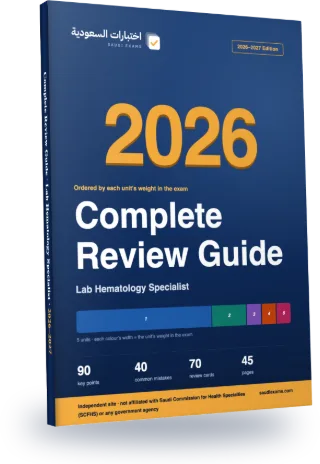 Complete Review Guide 2026–2027 included (PDF)Ordered by the weight of each unit in the examBuy now · SAR 34or 7 days for SAR 26
See everything included
Full mock exams like the real one and 706 explained questions that find your weak spots and train them
- Unlimited full mock exams to practise your pace and check your performance across the whole exam
- Practise 10 weak-area questions, starting where you lose the most marks
- 706 questions explaining why every option is right or wrong
- Arabic and English with one pass
- Unit notes and flashcards, then questions to check your understanding
This exam is part of professional classification as a laboratory specialist in hematology, and you cannot get a practice licence without classification. If you do not pass you get further attempts under SCFHS rules and pay the evaluation fee. Source Last verified: 2026-11-17