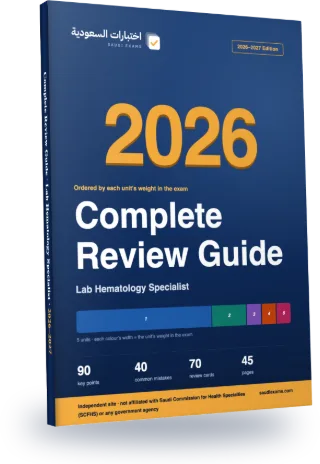
Lab Hematology Specialist Complete Review Guide 2026–2027
Every exam topic in a 45-page Arabic PDF, ordered from the heaviest unit to the lightest. The first three chapters alone cover about 90% of the exam questions.
- 45Pages
- 90Key points
- 40Common mistakes
- 70Flashcards
Guide map
Each chapter is one exam unit, ordered by its weight in the real exam.
| Chapter | Unit | Weight | Exam questions | Key points |
|---|---|---|---|---|
| 1 | Hematology | 65% | 96 | 18 |
| 2 | Blood Bank | 18% | 27 | 18 |
| 3 | Immunology and Serology | 8% | 9 | 18 |
| 4 | Laboratory Operations | 8% | 9 | 18 |
| 5 | Patient Safety and Professionalism | 8% | 9 | 18 |
Chapter 1 in full: Hematology
65% of the exam, about 96 questions. These are its key points, as in the guide.
- (Hematopoiesis, CBC and analyzers) Use the three rules of three to validate a CBC: Hct is about Hb x 3 (within 3), Hb is about RBC x 3 (within 0.3), and RBC is about Hb / 3 (within 0.3). They work for normocytic, normochromic blood only, per the analyzer review in the CBC reliability article.
- (Hematopoiesis, CBC and analyzers) Lipemia falsely raises Hb, MCH and MCHC. An MCHC above about 36 g/dL is a flag for a spurious result (lipemia, hemolysis, red cell agglutinins), so check the specimen and the smear before reporting. Marrow output is about 200 x 10^9 red cells per day, driven by erythropoietin.
- (Blood film and morphology) Inclusions: Howell-Jolly bodies are DNA remnants seen after splenectomy or in functional asplenia; basophilic stippling is aggregated RNA (thalassemia, lead or arsenic poisoning, sideroblastic anemia); Pappenheimer bodies are iron granules, purple on Romanowsky stain and blue on Perls stain, seen in sideroblastic anemia.
The rest of chapter 1, on this page
- (Iron deficiency and related anemias) Per the ASH 2026 guideline, a serum ferritin of 30 ng/mL or less diagnoses iron deficiency in adults (30 or less rather than 15 or less, also for menstruating individuals). With inflammation, consider iron deficiency if TSAT is below 20% or ferritin is below 100 ng/mL. Draw TSAT fasting.
- (Iron deficiency and related anemias) Anemia of chronic disease is driven by hepcidin: hepcidin blocks ferroportin, trapping iron in macrophages and hepatocytes. The picture is mild to moderate normocytic anemia with low TSAT, high ferritin, low reticulocytes and low to normal EPO. Iron deficiency anemia is microcytic, hypochromic, with low ferritin and TSAT.
- (Iron deficiency and related anemias) Vitamin B12 status: deficiency lowers methionine synthase and methylmalonyl-CoA mutase activity, so homocysteine and methylmalonic acid (MMA) rise. Total B12, holo-transcobalamin, homocysteine and MMA are the preferred biomarkers; a total B12 below 200 pmol/L is a common subclinical definition.
- (Iron deficiency and related anemias) Severe aplastic anemia (modified Camitta criteria): hypocellular marrow plus at least two of ANC below 0.5, platelets below 20, absolute reticulocytes below 20 (all x 10^9/L). Very severe means ANC below 0.2 x 10^9/L. Work-up must first exclude reversible causes (nutritional, drugs, infection) and then assess inherited marrow failure.
- (Hemolytic anemias and hemoglobinopathies) Autoimmune hemolysis types: warm AIHA is IgG, DAT IgG or IgG plus C3, extravascular; cold agglutinin disease is IgM, DAT C3 only, anti-I, titre usually above 1:500; paroxysmal cold hemoglobinuria is a biphasic IgG with anti-P and titre below 1:64 (per Immunity and Ageing review).
- (Hemolytic anemias and hemoglobinopathies) PNH: a GPI anchor defect removes CD55 and CD59 from the cell surface, so red cells undergo complement-mediated intravascular hemolysis; flow cytometry on blood cells is the test. G6PD deficiency: oxidant stress produces Heinz bodies and bite cells, and the G6PD enzyme assay is listed as the confirmatory test after the flare.
- (Hemolytic anemias and hemoglobinopathies) Thalassemia: the alpha/beta chain synthesis ratio falls below about 0.8 in alpha thalassemia, about 0.75 with one alpha gene lost, 0.5 with two and 0.25 with three. Beta thalassemia carriers are found by raised HbA2 (cut-off 3.6% used in the Thai screening program); HbS/beta thalassemia behaves more like sickle cell disease.
- (Benign leukocyte disorders) Neutropenia grades (European guideline): mild 1.0 to 1.5 (adults 1.8), moderate 0.5 to 1.0, severe below 0.5 x 10^9/L; agranulocytosis is below 0.2. Some people of African and Middle Eastern descent have a normal ANC of 0.5 to 1.5. Hypereosinophilic syndrome needs eosinophils of 1.5 x 10^9/L or more on two occasions plus organ damage.
- (Acute leukemias and MDS) AML with BCR::ABL1 needs at least 20% blasts (WHO) to distinguish it from CML in accelerated phase. APL (10 to 15% of AML) carries t(15;17) PML::RARA, blocks maturation and causes severe bleeding, so it is recognized early.
- (Acute leukemias and MDS) MDS diagnosis requires cytopenia plus morphologic dysplasia in at least 10% of cells of a lineage (WHO 5th edition). Minimal marrow criteria also include at least 15% ring sideroblasts or 5 to 19% myeloblasts. Blast phase of MPN is 20% blasts or more.
- (MPN, CML, CLL, lymphoma and myeloma) CML is defined by BCR::ABL1 from t(9;22). Monitoring uses BCR::ABL1 on the International Scale, with decision points at 10% and 0.1%; reports should state measurement uncertainty. Blast phase means at least 20% blasts. PV (WHO revision): Hb above 16.5 g/dL or Hct 49% in men, 16 or 48% in women, with JAK2 and low EPO.
- (Flow cytometry, cytogenetics and marrow) If no abnormality is found at diagnosis, examine at least 20 metaphases; this excludes a 14% abnormal clone with 95% confidence. Cytogenomic testing combines banding, FISH and microarray. Marrow work-up uses both aspirate and trephine biopsy, and the decalcification method must preserve genetic material for molecular tests.
- (Primary hemostasis and platelets) TTP: thrombocytopenia plus microangiopathic hemolytic anemia without another cause should prompt suspicion; severe ADAMTS13 deficiency (below 10%) lets ultralarge VWF multimers accumulate. Fewer than 10% of patients present with the full pentad.
- (Coagulation testing and VWD) VWD: type 1 (about 75%) is partial quantitative loss, type 3 near-complete loss, type 2A lacks high-molecular-weight multimers, 2B has gain of function for platelet binding, 2M has reduced platelet or collagen binding, and 2N has reduced FVIII binding and mimics hemophilia A. Hemophilia FVIII or FIX is measured by one-stage clotting or chromogenic assay.
- (Thrombosis, DIC and anticoagulants) HIT usually appears after about 5 days of heparin. The 4Ts score gives low (1 to 3), intermediate (4 to 5) or high (6 to 8) probability. At intermediate or high probability stop heparin, switch to a non-heparin anticoagulant and test for anti-PF4/heparin antibodies.
Common mistakes in this chapter
- The three rules of three work for normocytic, normochromic cells and fail for microcytic or macrocytic samples, so a failed rule in thalassemia does not always mean a bad sample.
- Ferritin is an acute phase protein: a normal or high ferritin does not exclude iron deficiency when inflammation is present, so TSAT below 20% or ferritin below 100 ng/mL is used there.
- Basophilic stippling (RNA remnants) and Howell-Jolly bodies (DNA remnants) are different inclusions with different causes.
- A negative heterophile test does not exclude infectious mononucleosis, especially in young children; the EBV-specific antibody profile is the better tool for staging the infection.
- Warm AIHA is IgG with a DAT positive for IgG (with or without C3), while cold agglutinin disease is IgM with a DAT positive for C3 only.
- In AML with BCR::ABL1 the blast threshold is 20%, which separates it from CML in accelerated phase, so do not apply the lower threshold used for other recurrent genetic lesions.
- A normal karyotype from fewer than 20 metaphases does not exclude a clone, because 20 cells only rule out about a 14% abnormal clone.
- A mildly prolonged aPTT that seems to correct on a 1:1 mix can still hide a weak inhibitor, residual anticoagulant or low-level lupus anticoagulant.
The other chapters are in the full guide
One purchase · lifetime access · review guide included
7-day review plan
The chapters are spread over 6 days by weight so each day carries a similar load. Day 7 is a full exam.
Day 1 · 65% of the exam
Chapter 1: Hematology
Day 2 · 18% of the exam
Chapter 2: Blood Bank
Day 3 · 8% of the exam
Chapter 3: Immunology and Serology
Day 4 · 8% of the exam
Chapter 4: Laboratory Operations
Day 5 · 8% of the exam
Chapter 5: Patient Safety and Professionalism
Day 6
Full mock exam: 150 questions in 180 minutes, then review the common mistakes in the units where you lost marks.
How many correct answers do you need?
- Pass mark 60%90 correct out of 150
Before you read: see your score today
10 free questions from the main units, no sign-up. Then you know which chapter to start with.
Try 10 free questions and see your levelA look at each chapter
The first three key points of each chapter, as they appear in the guide (in Arabic in the PDF).
Chapter 1: Hematology
- (Hematopoiesis, CBC and analyzers) Use the three rules of three to validate a CBC…
- (Hematopoiesis, CBC and analyzers) Lipemia falsely raises Hb, MCH and MCHC. An MCHC above…
- (Blood film and morphology) Inclusions
Chapter 2: Blood Bank
- (ABO, Rh and other blood groups) A, B and H carbohydrates differ by terminal…
- (ABO, Rh and other blood groups) ABO discrepancy work-up per Red Book ch13: missing…
- (ABO, Rh and other blood groups) D typing quality
Chapter 3: Immunology and Serology
- (Immunoglobulins) Human heavy chains come in five isotypes (IgA, IgD, IgE, IgG, IgM). IgM…
- (Immunoglobulins) Quantitative IgG, IgA and IgM testing supports diagnosis of immunodeficiency (frequent infections), and…
- (Complement) Classical C3 convertase is C4b2a and alternative C3 convertase is C3bBb. All pathways…
Chapter 4: Laboratory Operations
- (Quality control and proficiency testing) Sigma metric is calculated as (total allowable error minus…
- (Quality control and proficiency testing) Sigma grades
- (Quality control and proficiency testing) Westgard sigma rules choose QC by sigma level: world…
Chapter 5: Patient Safety and Professionalism
- (Patient identification) BCSH 2010 lists surname, forename, date of birth and a unique patient…
- (Patient identification) Positive identification means the patient says their full name and date of…
- (Specimen labelling) Sampling and labelling form one continuous event at the patient's side, with…
The full guide comes with lifetime access
The full guide (45 pages) is included with lifetime access to this exam, together with every question and full mock exam. Chapter 1 is free for everyone.
Questions about the guide
Is the guide free?
Chapter 1 is free to read on the guide page. The full guide comes with lifetime access to this exam; 7-day access does not include it.
Is it up to date for 2026–2027?
Yes. Unit weights and exam facts follow what the exam body last published, and the last check date is printed in the guide. If the standards change we update the file and buyers download the new version.
Does the guide have questions?
No. The guide covers key points and common mistakes; scoring, weak-area practice and full mock exams are on the site.
Can I read it on my phone?
Yes. A5 pages in a single column, with chapters linked from the contents.
- Pages
- 45
- Edition
- 1448 AH · 2026–2027
- Language
- Arabic
- Last updated
Full prep for this exam
All of this in one purchase.
- Full mock exam, same as the real one150 questions in 180 minutes. You get a total score and a score for every unit.
- Practice unit by unit706 questions, every option explained with its source. Starts with your weakest units.
- Complete Review Guide 2026–2027 (PDF)Ordered by each unit's weight in the exam. With lifetime access only.
Choose your access
Continue with your Google account and you go straight to the payment page.