SCFHS Laboratory Specialist – Clinical Biochemistry Exam
SCFHS Laboratory Specialist – Clinical Biochemistry Exam — Number of questions: 150 questions. Exam time: 3 hours. Pass mark: 60%. Calculator: The SCFHS content guideline does not say whether a calculator is allowed. Exam fee: Paid to SCFHS online when you apply through Mumaris Plus; the amount is shown in your application. Source: Saudi Commission for Health Specialties (SCFHS) (Last verified: 2026-11-17). Question bank: full mock exams of 150 questions in 180 minutes, like the real test with a result for every unit, plus 595 explained questions across 5 units, every option explained, a review of your mistakes, and two ways to practise: see the answer right away, or sit a full timed mock. Free questions: a 10-question diagnostic test covering the main units, no sign-up; at the end we compare your score with the pass mark and show your weakest units. With lifetime access: the Complete Review Guide, a 45-page PDF ordered by unit weight; chapter 1 is free to read on the guide page.
Last verified on the Saudi Commission for Health Specialties (SCFHS) website: 17 November 2026
If you sat the exam today, what would you score?
10 free questions · no sign-up · your score as soon as you finish
Question 1 of 10
A laboratory evaluates a creatinine assay. The control material's peer-group mean is 100 µmol/L, the laboratory's own mean over the month is 105 µmol/L, and the CV is 3%. The allowable total error (TEa) for the test is 15%. What is the sigma metric of the assay?
All 10 free questions with answers and an explanation for every option
Where the questions come from
- Clinical Chemistry87 questions
- Urinalysis and Other Body Fluids12 questions
- Immunology and Serology28 questions
- Laboratory Operations12 questions
- Patient Safety and Professionalism11 questions
Exam facts
- Exam language
- English
- Number of questions
- 150 questions Source
- Exam time
- 3 hours Source
- Pass mark
- 60% Source
- Calculator
- The SCFHS content guideline does not say whether a calculator is allowed Source
- Exam fee
- Paid to SCFHS online when you apply through Mumaris Plus; the amount is shown in your application Source
- Registration
- Apply through the Professional Classification service in Mumaris Plus; SCFHS has not published a separate window calendar for the clinical biochemistry specialist exam Source
- Retakes
- If you do not pass you get further attempts under SCFHS regulations and pay the evaluation fee Source
Last verified: 2026-11-17
Where other sources differ
- The pass mark is 60% in the content guideline. Section weights may differ by up to 5% in each category, and SCFHS may change content and percentages at any time.
- Five sections: clinical chemistry (50–60%), immunology and serology (15–20%), then urinalysis and body fluids, laboratory operations, and patient safety and professionalism (5–10% each). SCFHS does not state the exam language outright; the content guideline and its references are in English.
Exam body
Saudi Commission for Health Specialties (SCFHS): Official website: Saudi Commission for Health Specialties (SCFHS)
How to register
- Choose the Professional Classification service in the Mumaris Plus system and submit your application with your certificate and documents.
- Once your application is accepted you are referred to an electronic written exam delivered through Prometric.
- Pay the evaluation fee shown in your application.
- Book your slot at a test centre through the booking service SCFHS opens in your application.
- On exam day bring your ID or passport and your booking confirmation.
Study guides (3)
Frequently asked questions
How many questions are there and how long is the exam?
150 multiple-choice questions in 3 hours, according to the SCFHS Laboratory – Clinical Biochemistry content guideline.
Can I try Lab Clinical Biochemistry Specialist questions for free?
Yes. Free questions: a 10-question diagnostic test covering the main units, no sign-up; at the end we compare your score with the pass mark and show your weakest units. The free practice test page lists the same questions with answers and an explanation for every option. The rest of the questions and the full mock exams come with a pass from SAR 26.
What makes this Lab Clinical Biochemistry Specialist question bank different?
Question bank: full mock exams of 150 questions in 180 minutes, like the real test with a result for every unit, plus 595 explained questions across 5 units, every option explained, a review of your mistakes, and two ways to practise: see the answer right away, or sit a full timed mock. Practice questions and explanations are ready to use on your phone. Try the free questions and read the explanations before you buy.
Is there a PDF review guide for Lab Clinical Biochemistry Specialist?
Yes. "Lab Clinical Biochemistry Specialist Complete Review Guide 2026–2027" is a 45-page Arabic PDF: 5 units ordered from the heaviest in the exam to the lightest, each chapter with key points, common mistakes and review cards, plus a 7-day plan. Chapter 1 is free to read on the guide page; the full guide comes with lifetime access to this exam and is not part of 7-day access. The guide has no questions: scoring, practice and mock exams are on the site.
What is the pass mark?
60% according to the guideline. On our site your result shows your percentage in each section so you can see where you lose points.
What language is the exam in?
SCFHS does not state the exam language, but the guideline and its reference books are in English, so our questions and every option explanation are in English. Check your exam language in Mumaris Plus.
Which sections does the exam cover?
Five sections: clinical chemistry (50–60%), immunology and serology (15–20%), then urinalysis and body fluids, laboratory operations, and patient safety and professionalism (5–10% each).
How is it different from the SLLE and the lab technician exam?
This is the clinical biochemistry specialty exam: 150 questions, five sections, clinical chemistry at 50–60% and a 60% pass mark. The SLLE is the general specialist licensure exam (200 questions, nine sections) and the technician exam has six sections and a 55% pass mark.
Is this site part of SCFHS?
No. This is an independent exam preparation site with no link to SCFHS, Prometric or any government body. Always rely on what SCFHS announces.
Is this an official site, and how do I pay?
It is an independent site, not part of Qiyas, this exam's regulator or any government body, with practice questions and answer explanations. You pay once, with no automatic renewal, through Waffo Pancake (the merchant of record) by Visa, Mastercard, Apple Pay or Google Pay, and your statement shows "WAFFO". If you were charged twice or the pass did not open, email support@saudiexams.com.
Lab Clinical Biochemistry Specialist Complete Review Guide 2026–2027
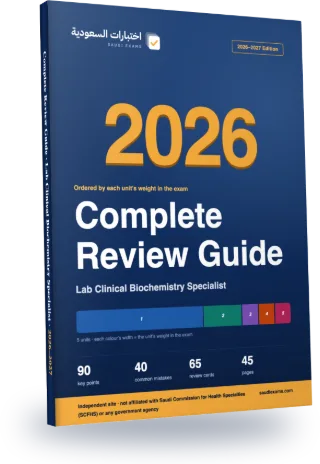
45-page · 90 key points · 40 common mistakes · 65 review cards
The first three chapters alone cover about 80% of the exam. Short on time? Start there.
About the question bank
Know your score before the SCFHS Laboratory Specialist – Clinical Biochemistry exam. We picked 595 questions on clinical chemistry, urinalysis and body fluids, immunology and serology, laboratory operations and patient safety, so you see where you lose points before test day.
- 150 questions in 180 min, like the real test
- 595 questions covering the main scoring topics, with explanations
- 60% pass mark, with targeted practice on your weak spots
See the gap to your target score Practise the units costing you the most marks A full mock exam like the real one
Every option explained so you understand why
What you get
- 595questions in the bankPractise with the answer shown right away, or sit a full timed mock
- 5unitsSplit by the exam syllabus
- 65flashcardsTo lock in terms and definitions
- 90quick review pointsEach unit in a few key lines
Study material sample: Clinical Chemistry
Summary
Clinical Chemistry carries the most weight in the exam: about 87 of the 150 questions, 58% by the blueprint. It has 15 sections: analytical methods (ISE, immunoassay, mass spectrometry), pre-analytical variables and reference intervals, electrolytes and acid-base, bone and calcium, diabetes and lipids, liver, pancreas and kidney tests, cardiac markers, endocrinology, iron and vitamins, toxicology, and inherited metabolic disease. Questions mix definitions, cut points and interpretation of a result or a lab artefact. Learn the diagnostic thresholds, the exceptions where a test misleads (indirect ISE with lipaemia, hook effect, haemoglobin variants), and work through the weighted sections first: diabetes, endocrinology, electrolytes, liver and cardiac markers.
What the exam focuses on · Common traps · Try the flashcards
What the exam focuses on
- Direct ISE needs no dilution; indirect ISE does, so lipids and proteins can give falsely low sodium.
- Hyponatraemia correction must stay below 10 mmol/L per day to avoid osmotic demyelination.
- Compensation rules for respiratory acidosis: 1 mEq/L HCO3 per 10 mmHg PaCO2 when acute, 3.5 when chronic.
Show 5 more
- Primary hyperparathyroidism: hypercalcaemia with raised or inappropriately normal PTH, calcium adjusted for albumin.
- Diabetes cut points: fasting glucose 7.0 mmol/L, 2-hour glucose 11.1 mmol/L, HbA1c 6.5%.
- Friedewald equation is inappropriate at triglycerides of 400 mg/dL or higher.
- KDIGO CKD staging combines GFR categories G1-G5 with albuminuria categories A1-A3.
- High-sensitivity troponin is judged against the 99th percentile with a CV below 10% at that level.
Common traps
- Pseudohyponatraemia is an indirect ISE artefact; direct ISE sodium is not affected by lipids or proteins the same way.
- A wrong order of draw may not cause K-EDTA contamination in closed systems, yet it still shifts potassium results.
- The hook effect gives a falsely low result at very high analyte levels; the fix is dilution, not a repeat at the same dilution.
Show 5 more
- Haemoglobin variants can make HbA1c misleading, so a normal HbA1c does not always exclude diabetes.
- Friedewald underestimates LDL-C at low LDL-C with triglycerides of 150 mg/dL or more.
- Ferritin is an acute-phase protein: a normal ferritin with inflammation does not exclude iron deficiency.
- A digoxin level inside the therapeutic range does not exclude toxicity, especially with kidney injury and high potassium.
- Amylase or lipase can be of limited value in hyperlipidaemic and alcoholic pancreatitis, so imaging and pain criteria still count.
Try the flashcards
Tap a card to see the answer
Which ISE method is affected by abnormal serum lipids or proteins?
Indirect ISE, because the sample is diluted before measurement.
What is the hook effect and how is it handled?
Very high analyte saturates the antibodies and gives a falsely low result. Dilute the sample and repeat.
What do LC-MS/MS techniques add to a method?
Liquid chromatography separates interferences such as isobaric compounds, giving high analytical selectivity.
How many reference subjects does the cited guideline recommend for confidence intervals of reference limits?
At least 120.
What is the maximum daily rise in sodium during hyponatraemia correction?
Avoid above 10 mmol/L per day.
How do you quickly check hydrogen ion against pH on a blood gas?
[H+] is 80 minus the two digits after the decimal of the pH.
What is the typical biochemical picture of hypoparathyroidism?
Low or absent PTH, low serum calcium and raised phosphate.
What fasting plasma glucose value is diagnostic of diabetes?
7.0 mmol/L (126 mg/dL) or higher.
Why you can trust these questions
- Published questions: 595. Read the explanations and references, and report any error from the question.
- Exam facts last checked against the organiser’s website: 2026-11-17. We check them again every three months and two weeks before each test.
- Found a mistake? Tap "Report an error" under any question in the practice area, or email us at support@saudiexams.com
- Independent website. Not affiliated with ETEC (Qiyas), the Financial Academy, ACAMS, the ACFE, DAMA, CompTIA, Saudi Aramco or any government body.
Update log
- 2026-11-17 Added the exam from the Laboratory – Clinical Biochemistry content guideline: 150 questions, 3 hours, 60% pass mark.
Full prep for this exam
All of this in one purchase.
- Full mock exam, same as the real one150 questions in 180 minutes. You get a total score and a score for every unit.
- Practice unit by unit595 questions, every option explained with its source. Starts with your weakest units.
- Complete Review Guide 2026–2027 (PDF)Ordered by each unit's weight in the exam. With lifetime access only.
Choose your access
Continue with your Google account and you go straight to the payment page.