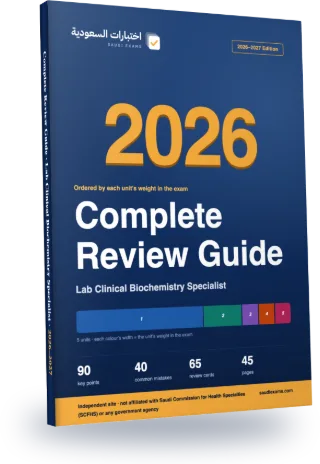
Lab Clinical Biochemistry Specialist Complete Review Guide 2026–2027
Every exam topic in a 45-page Arabic PDF, ordered from the heaviest unit to the lightest. The first three chapters alone cover about 80% of the exam questions.
- 45Pages
- 90Key points
- 40Common mistakes
- 65Flashcards
Guide map
Each chapter is one exam unit, ordered by its weight in the real exam.
| Chapter | Unit | Weight | Exam questions | Key points |
|---|---|---|---|---|
| 1 | Clinical Chemistry | 55% | 87 | 18 |
| 2 | Immunology and Serology | 18% | 28 | 18 |
| 3 | Urinalysis and Other Body Fluids | 8% | 12 | 18 |
| 4 | Laboratory Operations | 8% | 12 | 18 |
| 5 | Patient Safety and Professionalism | 8% | 11 | 18 |
Chapter 1 in full: Clinical Chemistry
55% of the exam, about 87 questions. These are its key points, as in the guide.
- (Analytical principles and instrumentation (spectrophotometry, ISE, electrophoresis, chromatography, mass spectrometry, immunoassay, point-of-care)) A direct ion-selective electrode (ISE) measures sodium without diluting the sample. An indirect ISE dilutes the sample first, so abnormal protein or lipid levels can distort the result. Lipaemia can make indirect ISE sodium falsely low.
- (Pre-analytical variables, interferences, reference intervals and method evaluation) In a study using closed collection systems, a wrong order of draw did not cause K-EDTA contamination. The order of draw still changed potassium results significantly, and 24% of successively drawn samples differed by more than 0.3 mmol/L.
- (Pre-analytical variables, interferences, reference intervals and method evaluation) Reference intervals are usually the central 95% of a reference distribution for a defined population. The guideline cited recommends at least 120 reference subjects to calculate confidence intervals for the limits.
The rest of chapter 1, on this page
- (Water, sodium, potassium, chloride and osmolality) In hyponatraemia, correction above 10 mmol/L per day must be avoided because of the risk of osmotic demyelination. Acute hyponatraemia means symptoms starting within 48 hours, with cerebral oedema as the cause of seizures or coma.
- (Acid-base balance and blood gases) Compensation rules for respiratory acidosis: HCO3 rises 1 mEq/L per 10 mmHg PaCO2 above 40 when acute, and 3.5 mEq/L per 10 mmHg when chronic. Check the report for consistency first: [H+] is about 80 minus the two digits after the decimal of the pH.
- (Calcium, phosphate, magnesium, vitamin D and bone metabolism) Primary hyperparathyroidism is hypercalcaemia with raised or inappropriately normal PTH. Measured total calcium should be adjusted for albumin. If corrected calcium is normal and PTH is raised, ionised calcium is the next test.
- (Carbohydrate metabolism and diabetes mellitus) ADA diagnostic cut points: fasting plasma glucose 7.0 mmol/L (126 mg/dL) or higher, 2-hour plasma glucose 11.1 mmol/L (200 mg/dL) or higher, and HbA1c 6.5% or higher. The HbA1c method should be certified for standardisation.
- (Carbohydrate metabolism and diabetes mellitus) Haemoglobin variants can make HbA1c misleading. A study of patients with diabetes found variants in about one third of them, and earlier work reported HbA1c underestimated in some variant phenotypes.
- (Lipids, lipoproteins and dyslipidaemia) The Friedewald equation is inappropriate when triglycerides are 400 mg/dL or higher or in dysbetalipoproteinaemia. At LDL-C below 70 mg/dL with triglycerides of 150 mg/dL or more, it underestimates LDL-C. The Martin-Hopkins equation adjusts the TG:VLDL-C factor.
- (Liver function, bilirubin and hepatic enzymes) The R factor is (ALT/ULN of ALT) divided by (ALP/ULN of ALP). It sorts injury into hepatocellular, cholestatic or mixed patterns, alongside isolated raised bilirubin. Aminotransferase elevation is mild below 5 times ULN, moderate from 5 to 15 times and severe above 15 times.
- (Clinical enzymology, pancreatic and gastrointestinal function) Acute pancreatitis needs two of three criteria: typical pain, serum lipase or amylase at least three times the upper limit, and typical imaging. A lipase/amylase ratio above 3 may help separate alcoholic from non-alcoholic pancreatitis.
- (Renal function, nitrogen compounds and kidney disease) KDIGO defines CKD by abnormality lasting more than 3 months. GFR categories: G1 90 or more, G2 60-89, G3a 45-59, G3b 30-44, G4 15-29, G5 below 15 mL/min/1.73 m2. Albuminuria: A1 below 30, A2 30-300, A3 above 300 mg/g.
- (Cardiac biomarkers and plasma proteins) High-sensitivity troponin assays need a CV below 10% at the 99th percentile. Concentrations below the 99th percentile must be measurable in more than 50% of healthy people. Interpretation rests on the 99th percentile of the population.
- (Endocrinology: thyroid, adrenal, pituitary, gonadal and pregnancy testing) Screening for Cushing syndrome uses 24-hour urinary free cortisol, late-night salivary cortisol or the 1-mg overnight dexamethasone suppression test. Abnormal results are repeated and non-neoplastic causes of hypercortisolism excluded.
- (Endocrinology: thyroid, adrenal, pituitary, gonadal and pregnancy testing) The hook effect occurs when very high analyte levels saturate the antibodies, giving falsely low results. It affected total PSA and total hCG assays, including a molar pregnancy. Dilute the sample when it is suspected.
- (Iron, trace elements, vitamins and nutritional assessment) Ferritin rises with inflammation, so it can hide iron deficiency. CRP of 5 mg/L is the most common threshold for judging inflammation, but most guidelines do not recognise it. Transferrin saturation is the companion test.
- (Tumour markers, therapeutic drug monitoring and toxicology) Salicylate toxicity can cause respiratory alkalosis together with an anion gap metabolic acidosis. Symptoms include tinnitus, vomiting and altered mental status.
- (Inherited metabolic disease, porphyrias, newborn screening and molecular basics) In phenylketonuria screening, most programmes in a 23-country survey sampled at 48-72 hours and used tandem mass spectrometry. Early detection allows a phenylalanine-restricted diet that prevents severe neurological impairment.
Common mistakes in this chapter
- Pseudohyponatraemia is an indirect ISE artefact; direct ISE sodium is not affected by lipids or proteins the same way.
- A wrong order of draw may not cause K-EDTA contamination in closed systems, yet it still shifts potassium results.
- The hook effect gives a falsely low result at very high analyte levels; the fix is dilution, not a repeat at the same dilution.
- Haemoglobin variants can make HbA1c misleading, so a normal HbA1c does not always exclude diabetes.
- Friedewald underestimates LDL-C at low LDL-C with triglycerides of 150 mg/dL or more.
- Ferritin is an acute-phase protein: a normal ferritin with inflammation does not exclude iron deficiency.
- A digoxin level inside the therapeutic range does not exclude toxicity, especially with kidney injury and high potassium.
- Amylase or lipase can be of limited value in hyperlipidaemic and alcoholic pancreatitis, so imaging and pain criteria still count.
The other chapters are in the full guide
One purchase · lifetime access · review guide included
7-day review plan
The chapters are spread over 6 days by weight so each day carries a similar load. Day 7 is a full exam.
Day 1 · 55% of the exam
Chapter 1: Clinical Chemistry
Day 2 · 18% of the exam
Chapter 2: Immunology and Serology
Day 3 · 8% of the exam
Chapter 3: Urinalysis and Other Body Fluids
Day 4 · 8% of the exam
Chapter 4: Laboratory Operations
Day 5 · 8% of the exam
Chapter 5: Patient Safety and Professionalism
Day 6
Full mock exam: 150 questions in 180 minutes, then review the common mistakes in the units where you lost marks.
How many correct answers do you need?
- Pass mark 60%90 correct out of 150
Before you read: see your score today
10 free questions from the main units, no sign-up. Then you know which chapter to start with.
Try 10 free questions and see your levelA look at each chapter
The first three key points of each chapter, as they appear in the guide (in Arabic in the PDF).
Chapter 1: Clinical Chemistry
- (Analytical principles and instrumentation (spectrophotometry, ISE, electrophoresis, chromatography, mass spectrometry, immunoassay, point-of-care)) A direct…
- (Pre-analytical variables, interferences, reference intervals and method evaluation) In a study using closed collection…
- (Pre-analytical variables, interferences, reference intervals and method evaluation) Reference intervals are usually the central…
Chapter 2: Immunology and Serology
- (Immune system, immunoglobulins and complement) IgM is the first immunoglobulin made after exposure to…
- (Immune system, immunoglobulins and complement) HLA class I molecules are on nearly all nucleated…
- (Immune system, immunoglobulins and complement) C3 and C4 are the most commonly tested individual…
Chapter 3: Urinalysis and Other Body Fluids
- (Urine collection, physical and chemical examination) A sterile container is mandatory for urine culture…
- (Urine collection, physical and chemical examination) Soap and antiseptics are not recommended for cleansing…
- (Urine collection, physical and chemical examination) If urinalysis cannot be done within 2 hours…
Chapter 4: Laboratory Operations
- (Quality control and quality assurance (Westgard rules, EQA, bias and imprecision)) A Levey-Jennings chart…
- (Quality control and quality assurance (Westgard rules, EQA, bias and imprecision)) The 1-3s rule…
- (Quality control and quality assurance (Westgard rules, EQA, bias and imprecision)) The 2-2s rule…
Chapter 5: Patient Safety and Professionalism
- (Patient identification, specimen labelling and error prevention) Ask an adult, conscious patient to state…
- (Patient identification, specimen labelling and error prevention) Attach identifying labels to the tube at…
- (Patient identification, specimen labelling and error prevention) For neonates and children, use a wrist…
The full guide comes with lifetime access
The full guide (45 pages) is included with lifetime access to this exam, together with every question and full mock exam. Chapter 1 is free for everyone.
Questions about the guide
Is the guide free?
Chapter 1 is free to read on the guide page. The full guide comes with lifetime access to this exam; 7-day access does not include it.
Is it up to date for 2026–2027?
Yes. Unit weights and exam facts follow what the exam body last published, and the last check date is printed in the guide. If the standards change we update the file and buyers download the new version.
Does the guide have questions?
No. The guide covers key points and common mistakes; scoring, weak-area practice and full mock exams are on the site.
Can I read it on my phone?
Yes. A5 pages in a single column, with chapters linked from the contents.
- Pages
- 45
- Edition
- 1448 AH · 2026–2027
- Language
- Arabic
- Last updated
All Health Exams review guides
Back to SCFHS Laboratory Specialist – Clinical Biochemistry Exam
Full prep for this exam
All of this in one purchase.
- Full mock exam, same as the real one150 questions in 180 minutes. You get a total score and a score for every unit.
- Practice unit by unit595 questions, every option explained with its source. Starts with your weakest units.
- Complete Review Guide 2026–2027 (PDF)Ordered by each unit's weight in the exam. With lifetime access only.
Choose your access
Continue with your Google account and you go straight to the payment page.