Saudi Board Part One Examination – Dermatology
Saudi Board Part One Examination – Dermatology — Number of questions: 150 questions. Exam time: Confirm with the exam body. Pass mark: 65%. Exam fee: Registration is automatic and free for eligible trainees. Source: Saudi Commission for Health Specialties (SCFHS) (Last verified: 2026-11-17). Question bank: A site supplementary practice session of 150 questions in 90 minutes with a result for every unit, plus 527 explained questions across 12 units, every option explained, a review of your mistakes, and two ways to practise: see the answer right away, or sit a full timed mock. Free questions: a 10-question diagnostic test covering the main units, no sign-up; at the end we compare your score with the pass mark and show your weakest units. With lifetime access: the Complete Review Guide, a 86-page PDF ordered by unit weight; chapter 1 is free to read on the guide page.
Last verified on the Saudi Commission for Health Specialties (SCFHS) website: 17 November 2026
If you sat the exam today, what would you score?
10 free questions · no sign-up · your score as soon as you finish
Question 1 of 10
In a study of corneocyte maturation, an inhibitor impairs both the conversion of profilaggrin to filaggrin and, later, the degradation of filaggrin into natural moisturizing factor precursors. Which calcium-dependent cysteine protease participates in both steps?
All 10 free questions with answers and an explanation for every option
Where the questions come from
- Anatomy, structure and development of skin15 questions
- Innate immune system related to dermatology15 questions
- Adaptive immune system related to dermatology15 questions
- Keratinocytes, epidermal and dermal-epidermal cohesion8 questions
- Dermal connective tissue and subcutaneous tissue15 questions
- Pigmentation7 questions
- Skin appendages8 questions
- Hair, nail and mucosa7 questions
- Neoplasms15 questions
- Genodermatosis15 questions
- Infectious and environmental15 questions
- Therapeutics15 questions
Exam facts
- Exam language
- English
- Number of questions
- 150 questions Source
- Exam time
- Confirm with the exam body
- Pass mark
- 65% Source
- Exam fee
- Registration is automatic and free for eligible trainees Source
Last verified: 2026-11-17
Where other sources differ
- The current blueprint covers 2024–2027 (v.1); each section may vary by ±5%.
Exam body
Saudi Commission for Health Specialties (SCFHS): Official website: Saudi Commission for Health Specialties (SCFHS)
How to register
- The system registers you automatically in the Saudi Board exam you are due once you meet the eligibility requirements for your training level.
- You are notified of the registration, date and city on Mumaris+, and can adjust details such as the city.
- Check the SCFHS website for the current sitting date and exam details.
Study guides (3)
Frequently asked questions
How many questions are in Dermatology Part One and what is the pass mark?
150 single-best-answer questions, plus up to 10% unscored pretest items. The pass mark is 65%; it can be lowered one mark at a time to a floor of 60% if fewer than 70% pass, according to the published blueprint.
Can I try Saudi Board Dermatology Part 1 questions for free?
Yes. Free questions: a 10-question diagnostic test covering the main units, no sign-up; at the end we compare your score with the pass mark and show your weakest units. The free practice test page lists the same questions with answers and an explanation for every option. The rest of the questions and the full mock exams come with a pass from SAR 26.
What makes this Saudi Board Dermatology Part 1 question bank different?
Question bank: A site supplementary practice session of 150 questions in 90 minutes with a result for every unit, plus 527 explained questions across 12 units, every option explained, a review of your mistakes, and two ways to practise: see the answer right away, or sit a full timed mock. Practice questions and explanations are ready to use on your phone. Try the free questions and read the explanations before you buy.
Is there a PDF review guide for Saudi Board Dermatology Part 1?
Yes. "Saudi Board Dermatology Part 1 Complete Review Guide 2026–2027" is a 86-page Arabic PDF: 12 units ordered from the heaviest in the exam to the lightest, each chapter with key points, common mistakes and review cards, plus a 7-day plan. Chapter 1 is free to read on the guide page; the full guide comes with lifetime access to this exam and is not part of 7-day access. The guide has no questions: scoring, practice and mock exams are on the site.
What does Saudi Board Dermatology Part 1 cover, and how many questions per section?
Twelve sections with published weights: Anatomy, structure and development of skin (15); Innate immune system related to dermatology (15); Adaptive immune system related to dermatology (15); Keratinocytes, epidermal and dermal-epidermal cohesion (8); Dermal connective tissue and subcutaneous tissue (15); Pigmentation (7); Skin appendages (8); Hair, nail and mucosa (7); Neoplasms (15); Genodermatosis (15); Infectious and environmental (15); Therapeutics (15). Source: the SCFHS published blueprint; question counts are calculated from the weights.
Which language is Saudi Board Dermatology Part 1 in?
The blueprint does not state the exam language explicitly, but the blueprint and the suggested references are all in English. Our questions are in English with an explanation for every option.
How do I register for Saudi Board Dermatology Part 1?
The system registers you automatically once you meet the eligibility requirements for your training level, and you are notified of the date and city on Mumaris+.
Is this an official site, and how do I pay?
It is an independent site, not part of Qiyas, this exam's regulator or any government body, with practice questions and answer explanations. You pay once, with no automatic renewal, through Waffo Pancake (the merchant of record) by Visa, Mastercard, Apple Pay or Google Pay, and your statement shows "WAFFO". If you were charged twice or the pass did not open, email support@saudiexams.com.
Saudi Board Dermatology Part 1 Complete Review Guide 2026–2027
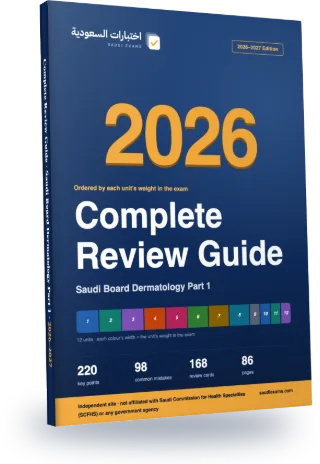
86-page · 220 key points · 98 common mistakes · 168 review cards
The first three chapters alone cover about 30% of the exam. Short on time? Start there.
About the question bank
527 Saudi Board Dermatology Part 1 questions across 12 domains. Every question comes with an answer explanation.
- 150 questions in 90 minutes per site supplementary practice session
- 527 questions covering the main scoring topics, with explanations
- 65% pass mark, with targeted practice on your weak spots
See the gap to your target score Practise the units costing you the most marks Supplementary practice
Every option explained so you understand why
What you get
- 527questions in the bankPractise with the answer shown right away, or sit a full timed mock
- 12unitsSplit by the exam syllabus
- 168flashcardsTo lock in terms and definitions
- 220quick review pointsEach unit in a few key lines
Study material sample: Anatomy, structure and development of skin
Summary
This unit covers the structure and development of skin and accounts for about 15 of the 150 scored questions. Expect items on the epidermal layers and keratinization (keratins, filaggrin, lamellar granules, ichthyosis genes), the dermoepidermal junction, dermal matrix and fetal development, cutaneous blood vessels and sensory nerve endings, and resident cells (melanocytes, Langerhans cells, Merkel cells, mast cells) with regional variation. Questions are usually clinical vignettes that end in a gene, protein, receptor or number. Prepare by linking each structure to its marker and its disease, and by memorising the few numbers the bank repeats: about 14 days transit, 250 mL/min flow, 80 to 90 percent type I collagen.
What the exam focuses on · Common traps · Try the flashcards
What the exam focuses on
- Keratin pairs: basal 5/14, suprabasal spinous 1/10, and the layer in which each cell type sits.
- Filaggrin pathway: profilaggrin to filaggrin to natural moisturizing factor, with calpain-1 and pyrrolidone carboxylic acid.
- Barrier genes: ABCA12 (harlequin), TGM1 (collodion/lamellar), LOR (keratoderma with pseudoainhum).
Show 5 more
- Basement membrane components: hemidesmosome linkage, type VII collagen anchoring fibrils, nidogen, LAMB3.
- Dermal matrix: collagen I and III proportions, oxytalan fibers and FBN1, MMP-1 and TIMPs in photoaging.
- Cutaneous vessels: papillary loops, deep plexus, arteriovenous anastomoses and the mechanisms of heat-induced vasodilation.
- Sensory receptors matched to stimulus: Meissner, Pacinian, Merkel, Ruffini, C-LTMR and D-hair afferents.
- Resident cells: melanocyte origin and melanosome transport, Langerhans cell markers and migration, Merkel cell origin, mast cell MRGPRX2.
Common traps
- Keratin 5/14 marks basal proliferative cells; keratin 1/10 is the postmitotic spinous program. Keratin 8/18 and 6/16 are distractors.
- Desmoglein 3 decreases and desmoglein 1 increases with differentiation, not the reverse.
- Do not swap Langerhans cells (spinous layer) with melanocytes and Merkel cells (basal layer).
Show 5 more
- TGM1 defect is a failure to ester-link omega-hydroxyceramides to involucrin and scaffold proteins; do not confuse it with the empty lamellar granules of ABCA12.
- Meissner corpuscle detects low-frequency flutter and slip in dermal papillae; Pacinian corpuscle in the deep dermis detects high-frequency vibration.
- Ruffini (SAII) has a receptive field about five times larger than Merkel units; both fire during sustained stimulation.
- Dark skin has similar melanocyte numbers to light skin; the difference is melanosome size, dispersion and retention, not cell count.
- Langerhans cells self-renew locally at steady state; blood-derived precursors matter only after severe inflammation.
Try the flashcards
Tap a card to see the answer
Keratin pair of basal proliferative cells versus postmitotic spinous cells?
Basal: keratin 5/14. Spinous: keratin 1/10.
Which layer of palms and soles contains eleidin?
Stratum lucidum, between granular layer and stratum corneum.
Gene in harlequin ichthyosis with empty lamellar granules?
ABCA12.
Defect in TGM1-related ichthyosis?
Failure to ester-link omega-hydroxyceramides to involucrin and scaffold proteins.
Which cysteine protease acts on profilaggrin and filaggrin?
Calpain-1.
Transcription factor needed for the keratin 8/18 to 5/14 switch?
p63.
Molecule forming anchoring fibrils?
Type VII collagen.
What links the laminin and collagen IV networks?
Nidogen.
Why you can trust these questions
- Published questions: 527. Read the explanations and references, and report any error from the question.
- Exam facts last checked against the organiser’s website: 2026-11-17. We check them again every three months and two weeks before each test.
- Found a mistake? Tap "Report an error" under any question in the practice area, or email us at support@saudiexams.com
- Independent website. Not affiliated with ETEC (Qiyas), the Financial Academy, ACAMS, the ACFE, DAMA, CompTIA, Saudi Aramco or any government body.
Full prep for this exam
All of this in one purchase.
- Timed supplemental practice sessions150 questions in 90 minutes. You get a total score and a score for every unit.
- Practice unit by unit527 questions, every option explained with its source. Starts with your weakest units.
- Complete Review Guide 2026–2027 (PDF)Ordered by each unit's weight in the exam. With lifetime access only.
Choose your access
Continue with your Google account and you go straight to the payment page.