Saudi Licensure Examination: Nuclear Medicine Technologist
Saudi Licensure Examination: Nuclear Medicine Technologist — Number of questions: 150 questions. Exam time: 180 minutes. Pass mark: 60%. Exam fee: Check the current fee when you apply for eligibility and book through the approved channels. Source: Saudi Commission for Health Specialties (Last verified: 2026-11-17). Question bank: full mock exams of 150 questions in 180 minutes, like the real test with a result for every unit, plus 591 explained questions across 9 units, every option explained, a review of your mistakes, and two ways to practise: see the answer right away, or sit a full timed mock. Free questions: a 10-question diagnostic test covering the main units, no sign-up; at the end we compare your score with the pass mark and show your weakest units. With lifetime access: the Complete Review Guide, a 66-page PDF ordered by unit weight; chapter 1 is free to read on the guide page.
Last verified on the Saudi Commission for Health Specialties website: 17 November 2026
If you sat the exam today, what would you score?
10 free questions · no sign-up · your score as soon as you finish
Question 1 of 10
A generator carries 20 GBq of Mo-99 on its calibration date. Using a Mo-99 half-life of 66 h, about how much Mo-99 remains 5 days later?
All 10 free questions with answers and an explanation for every option
Where the questions come from
- Physics and Radiation Safety29 questions
- Radiopharmaceuticals10 questions
- Instrumentation10 questions
- Quality Control10 questions
- Clinical Procedures50 questions
- Management and Ethics8 questions
- Image Production and Processing9 questions
- Image Interpretation and Image Artifacts9 questions
- Patient Care15 questions
Exam facts
- Exam language
- English
- Number of questions
- 150 questions Source
- Exam time
- 180 minutes Source
- Pass mark
- 60% Source
- Exam fee
- Check the current fee when you apply for eligibility and book through the approved channels. Source
Last verified: 2026-11-17
Exam body
Saudi Commission for Health Specialties: Official website: Saudi Commission for Health Specialties
How to register
- Apply for eligibility on Mumaris+ at the Saudi Commission for Health Specialties with your nuclear medicine qualification (check the qualification requirement in your application).
- Once approved, you receive a scheduling permit.
- Book your appointment with Prometric inside the permitted window.
Study guides (3)
Frequently asked questions
How many questions are in the Nuclear Medicine Technologist exam, and how long is it?
150 multiple-choice questions in 3 hours, according to the SCFHS content guideline.
Can I try Nuclear Medicine Technologist (SCFHS) questions for free?
Yes. Free questions: a 10-question diagnostic test covering the main units, no sign-up; at the end we compare your score with the pass mark and show your weakest units. The free practice test page lists the same questions with answers and an explanation for every option. The rest of the questions and the full mock exams come with a pass from SAR 26.
What makes this Nuclear Medicine Technologist (SCFHS) question bank different?
Question bank: full mock exams of 150 questions in 180 minutes, like the real test with a result for every unit, plus 591 explained questions across 9 units, every option explained, a review of your mistakes, and two ways to practise: see the answer right away, or sit a full timed mock. Practice questions and explanations are ready to use on your phone. Try the free questions and read the explanations before you buy.
Is there a PDF review guide for Nuclear Medicine Technologist (SCFHS)?
Yes. "Nuclear Medicine Technologist (SCFHS) Complete Review Guide 2026–2027" is a 66-page Arabic PDF: 9 units ordered from the heaviest in the exam to the lightest, each chapter with key points, common mistakes and review cards, plus a 7-day plan. Chapter 1 is free to read on the guide page; the full guide comes with lifetime access to this exam and is not part of 7-day access. The guide has no questions: scoring, practice and mock exams are on the site.
What is the passing score?
60%, according to the SCFHS content guideline.
Which sections does the exam cover?
Physics and radiation safety 19%, radiopharmaceuticals 7%, instrumentation 7%, quality control 7%, clinical procedures 33%, management and ethics 5%, image production and processing 6%, image interpretation and artifacts 6%, and patient care 10%. Each share can differ by up to 5 percentage points.
Is this website affiliated with SCFHS?
No. This is an independent website, unaffiliated with SCFHS or any government agency. The questions are our own practice items, not actual exam questions.
What language is the exam in?
English. The content guideline does not state a language, so we follow the usual SCFHS practice of English-language health exams.
How much does the exam cost?
The content guideline does not publish a fee. Check the fee shown when you apply and book.
How do I register?
Apply for eligibility on Mumaris+ at the Saudi Commission for Health Specialties. After approval you receive a scheduling permit and book your appointment with Prometric.
Is this an official site, and how do I pay?
It is an independent site, not part of Qiyas, this exam's regulator or any government body, with practice questions and answer explanations. You pay once, with no automatic renewal, through Waffo Pancake (the merchant of record) by Visa, Mastercard, Apple Pay or Google Pay, and your statement shows "WAFFO". If you were charged twice or the pass did not open, email support@saudiexams.com.
Nuclear Medicine Technologist (SCFHS) Complete Review Guide 2026–2027
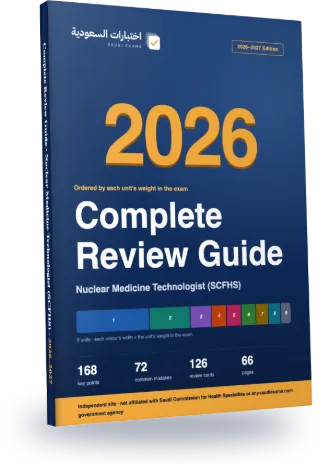
66-page · 168 key points · 72 common mistakes · 126 review cards
The first three chapters alone cover about 62% of the exam. Short on time? Start there.
About the question bank
Practise radiation physics, radiopharmaceuticals, instrumentation, clinical procedures and patient care with every option explained.
- 150 questions in 180 min, like the real test
- 591 questions covering the main scoring topics, with explanations
- 60% pass mark, with targeted practice on your weak spots
See the gap to your target score Practise the units costing you the most marks A full mock exam like the real one
Every option explained so you understand why
What you get
- 591questions in the bankPractise with the answer shown right away, or sit a full timed mock
- 9unitsSplit by the exam syllabus
- 126flashcardsTo lock in terms and definitions
- 168quick review pointsEach unit in a few key lines
Study material sample: Physics and Radiation Safety
Summary
This unit covers the physics and radiation safety behind every nuclear medicine procedure, about 29 of the 150 exam questions (19%). It has six parts: radioactive decay, half-life and activity calculations; photon interaction, attenuation and shielding; dosimetry quantities and the ICRP principles; ALARA, dose limits and monitoring; contamination, spills, waste and transport; and release of patients and protection of the public. Expect short calculations (decay, HVL, effective half-life) and questions on limits, instructions and what to do first in a spill.
What the exam focuses on · Common traps · Try the flashcards
What the exam focuses on
- Decay law: A = A0 e^(−λt), λ = 0.693 / T½, and activity after n half-lives is A0 / 2^n.
- Effective half-life: 1/T_eff = 1/T_phys + 1/T_biol, always shorter than both.
- Attenuation: I = I0 e^(−μx); HVL = 0.693/μ and TVL = 2.303/μ; each HVL halves the beam.
Show 5 more
- Photon interactions: photoelectric at low energy and high Z, Compton at intermediate energy and in tissue, pair production only above 1.022 MeV.
- Dose quantities: Gy for absorbed dose, Sv for equivalent and effective dose; wR is 1 for photons and electrons, 20 for alpha.
- Three ICRP principles are justification, optimisation and dose limits; limits do not apply to patients.
- Occupational limits: 20 mSv per year averaged over 5 years (50 mSv in one year), lens 20 mSv, skin and extremities 500 mSv; public 1 mSv per year.
- Spill response order: protect yourself, contain with absorbent, inform the radiation protection officer, clean from edge to centre, wipe-test, monitor people.
Common traps
- Using the 50 mSv single-year figure as the annual limit; the limit is 20 mSv per year averaged over five years.
- Thinking pair production happens with 140 keV photons; the threshold is 1.022 MeV.
- Adding half-lives for effective half-life; reciprocals are added, and the result is shorter than both.
Show 5 more
- Treating a lead apron as strong protection against 99mTc; it only cuts readings by about half.
- Applying dose limits to a patient receiving a diagnostic or therapeutic dose; patient exposure falls under justification and optimisation.
- Mixing up Gy and Sv: absorbed dose is in Gy, equivalent and effective dose are in Sv.
- Cleaning a spill from the centre outward; wipe from the edge toward the centre to avoid spreading it.
- Forgetting that the 5 mSv release criterion is for carers and the most exposed person, while children and pregnant women have 1 mSv constraints.
Try the flashcards
Tap a card to see the answer
What is the SI unit of activity and how does it relate to the curie?
The becquerel (1 decay per second). 1 Ci = 3.7 × 10^10 Bq.
Write the relation between decay constant and half-life.
λ = ln 2 / T½ = 0.693 / T½.
How much activity of 99mTc is left after 24 hours (half-life 6 h)?
Four half-lives, so 1/16 (6.25%) of the starting activity.
How is effective half-life calculated?
1/T_eff = 1/T_phys + 1/T_biol. The result is shorter than both.
Define HVL and give its formula.
The absorber thickness that cuts a narrow beam to 50%: HVL = 0.693 / μ.
Which interaction dominates for 100 keV photons in lead and in soft tissue?
Photoelectric effect in lead, Compton effect in soft tissue.
What is the threshold energy for pair production?
1.022 MeV, twice the electron rest energy.
What are wR values for gamma rays and alpha particles?
1 for gamma rays (and X rays and electrons); 20 for alpha particles.
Why you can trust these questions
- Published questions: 591. Read the explanations and references, and report any error from the question.
- Exam facts last checked against the organiser’s website: 2026-11-17. We check them again every three months and two weeks before each test.
- Found a mistake? Tap "Report an error" under any question in the practice area, or email us at support@saudiexams.com
- Independent website. Not affiliated with ETEC (Qiyas), the Financial Academy, ACAMS, the ACFE, DAMA, CompTIA, Saudi Aramco or any government body.
Update log
- 2026-11-17 Added the Nuclear Medicine Technologist question bank, course notes and syllabus guide.
Full prep for this exam
All of this in one purchase.
- Full mock exam, same as the real one150 questions in 180 minutes. You get a total score and a score for every unit.
- Practice unit by unit591 questions, every option explained with its source. Starts with your weakest units.
- Complete Review Guide 2026–2027 (PDF)Ordered by each unit's weight in the exam. With lifetime access only.
Choose your access
Continue with your Google account and you go straight to the payment page.