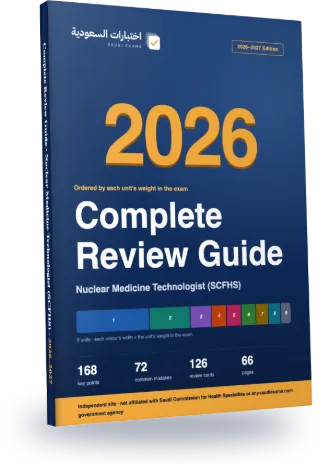
Nuclear Medicine Technologist (SCFHS) Complete Review Guide 2026–2027
Every exam topic in a 66-page Arabic PDF, ordered from the heaviest unit to the lightest. The first three chapters alone cover about 62% of the exam questions.
- 66Pages
- 168Key points
- 72Common mistakes
- 126Flashcards
Guide map
Each chapter is one exam unit, ordered by its weight in the real exam.
| Chapter | Unit | Weight | Exam questions | Key points |
|---|---|---|---|---|
| 1 | Clinical Procedures | 33% | 50 | 26 |
| 2 | Physics and Radiation Safety | 19% | 29 | 17 |
| 3 | Patient Care | 10% | 15 | 18 |
| 4 | Radiopharmaceuticals | 7% | 10 | 18 |
| 5 | Instrumentation | 7% | 10 | 18 |
| 6 | Quality Control | 7% | 10 | 18 |
| 7 | Image Production and Processing | 6% | 9 | 17 |
| 8 | Image Interpretation and Image Artifacts | 6% | 9 | 18 |
| 9 | Management and Ethics | 5% | 8 | 18 |
Chapter 1 in full: Clinical Procedures
33% of the exam, about 50 questions. These are its key points, as in the guide.
- (Bone imaging) Multiphase bone scintigraphy has a flow phase (about 30-60 frames at 1-3 s), a blood pool phase within 10 min of injection, and delayed images usually 2-4 h later, with further images up to 24 h if needed. The energy window is 140 keV with a 15-20% width.
- (Bone imaging) Adult activity of the 99mTc bone agent is 500-1,110 MBq. Patients drink two or more glasses of water, void often for 24 h, and empty the bladder just before imaging. For 18F-fluoride PET adults receive 185-370 MBq, imaged from 45 min after 185 MBq or from 2 h after 370 MBq.
- (Thyroid and parathyroid imaging) Thyroid imaging uses 74-111 MBq 99mTc-pertechnetate imaged 15-20 min after injection, or 7.4-14.8 MBq 123I imaged at 2-6 h and 24 h. Before iodine-based tests stop amiodarone 3-6 months, IV contrast 1-2 months, levothyroxine 4 weeks, liothyronine 2 weeks, antithyroid drugs 3-7 days, perchlorate 1 week.
The rest of chapter 1, on this page
- (Thyroid and parathyroid imaging) Parathyroid scans use 740-1,110 MBq 99mTc-sestamibi in adults, with early images at 10-30 min and delayed images at 1.5-2.5 h because thyroid washes out faster than an adenoma. The subtraction method pairs sestamibi with 123I or pertechnetate, and images should include the mediastinum for ectopic glands. Tetrofosmin has no differential washout, so dual-phase imaging does not work with it.
- (Radioiodine therapy) 131I therapy is contraindicated in pregnancy, so women who could be pregnant need a urine or serum hCG test, ideally within 24 h of treatment. Breastfeeding must stop and treatment waits until lactation ends, usually 4-6 weeks after birth without nursing or after nursing stops.
- (Radioiodine therapy) For thyroid cancer, patients follow a low-iodine diet for 1-2 weeks and need TSH of at least 30 mIU/L, reached by hormone withdrawal or rhTSH 0.9 mg IM on 2 consecutive days with 131I 48-72 h later. Water-soluble iodinated contrast must be avoided for 6-8 weeks. Fluids of 2,500-3,000 mL daily, frequent voiding, daily bowel movements and sugar-free candy for sialadenitis reduce the dose and side effects. A post-therapy whole-body scan follows, at a day between 2 and 10.
- (Cardiac imaging (SPECT, ERNA)) Patients fast at least 4 h for rest imaging. Caffeine and methylxanthines stop at least 12 h before vasodilator stress; adenosine runs at 140 mcg/kg/min for 6 min, or 4 min with tracer at 2 min and infusion continuing 2 min after; regadenoson is a 0.4 mg bolus with tracer 10-20 s after the saline flush. Adenosine is avoided in active bronchospasm, second or third degree AV block without a pacemaker, and systolic BP below 90 mmHg.
- (Cardiac imaging (SPECT, ERNA)) 99mTc sestamibi or tetrofosmin SPECT starts 15-30 min after a stress injection and 45-60 min after a rest injection; 201Tl imaging starts within 10 min of a stress injection. For gated blood pool studies, red cells are labelled in vitro (at least 95% efficiency), 555-1,110 MBq is given, the window is 140 keV, 16 or more frames per R-R interval are acquired, and the best septal view is the 45 degree LAO.
- (Cardiac PET and amyloid imaging) 82Rb has a 75 s half-life and comes from an 82Sr generator (half-life 25.5 days), eluted only with additive-free 0.9% saline. Dose is 10-30 MBq/kg per rest or stress step up to 2,220 MBq, the rest-stress gap is at least 10 min, and imaging starts 60-90 s after infusion. 13N-ammonia (10 min half-life) needs an on-site cyclotron; 18F-flurpiridaz (110 min) allows treadmill stress.
- (Cardiac PET and amyloid imaging) For brain amyloid PET, 370 MBq 18F-florbetapir is injected and a 10 min scan starts 30-50 min later. A positive scan shows loss of gray-white contrast in cortex; a negative scan keeps clear contrast. Cerebellar signal is not used for the read, and a positive result alone does not prove Alzheimer disease.
- (Renal imaging) Dynamic renography uses 90-200 MBq 99mTc: MAG3 for tubular extraction or DTPA for filtration, with frames of 1-2 s for 1-2 min, then 10-15 s for about 5 min, then 20-30 s for about 20 min. Split function is taken at 90-150 s for MAG3 and 120-180 s for DTPA. For ACE inhibitor renography give captopril 25-50 mg about 1 h before, or enalaprilat 40 mcg/kg (max 2.5 mg) 10-20 min before, and stop chronic ACE inhibitors 3-7 days earlier.
- (Renal imaging) Diuretic renography uses furosemide 1 mg/kg (maximum 40 mg): F-0 gives it with the tracer and images 20 min, while F+20 or F+30 gives it later. IV hydration is 15-20 mL/kg in infants. DMSA cortical imaging uses 74-222 MBq in adults, starts 1-4 h after injection and can wait 6-24 h when GFR is very low; it is the method of choice for scars after pyelonephritis.
- (Gastrointestinal and hepatobiliary imaging) For hepatobiliary scans adults fast 2-6 h and receive 111-185 MBq of the mebrofenin type agent, imaged continuously for 60 min. If the gallbladder is not seen by 30-60 min, give morphine 0.04 mg/kg over 2-3 min or obtain images at 3-4 h. Sincalide 0.02 mg/kg gives the ejection fraction: (maximum counts minus minimum counts) divided by maximum, times 100.
- (Gastrointestinal and hepatobiliary imaging) Gastrointestinal bleeding scans use in vitro labelled red cells, 555-1,110 MBq in adults, with dynamic frames no longer than 60 s; a bleed of 0.1 mL/min can be seen. Solid gastric emptying uses egg white labelled with 18.5-37 MBq sulfur colloid, toast, jam and water, imaged hourly for 4 h after a fast of at least 4 h; more than 10% retention at 4 h is abnormal.
- (Lung ventilation and perfusion) Perfusion uses 99mTc-MAA, 40-150 MBq and 200,000-700,000 particles in adults, with 100,000-200,000 as the minimum. Reduce particles in pulmonary hypertension, after pneumonectomy or with a right-to-left shunt; in pregnancy lower the activity but keep at least 100,000 particles. Inject slowly and do not draw blood into the syringe, which causes clots.
- (Lung ventilation and perfusion) Ventilation agents include Technegas carbon nanoparticles, 99mTc-DTPA aerosol, 133Xe (half-life 5.245 days) and 81mKr (half-life 13 s). A mismatched defect is a perfusion defect with normal ventilation, the pattern of pulmonary embolism. Ventilation and perfusion should be imaged in the same position when possible.
- (Brain and neuro imaging) A brain death study needs a good bolus: 1,110 MBq of a hydrophilic agent with 1 s frames for at least 60 s, or a lipophilic agent (HMPAO, ECD) with planar and SPECT images. Children get at least 185 MBq. Reconstituted HMPAO is usable for 30 min and bicisate within 6 h, with best images 30-60 min after injection.
- (Brain and neuro imaging) DaTscan uses 111-185 MBq 123I-ioflupane, thyroid blockade at least 1 h before, and SPECT 3-6 h after injection; a normal scan shows two symmetric comma-shaped striata. For brain FDG PET fast 4-6 h, keep glucose below 110 mg/dL, and scan in a dim quiet room with eyes open starting at least 30 min after injection.
- (Oncology PET (FDG, PSMA, SSTR, FAP)) FDG: fast at least 4 h, plasma glucose under 11 mmol/L (200 mg/dL), uptake 60 min (55-75 min), and the same uptake time within 10 min on repeat studies. Keep the patient warm 30-60 min beforehand and silent to cut brown fat and muscle uptake; rapid-acting insulin only if given more than 4 h before; hold metformin 48 h after IV contrast.
- (Oncology PET (FDG, PSMA, SSTR, FAP)) PSMA PET needs no fasting; 68Ga-PSMA-11 is 111-259 MBq at 60 min, 18F-DCFPyL 296-370 MBq, and 18F-PSMA-1007 is liver-excreted with 90-120 min uptake. Furosemide 20 mg IV or 1 L of water reduces bladder activity. For SSTR PET stop short-acting somatostatin analogs 12 h before; 68Ga-DOTATATE is 2 MBq/kg up to 200 MBq. FAP PET needs no fasting, with 68Ga-FAPI uptake of 30-60 min.
- (Infection, inflammation and lymphatic imaging) 111In-oxine leukocytes: 40-80 mL of blood, 10-20 MBq in adults, reinjection within 1-2 h (cells lose viability after 3 h), images at 1-4 h and 16-30 h. 99mTc-HMPAO leukocytes are best read at 2-4 h because 24 h bowel activity misleads. 67Ga has a 78 h half-life, 150-220 MBq, imaging at 24-72 h with a medium-energy collimator.
- (Infection, inflammation and lymphatic imaging) Colloids of 5-30 nm drain fast and are imaged at 1-3 h; 50-200 nm colloids may need images at 4-6 h or next day. Sulfur colloid is filtered through a 100-200 nm membrane. 99mTc-tilmanocept is 18.5 MBq by intradermal, subcutaneous, subareolar or peritumoral injection, given at least 15 min before surgery and used within 15 h.
- (Radionuclide therapy) Bone pain palliation: 89Sr is 148 MBq (half-life 50.5 days, pure beta), 153Sm-EDTMP is 37 MBq/kg (half-life 1.93 days), and 223Ra, an alpha emitter, is 55 kBq/kg every 4 weeks for 6 injections. Blood counts are checked before each 223Ra dose; patients flush the toilet several times after use.
- (Radionuclide therapy) 177Lu-DOTATATE is 7.4 GBq every 8 weeks for 4 doses, with lysine-arginine amino acids started 30 min before and run at least 3 h after, and long-acting somatostatin analogs stopped at least 4 weeks before. 177Lu-PSMA is 7.4 GBq every 6 weeks for up to 6 doses. 177Lu (half-life 6.647 days) emits 208 and 113 keV photons; post-therapy SPECT/CT uses a medium-energy collimator and a 208 keV window.
- (Paediatric nuclear medicine) Weight-based doses: 99mTc-MDP 9.3 MBq/kg (min 37, max 740 MBq), 99mTc-DMSA 1.85 MBq/kg (min 18.5, max 100 MBq), 99mTc-MAG3 3.7 MBq/kg without flow and 5.55 MBq/kg with flow (min 37, max 148 MBq), Meckel pertechnetate 1.85 MBq/kg (min 9.25, max 296 MBq), FDG body 2.96-5.2 MBq/kg.
- (Paediatric nuclear medicine) Pinhole or SPECT DMSA scans need 20-30 min or more, so sedation may be needed. Paediatric FDG needs a 4-6 h fast, a warm quiet room and no vigorous exercise for 24 h before. Paediatric solid gastric emptying uses 9.25-18.5 MBq after a 4 h fast, and diuretic renography needs good hydration, with bladder drainage by catheter if possible.
Common mistakes in this chapter
- Recent dipyridamole use (within 48 h) rules out adenosine stress, and caffeine must also be off for 12 h; patients often forget both.
- Reaching 85% of age-predicted maximum heart rate is not by itself a reason to end an exercise stress test.
- Iodine interference blocks radioiodine and pertechnetate thyroid uptake, but not sestamibi or FDG uptake, so those drugs need not be stopped for sestamibi or FDG scans.
- Do not give regular insulin shortly before FDG: it drives tracer into muscle. Rapid-acting insulin is acceptable only when FDG is given more than 4 h later.
- In a hepatobiliary scan, a prolonged fast over 24 h or parenteral nutrition can make the gallbladder look obstructed; sincalide pretreatment is the fix.
- Gastric activity on a bleed study with thyroid and salivary uptake points to free pertechnetate from poor red cell labelling, not to bleeding.
- A PSMA scan should be done before starting new androgen deprivation, and a negative result does not exclude small pelvic nodal metastases.
- Using the wrong eluent on a Rb-82 generator raises strontium breakthrough; only additive-free 0.9% sodium chloride is used.
The other chapters are in the full guide
One purchase · lifetime access · review guide included
7-day review plan
The chapters are spread over 6 days by weight so each day carries a similar load. Day 7 is a full exam.
Day 1 · 33% of the exam
Chapter 1: Clinical Procedures
Day 2 · 19% of the exam
Chapter 2: Physics and Radiation Safety
Day 3 · 10% of the exam
Chapter 3: Patient Care
Day 4 · 13% of the exam
Chapter 4: Radiopharmaceuticals
Chapter 7: Image Production and ProcessingDay 5 · 13% of the exam
Chapter 5: Instrumentation
Chapter 8: Image Interpretation and Image ArtifactsDay 6 · 12% of the exam
Chapter 6: Quality Control
Chapter 9: Management and EthicsDay 7
Full mock exam: 150 questions in 180 minutes, then review the common mistakes in the units where you lost marks.
How many correct answers do you need?
- Pass mark 60%90 correct out of 150
Before you read: see your score today
10 free questions from the main units, no sign-up. Then you know which chapter to start with.
Try 10 free questions and see your levelA look at each chapter
The first three key points of each chapter, as they appear in the guide (in Arabic in the PDF).
Chapter 1: Clinical Procedures
- (Bone imaging) Multiphase bone scintigraphy has a flow phase (about 30-60 frames at 1-3…
- (Bone imaging) Adult activity of the 99mTc bone agent is 500-1,110 MBq. Patients drink…
- (Thyroid and parathyroid imaging) Thyroid imaging uses 74-111 MBq 99mTc-pertechnetate imaged 15-20 min after…
Chapter 2: Physics and Radiation Safety
- (Decay, half-life and activity) Activity is the number of decays per unit time, A…
- (Decay, half-life and activity) The decay constant and half-life are linked by λ =…
- (Decay, half-life and activity) Typical half-lives
Chapter 3: Patient Care
- (Extravasation, injection and patient preparation) An extravasation is the wrong delivery of a radiopharmaceutical…
- (Extravasation, injection and patient preparation) Many extravasations are never noticed because injection volumes are…
- (Extravasation, injection and patient preparation) Choose a forearm vein and avoid areas of flexion…
Chapter 4: Radiopharmaceuticals
- (Tc-99m generator and kit preparation) The generator column contains Mo-99 (made by uranium fission)…
- (Tc-99m generator and kit preparation) About 88% of decaying Mo-99 atoms form Tc-99m, so…
- (Tc-99m generator and kit preparation) Each eluate is tested for Mo-99 breakthrough (limit 0.15…
Chapter 5: Instrumentation
- (Gamma camera components, collimators and crystals) The collimator is a mechanical lens made of…
- (Gamma camera components, collimators and crystals) Collimator FWHM resolution is roughly proportional to distance…
- (Gamma camera components, collimators and crystals) Parallel holes keep object size; converging (cone-beam, fan-beam)…
Chapter 6: Quality Control
- (Gamma camera and SPECT quality control) Daily planar gamma camera checks are background count…
- (Gamma camera and SPECT quality control) A 20% window centred on the 140 keV…
- (Gamma camera and SPECT quality control) On a flood image a defective PMT gives…
Chapter 7: Image Production and Processing
- (Acquisition, matrix and reconstruction) Step-and-shoot is the most common SPECT acquisition mode: the camera…
- (Acquisition, matrix and reconstruction) Cardiac SPECT usually scans a 180-degree arc starting 45 degrees…
- (Acquisition, matrix and reconstruction) A projection matrix rule of thumb is at least three…
Chapter 8: Image Interpretation and Image Artifacts
- (Gamma camera and SPECT artifacts) A symmetric 20% window on Tc-99m spans about 126…
- (Gamma camera and SPECT artifacts) A flood of Co-57 taken with the Tc-99m window…
- (Gamma camera and SPECT artifacts) Non-uniformity in the detector response gives full or partial…
Chapter 9: Management and Ethics
- (Ethics, consent and patient rights) Valid consent needs four things: enough information in a…
- (Ethics, consent and patient rights) Any sign of approval, whether spoken, a nod or…
- (Ethics, consent and patient rights) Written consent is required for surgery, anaesthesia, interventional examinations…
The full guide comes with lifetime access
The full guide (66 pages) is included with lifetime access to this exam, together with every question and full mock exam. Chapter 1 is free for everyone.
Questions about the guide
Is the guide free?
Chapter 1 is free to read on the guide page. The full guide comes with lifetime access to this exam; 7-day access does not include it.
Is it up to date for 2026–2027?
Yes. Unit weights and exam facts follow what the exam body last published, and the last check date is printed in the guide. If the standards change we update the file and buyers download the new version.
Does the guide have questions?
No. The guide covers key points and common mistakes; scoring, weak-area practice and full mock exams are on the site.
Can I read it on my phone?
Yes. A5 pages in a single column, with chapters linked from the contents.
- Pages
- 66
- Edition
- 1448 AH · 2026–2027
- Language
- Arabic
- Last updated
All Health Exams review guides
Back to Saudi Licensure Examination: Nuclear Medicine Technologist
Full prep for this exam
All of this in one purchase.
- Full mock exam, same as the real one150 questions in 180 minutes. You get a total score and a score for every unit.
- Practice unit by unit591 questions, every option explained with its source. Starts with your weakest units.
- Complete Review Guide 2026–2027 (PDF)Ordered by each unit's weight in the exam. With lifetime access only.
Choose your access
Continue with your Google account and you go straight to the payment page.