SCFHS Laboratory Specialist – Microbiology Exam
SCFHS Laboratory Specialist – Microbiology Exam — Number of questions: 150 questions. Exam time: 3 hours. Pass mark: 60%. Calculator: The SCFHS content guideline does not say whether a calculator is allowed. Exam fee: Paid to SCFHS online when you apply through Mumaris Plus; the amount is shown in your application. Source: Saudi Commission for Health Specialties (SCFHS) (Last verified: 2026-11-17). Question bank: full mock exams of 150 questions in 180 minutes, like the real test with a result for every unit, plus 572 explained questions across 5 units, every option explained, a review of your mistakes, and two ways to practise: see the answer right away, or sit a full timed mock. Free questions: a 10-question diagnostic test covering the main units, no sign-up; at the end we compare your score with the pass mark and show your weakest units. With lifetime access: the Complete Review Guide, a 37-page PDF ordered by unit weight; chapter 1 is free to read on the guide page.
Last verified on the Saudi Commission for Health Specialties (SCFHS) website: 17 November 2026
If you sat the exam today, what would you score?
10 free questions · no sign-up · your score as soon as you finish
Question 1 of 10
A large Gram-positive rod forms flat, grey-white, tacky colonies with irregular edges on horse blood agar after 24 hours. It is non-haemolytic, non-motile on motility testing and inhibited by penicillin. Which organism fits best?
All 10 free questions with answers and an explanation for every option
Where the questions come from
- Microbiology100 questions
- Urinalysis and Other Body Fluids12 questions
- Immunology and Serology12 questions
- Laboratory Operations13 questions
- Patient Safety and Professionalism13 questions
Exam facts
- Exam language
- English
- Number of questions
- 150 questions Source
- Exam time
- 3 hours Source
- Pass mark
- 60% Source
- Calculator
- The SCFHS content guideline does not say whether a calculator is allowed Source
- Exam fee
- Paid to SCFHS online when you apply through Mumaris Plus; the amount is shown in your application Source
- Registration
- Apply through the Professional Classification service in Mumaris Plus; SCFHS has not published a separate window calendar for the microbiology specialist exam Source
- Retakes
- If you do not pass you get further attempts under SCFHS regulations and pay the evaluation fee Source
Last verified: 2026-11-17
Where other sources differ
- The pass mark is 60% in the content guideline. Section weights may differ by up to 5% in each category, and SCFHS may change content and percentages at any time.
- Five sections: microbiology (60–70%), then urinalysis and body fluids, immunology and serology, laboratory operations, and patient safety and professionalism (5–10% each). SCFHS does not state the exam language outright; the content guideline and its references are in English.
Exam body
Saudi Commission for Health Specialties (SCFHS): Official website: Saudi Commission for Health Specialties (SCFHS)
How to register
- Choose the Professional Classification service in the Mumaris Plus system and submit your application with your certificate and documents.
- Once your application is accepted you are referred to an electronic written exam delivered through Prometric.
- Pay the evaluation fee shown in your application.
- Book your slot at a test centre through the booking service SCFHS opens in your application.
- On exam day bring your ID or passport and your booking confirmation.
Study guides (3)
Frequently asked questions
How many questions are there and how long is the exam?
150 multiple-choice questions in 3 hours, according to the SCFHS Laboratory – Microbiology content guideline.
Can I try Lab Microbiology Specialist questions for free?
Yes. Free questions: a 10-question diagnostic test covering the main units, no sign-up; at the end we compare your score with the pass mark and show your weakest units. The free practice test page lists the same questions with answers and an explanation for every option. The rest of the questions and the full mock exams come with a pass from SAR 26.
What makes this Lab Microbiology Specialist question bank different?
Question bank: full mock exams of 150 questions in 180 minutes, like the real test with a result for every unit, plus 572 explained questions across 5 units, every option explained, a review of your mistakes, and two ways to practise: see the answer right away, or sit a full timed mock. Practice questions and explanations are ready to use on your phone. Try the free questions and read the explanations before you buy.
Is there a PDF review guide for Lab Microbiology Specialist?
Yes. "Lab Microbiology Specialist Complete Review Guide 2026–2027" is a 37-page Arabic PDF: 5 units ordered from the heaviest in the exam to the lightest, each chapter with key points, common mistakes and review cards, plus a 7-day plan. Chapter 1 is free to read on the guide page; the full guide comes with lifetime access to this exam and is not part of 7-day access. The guide has no questions: scoring, practice and mock exams are on the site.
What is the pass mark?
60% according to the guideline. On our site your result shows your percentage in each section so you can see where you lose points.
What language is the exam in?
SCFHS does not state the exam language, but the guideline and its reference books are in English, so our questions and every option explanation are in English. Check your exam language in Mumaris Plus.
Which sections does the exam cover?
Five sections: microbiology (60–70%), then urinalysis and body fluids, immunology and serology, laboratory operations, and patient safety and professionalism (5–10% each).
How is it different from the SLLE and the lab technician exam?
This is the microbiology specialty exam: 150 questions, five sections, microbiology at 60–70% and a 60% pass mark. The SLLE is the general specialist licensure exam (200 questions, nine sections) and the technician exam has six sections and a 55% pass mark.
Is this site part of SCFHS?
No. This is an independent exam preparation site with no link to SCFHS, Prometric or any government body. Always rely on what SCFHS announces.
Is this an official site, and how do I pay?
It is an independent site, not part of Qiyas, this exam's regulator or any government body, with practice questions and answer explanations. You pay once, with no automatic renewal, through Waffo Pancake (the merchant of record) by Visa, Mastercard, Apple Pay or Google Pay, and your statement shows "WAFFO". If you were charged twice or the pass did not open, email support@saudiexams.com.
Lab Microbiology Specialist Complete Review Guide 2026–2027
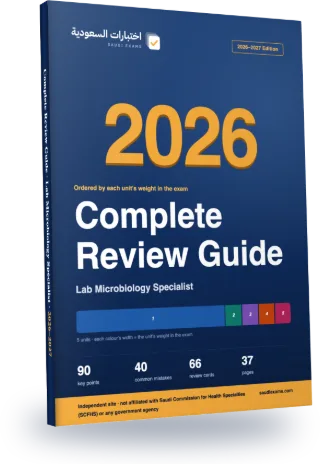
37-page · 90 key points · 40 common mistakes · 66 review cards
The first three chapters alone cover about 80% of the exam. Short on time? Start there.
About the question bank
Know your score before the SCFHS Laboratory Specialist – Microbiology exam. We picked 572 questions on bacteriology, mycology, parasitology, virology, urinalysis, immunology and laboratory safety, so you see where you lose points before test day.
- 150 questions in 180 min, like the real test
- 572 questions covering the main scoring topics, with explanations
- 60% pass mark, with targeted practice on your weak spots
See the gap to your target score Practise the units costing you the most marks A full mock exam like the real one
Every option explained so you understand why
What you get
- 572questions in the bankPractise with the answer shown right away, or sit a full timed mock
- 5unitsSplit by the exam syllabus
- 66flashcardsTo lock in terms and definitions
- 90quick review pointsEach unit in a few key lines
Study material sample: Microbiology
Summary
Microbiology is the largest unit, about 100 of the 150 questions. It has 11 sections. Specimen collection and direct examination cover blood culture volume, transport and staining. Culture and identification cover media, incubation and MALDI-TOF. Four organism sections cover Gram-positive cocci, Gram-positive bacilli with anaerobes, Enterobacterales with curved rods, and non-fermenters with fastidious Gram-negatives. Further sections cover mycobacteria and spirochetes, susceptibility testing and resistance, then mycology, parasitology and virology. Expect identification keys, specimen handling rules, test selection and result interpretation. Each section ends with quick-recall points.
What the exam focuses on · Common traps · Try the flashcards
What the exam focuses on
- Blood cultures: volume is the main factor in yield (about 3% more per mL); adults need 20 to 30 mL per set, and cultures should ideally be taken before antibiotics.
- Streptococcus keys: S. pyogenes is group A, bacitracin sensitive and PYR positive; S. agalactiae is group B and CAMP positive; S. pneumoniae is optochin sensitive and bile soluble.
- Staphylococcus: catalase positive clusters; slide coagulase detects clumping factor, and tube coagulase is the confirmatory method.
Show 5 more
- C. difficile testing is two-stage: a sensitive GDH immunoassay or NAAT first, then a toxin A and B immunoassay, with a third test for discordant results.
- Enterobacterales are oxidase negative, glucose-fermenting, facultatively anaerobic Gram-negative rods; Campylobacter and Neisseria are oxidase positive.
- Neisseria and Haemophilus are fastidious: chocolate agar in 5 to 10% CO2 at 35 to 37 C; Haemophilus needs factor X (haemin) and/or factor V (NAD).
- Disk diffusion standardisation: 0.5 McFarland inoculum on Mueller-Hinton agar 4.0 mm deep, using the 15-15-15 minute rule.
- Malaria: the thick film detects parasites, the thin film confirms species, and Giemsa is used at buffered pH 7.2.
Common traps
- Slide coagulase detects bound coagulase (clumping factor); tube coagulase detects free coagulase. S. lugdunensis can be slide positive but tube negative.
- A positive GDH only shows C. difficile is present; toxin A and B detection shows whether a toxin-producing strain is active.
- Optochin sensitivity and bile solubility identify S. pneumoniae; bacitracin and PYR identify S. pyogenes. Do not swap the two sets.
Show 5 more
- Thick and thin malaria films have different jobs: the thick film concentrates parasites for detection, and the thin film is for species. Methanol fixes only the thin film.
- Treponemal tests stay positive after treated infection, while non-treponemal results fall to negative or low titre.
- An ESBL hydrolyses oxyimino-cephalosporins but not cephamycins such as cefoxitin or carbapenems; do not call resistance to all cephalosporins ESBL.
- Staphylococcus and Micrococcus are both catalase positive clusters or tetrads; Staphylococcus is facultatively anaerobic and Micrococcus is strictly aerobic.
- A positive NAAT can rule in tuberculosis, but a negative NAAT cannot rule it out.
Try the flashcards
Tap a card to see the answer
Which two tests identify S. pyogenes among beta-haemolytic streptococci?
Bacitracin sensitivity and PYR positivity; it is Lancefield group A.
Which streptococcus is CAMP positive?
S. agalactiae (group B).
Which tests identify S. pneumoniae?
Optochin sensitivity and bile solubility; it has no Lancefield group.
What does the slide coagulase test detect?
Bound coagulase (clumping factor); tube coagulase is the confirmatory method.
How is C. difficile infection tested?
A GDH immunoassay or NAAT first, then a toxin A and B immunoassay; a third test resolves discordant results.
Which growth factors does Haemophilus need?
Haemin (factor X) and/or NAD (factor V).
What culture conditions suit Neisseria?
Chocolate or enriched agar, 5 to 10% CO2, 35 to 37 C, for 18 to 48 hours.
What is the oxidase result of Enterobacterales?
Negative.
Why you can trust these questions
- Published questions: 572. Read the explanations and references, and report any error from the question.
- Exam facts last checked against the organiser’s website: 2026-11-17. We check them again every three months and two weeks before each test.
- Found a mistake? Tap "Report an error" under any question in the practice area, or email us at support@saudiexams.com
- Independent website. Not affiliated with ETEC (Qiyas), the Financial Academy, ACAMS, the ACFE, DAMA, CompTIA, Saudi Aramco or any government body.
Update log
- 2026-11-17 Added the exam from the Laboratory – Microbiology content guideline: 150 questions, 3 hours, 60% pass mark.
Full prep for this exam
All of this in one purchase.
- Full mock exam, same as the real one150 questions in 180 minutes. You get a total score and a score for every unit.
- Practice unit by unit572 questions, every option explained with its source. Starts with your weakest units.
- Complete Review Guide 2026–2027 (PDF)Ordered by each unit's weight in the exam. With lifetime access only.
Choose your access
Continue with your Google account and you go straight to the payment page.